Agriculture in Bangladesh: Output, Farm Structure and Food Security
Agriculture in Bangladesh employs 45% of workers and grows 40.6 million tonnes of rice — its output, tiny farms, subsidies, imports and climate risks.


Bangladesh's national fish supplies most of the world's hilsa and about 1% of GDP — its production, conservation bans, Chandpur trade and India exports.
No single fish carries more weight in Bangladesh than the hilsa. The ilish, Tenualosa ilisha, is the country's national fish, the centrepiece of its most celebrated meals, and — by the Department of Fisheries' reckoning — the source of about 12 per cent of all fish produced in Bangladesh and roughly 1 per cent of its gross domestic product. Bangladesh catches more of this one species than any other country on earth: the Department of Fisheries puts the Bangladeshi share of the world hilsa catch at around 70 to 75 per cent, with India and Myanmar supplying most of the remainder. In 2017 the fish was registered as a Geographical Indication product of Bangladesh, formalising what Bengali cooks on both sides of the border had always assumed — that the definitive hilsa is a Bangladeshi fish.
Yet the hilsa economy now stands at an uncomfortable point. After two decades in which an internationally praised conservation regime more than doubled production, the catch has fallen for three consecutive years, dropping about 26 per cent from its record peak by the fiscal year 2025-26. The fish that Bangladesh spent twenty years rescuing has become, again, a subject of scientific argument — about polluted rivers, shifting estuaries and a warming sea — and of diplomatic friction, after Dhaka declined in 2026 to open its customary festive export window for India. The story of the hilsa is therefore three stories at once: a remarkable fish, a remarkable management success, and a test of whether that success can hold.
Table of contents [Show]
The hilsa belongs to the herring family, Clupeidae, and is built for migration. It is an anadromous species: adults live and feed in the coastal waters of the northern Indian Ocean, then ascend the great rivers to spawn in fresh water. Its range is wide — from the Persian Gulf along the coasts of the subcontinent to the Irrawaddy and Salween rivers of Myanmar, and by some accounts into the seas off Vietnam and China — but its stronghold is the Bay of Bengal and the river system that feeds it. Historically, hilsa ran more than a thousand kilometres up the Ganges system; in Bangladesh the heart of the fishery is the Rivers of Bangladesh that form the world's largest delta, above all the Padma and the lower Meghna and their shared estuary.
A large hilsa can reach 60 centimetres and about 2.5 kilograms, though fish of 35 to 40 centimetres are more typical, and females grow faster and larger than males. It is a plankton feeder, sieving diatoms, blue-green algae, copepods and other small organisms from the water, which ties its fortunes directly to the microscopic productivity of the rivers and estuary. Hilsa mature at one to two years of age and may live up to about seven years. They spawn more or less throughout the year, but with two peaks: a major spawning season in September and October, during and just after the monsoon, and a minor one in February and March. A large female is extraordinarily fecund — Banglapedia puts her output at up to two million eggs. The young fish, known as jatka, spend their first months in river channels and estuarine nursery grounds before descending to the sea, where they grow for a year or more before returning upriver to breed. Almost everything in hilsa policy — the closed seasons, the protected stretches of river, the size limits — is derived from this calendar and this geography.
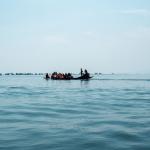
Hilsa is the largest single-species fishery in Bangladesh, and one of the largest anywhere in the world for a wild-caught fish. Its roughly 12 per cent share of national fish production understates its economic presence, because hilsa commands prices far above the average fish. The fiscal 2023-24 catch of 529,000 tonnes was valued by the Department of Fisheries at about Tk 20,680 crore — the basis for the often-quoted estimate that the fishery contributes around 1 per cent of GDP. The work is spread widely: about 450,000 to 500,000 people are directly engaged in catching hilsa, according to Department of Fisheries figures, and an estimated four to five million people are involved indirectly in transporting, trading, processing and selling it. For the char and coastal communities of the southern delta, the hilsa season is the economic year.
The fish's status was formalised in August 2017, when the Department of Patents, Designs and Trademarks recognised ilish as a Geographical Indication product of Bangladesh, on an application by the Department of Fisheries. GI status certified the fish's Bangladeshi origin and reputation in law — a branding asset for any future export trade, and a point of national pride for a country that supplies the great majority of the world's catch of the species.
The modern hilsa story begins with a collapse. In fiscal 2002-03, production fell to 199,032 tonnes, a level that set off a national alarm: a fish that had seemed inexhaustible was visibly failing under the pressure of jatka catching, the interception of breeding fish, declining river flows and general overfishing. The government responded with a jatka conservation project in 2004 and a Hilsa Fisheries Management Action Plan in 2005, and from 2007-08 built the system of sanctuaries and seasonal bans described below.
The recovery that followed is one of the most cited successes in world fisheries management. Production climbed almost without interruption for fifteen years: about 496,000 tonnes in 2016-17, 517,000 tonnes in 2017-18, and a record 571,000 tonnes in fiscal 2022-23 — nearly three times the 2002-03 trough. Researchers and the WorldFish-supported ECOFISH programme credited the combination of protected breeding and nursery grounds, compensated closed seasons and community enforcement for rebuilding the stock.
Since the peak, however, the line has turned down. Production fell to 529,000 tonnes in 2023-24, 500,000 tonnes in 2024-25 and 420,000 tonnes in 2025-26 — three consecutive declines totalling about 151,000 tonnes, or 26 per cent, according to figures from the Ministry of Fisheries and Livestock reported in November 2026. The fall has not been uniform across the fishery: commercial trawler landings of hilsa from the Bay of Bengal dropped by 78 per cent between 2022-23 and 2024-25, from 8,138 tonnes to 1,790 tonnes, on Department of Marine Fisheries figures. Department of Fisheries officials caution that hilsa output fluctuates naturally and say there is no cause for alarm; a professor at Bangladesh Maritime University, Md Abdul Wahab, has estimated the sustainable annual catch at 5.5 to 6 lakh tonnes, implying that the record years may themselves have fished the stock hard. What is not in dispute is that the fishery has moved, within three seasons, from celebration to investigation.
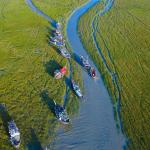
The machinery built to save the hilsa has four main parts. The first is space. Six river stretches, totalling 432 kilometres, have been declared hilsa sanctuaries: 100 kilometres of the Meghna from Shatnol in Chandpur to Char Alexander in Lakshmipur; 90 kilometres of the Shahbazpur Channel in Bhola; 100 kilometres of the Tentulia River in Bhola; 40 kilometres of the Andharmanik River in Patuakhali; 20 kilometres of the lower Padma at the Padma confluence in Shariatpur; and 82 kilometres of the Meghna between Hizla and Mehendiganj in Barishal. In these waters, all fishing is prohibited for two months each year, from 1 March to 30 April, covering the minor spawning season and the jatka nursery period.
The second part is time. Each autumn, over the peak spawning season, the government closes the fishery to protect egg-bearing "mother hilsa". The closure began in 2008 as an 11-day ban timed to the full moon; when research showed spawning also peaks around the new moon, it was extended to 22 days. In 2026 the Mother Hilsa Conservation Campaign ran from 8 to 29 October: for those 22 days, catching, transporting, storing, marketing, buying, selling or exchanging hilsa was prohibited across the whole country, all fishing was banned in the rivers of twenty districts, and hilsa fishing alone was banned in another eighteen. The third part of the system protects the young. From 1 November to 30 June — eight months of every year — it is an offence to catch, carry, store or sell any hilsa smaller than 25 centimetres, punishable by up to two years' rigorous imprisonment or a fine of up to Tk 5 lakh.
The fourth part is what makes the other three politically possible: compensation. Closed seasons fall hardest on the poorest fishing households, so the state pays for the pause in food. During the October 2026 ban, 647,690 registered fisher families each received 25 kilograms of rice under the Vulnerable Group Feeding programme — more than 16,000 tonnes of rice in total — and the government announced that VGF coverage was being raised from 6.20 lakh to about 6.46 lakh fisher families. Enforcement, meanwhile, is a combined operation of the fisheries department, police, Coast Guard and Navy; in the 2026 campaign the Navy alone reported 212 operations and the seizure of some 8.4 million metres of illegal netting. In October 2026 the government also announced a new project, "Sustainable Development of Hilsa through Conservation of Mother Hilsa and Jatka", pairing stronger enforcement and river-navigability work with higher support allocations.
If the Meghna estuary is the fishery's engine room, Chandpur is its exchange floor. The town sits where the Padma and Meghna meet the Dakatia, and brands itself — with some justice — as the City of Hilsa. Its century-old Boro Station fish landing centre, on the bank of the Dakatia, is the district's largest landing centre and one of the biggest in the country. The fish traded there are not all local: catches from Bhola, Hatiya, Barishal and Patuakhali are landed at or routed through Chandpur, where rows of wholesale arat auction them onward to Dhaka and the rest of the country. The Bangladesh Fisheries Research Institute keeps its Riverine Station in Chandpur, which is why so much of the science of the fishery — from plankton counts to the estuary shoals reported in 2026 — carries a Chandpur dateline.
From the landing centres, hilsa move through a chain of wholesalers, commission agents and retailers that employs far more people than the catching fleet itself. The chain terminates in some of the highest fish prices in South Asia. In 2026, press reports from Dhaka's markets put large hilsa at Tk 3,000 or more per kilogram — a price that has turned the fish from a staple into an occasion purchase for many families, and that frames every argument about exports: every tonne sold abroad is a tonne priced further out of reach at home. That domestic price pressure, as much as biology, explains the next part of the story.
Hilsa is as beloved in India's West Bengal and Tripura as it is in Bangladesh, and for decades a share of the Bangladeshi catch crossed the border. In July 2012, worried about domestic supply and prices, Dhaka banned hilsa exports altogether. The ban held in full until 2019, when Bangladesh began granting short special permissions each September so that Indian consumers could have Bangladeshi hilsa for Durga Puja, the festival at which the fish is traditionally eaten in Bengal. The windows were narrow and, in the event, little used: in September 2024, 2,420 tonnes were permitted but only about 577 tonnes actually crossed; in September 2025, 1,200 tonnes were permitted and only about 150 tonnes were shipped, as exporters struggled with prices, timing and the approach of the October fishing closure.
In 2026 the window did not open at all. Kolkata's Fish Importers' Association wrote to Bangladesh's commerce minister in September asking for the ban to be lifted, arguing that a one-month festive window is too short to organise a trade around. Dhaka did not grant the permission, and no Bangladeshi hilsa reached India for the festival. Then the flow reversed. With Bangladesh's own catch down, Indian traders reported exporting about 500 tonnes of hilsa to Bangladesh through the Petrapole land port in August and September 2026 — Indian-caught fish sold into the world's hilsa heartland — before the Bangladeshi authorities cancelled the import permits by a circular on 23 September. Both governments' positions have their logic as their supporters state them: Dhaka prioritises a scarce, high-priced national fish for its own consumers; Indian importers argue that a predictable, longer export season would serve traders and consumers on both sides. What 2026 demonstrated is that the trade now turns less on diplomacy than on the size of the Bangladeshi catch itself.
The decline since 2022-23 has several candidate causes, and researchers are careful to say the evidence is still being assembled. The Bangladesh Fisheries Research Institute is collecting field data during the closed seasons to establish what has changed. Three pressures recur in the 2026 reporting. The first is habitat: a BFRI study found that the plankton on which hilsa feed has fallen by about 68 per cent in the Meghna, largely as a result of pollution, and scientists at the institute's Chandpur River Centre reported new submerged shoals forming in the estuary towards Bhola that may be deflecting the fish's migration routes into the rivers. The second is water: reduced dry-season flows, siltation and falling navigability in the delta's channels are repeatedly cited by university researchers, alongside rising water temperatures. The third is fishing itself — continued jatka killing, illegal fine-mesh nets, and, on some accounts, industrial trawlers working inside restricted zones, all of which the October 2026 enforcement drives were aimed at.
Against this, fisheries officials maintain that hilsa production has always fluctuated and that the management system that rebuilt the stock remains in place. Both readings can be partly true: a stock managed near its sustainable ceiling — as the 5.5 to 6 lakh tonne estimate implies about the record years — has less room to absorb a run of bad environmental years.
The hilsa remains what it was: Bangladesh's national fish, most of the world supply of its species, about an eighth of the nation's fish production, around 1 per cent of GDP and the livelihood of millions. The conservation regime built since 2004 — sanctuaries, compensated closed seasons, size limits and a GI-certified national brand — is still the reference case for single-species fishery recovery in a developing country. The question the next few seasons will answer is whether the fall from 571,000 tonnes to 420,000 tonnes was a fluctuation, as officials suggest, or the beginning of a second decline driven by the rivers themselves. On that answer depends not only a famous fish, but the price of celebration on both sides of the Bengal border.