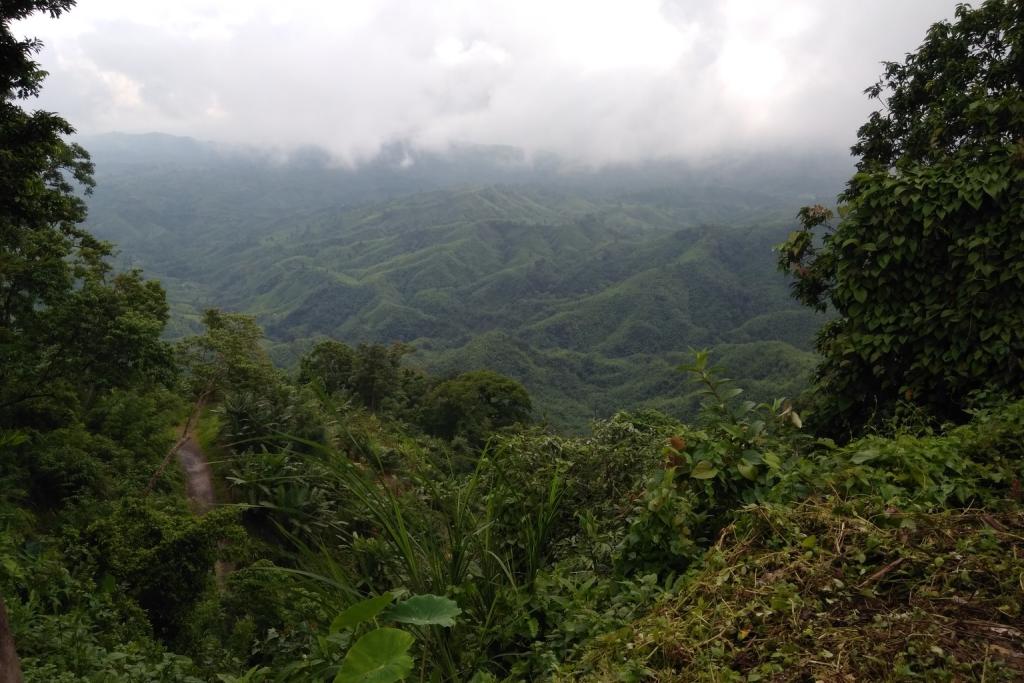
On a clear morning in Sajek, the hills below the ridge disappear. Cloud fills the folds of the Kasalong range like a slow white sea, and the villages of Ruilui and Konglak seem to float on top of it. It is the image that made Sajek Valley famous — the "Queen of Hills", the "Roof of Rangamati" — and it turned one of the most remote corners of Bangladesh into the country's best-known hill destination within a single decade. Yet Sajek's story is not only a tourism story. It is about an old Indigenous homeland that a road reached barely a generation ago, about a valley that learned to live from visitors, and about how quickly that living can be interrupted — by fire, by weather and, most recently, by the politics of the hills themselves.
Where Sajek Is and How the Land Lies
Sajek Valley lies in the far north of the Chittagong Hill Tracts, among the hills of the Kasalong range. Administratively it belongs to Sajek Union of Baghaichhari Upazila in Rangamati Hill District — and Sajek Union is the largest union in Bangladesh by area, a vast tract of ridges and forest pressed against the border with the Indian state of Mizoram, with the hills of Tripura to the north. The valley sits roughly 70 kilometres north-east of Khagrachhari town and about 95 kilometres from Rangamati city.
Despite its name, Sajek is not really a valley floor. The settled, visited part of Sajek runs along a high ridge about 1,800 feet (550 metres) above sea level. At the near end of the ridge stands Ruilui Para, at roughly 1,720 feet, where most of the resorts and cottages cluster. At the far end, about two kilometres on, Konglak Para sits on top of Konglak Hill — locally called Konglak Haphong — the highest point in Sajek. From Konglak's summit the eye travels over ridge after ridge into Mizoram, and on the clearest mornings the cloud lies below the viewer rather than above. Settlements here are recorded as dating back to 1885, long before anyone arrived with a camera.
The geography explains both the beauty and the fragility. Everything in Sajek — water, food, fuel, building materials — must come up a single steep road, and the ridge is exposed to the full force of the monsoon and the dry season alike.
The famous clouds are a product of that geography. Through the monsoon and into autumn, moisture rising from the forested valleys condenses below the ridge overnight, so that at dawn the settlements stand above a white, slow-moving sea of cloud; in the clear, cool weeks of winter the cloud thins and the view opens out across the hills into India. It is this double character — cloud kingdom in one season, panoramic lookout in the other — that underpins Sajek's year-round pull on visitors, and also why the winter months, when the road is driest and the skies clearest, form its high season.
The Name and the River
Sajek takes its name from the Sajek River, which threads through these hills along the Bangladesh–India border before draining into the Karnaphuli river system. The river is also known locally as the Kasalong, and the range around the valley carries the same name. Another stream, the Masalong, runs through the hills nearby, and the road in climbs across the Mayni range and the Mayni river before the final ascent to Ruilui. In a region where villages were historically reached by river and footpath rather than by road, it is fitting that the valley is named for its water rather than its hills.
The People of the Valley
Sajek was a homeland long before it was a destination. Its villages are home to Indigenous communities of the hill tracts — principally the Lushai (also spelled Lusai), the Pangkhua, the Tripura and the Chakma, with Marma and other communities also present in the wider union. Ruilui and Konglak are largely Lushai and Pangkhua villages; the Lushai of Sajek are predominantly Christian, and both Ruilui and Konglak have their churches. Villages are led by hereditary headmen known as karbaris — Ruilui's headman is Lal Thanga Lushai — who remain the first point of authority in local life and, as recent events have shown, in local politics too.
For generations the people of Sajek lived by hill farming — shifting cultivation on the slopes, fruit and vegetable growing, and the trade that could be carried down to the markets of Baghaihat and Dighinala. Women have long been central to that economy, working the gardens and orchards; Konglak is known among travellers for its orange groves. What the valley did not have, for most of its history, was a road. Until the army-built road arrived, Sajek was routinely described as one of the most inaccessible places in the country, days of walking from the nearest town.
From Quiet Hills to Tourism Boom
The change began with the road. The Baghaihat–Masalong–Sajek road, built by the Engineer Construction Brigade of the Bangladesh Army from Khagrachhari through Dighinala and Baghaihat, took roughly a decade of phased construction and was completed around 2009. Visitors still travel its final stretch the way they always have: in open chander gari jeeps, moving in escorted convoys at fixed times and registering at the checkpoints along the way. From about 2014, tourism gathered pace — and then it surged.
The numbers tell the story of the boom. Sajek had six registered resorts in 2016; by 2020 it had 83, and by the early 2020s more than a hundred resorts and cottages lined the ridge at Ruilui, alongside restaurants, shops and a helipad. On peak weekends thousands of visitors a day could be in the valley. The ridge acquired landmarks of the new economy — the army-run Sajek Resort, large private resorts such as Runmoy, and rows of small family-run cottages whose balconies all face the same eastern clouds. Sajek became, in effect, the hill-country counterpart to Cox's Bazar on the coast: the default short break for a new generation of domestic tourists, and a complete economic transformation for the valley. Resort work, jeep driving, cooking, guiding and shopkeeping replaced or supplemented the jhum fields for hundreds of local families, Indigenous and Bengali alike.
But a single-road economy balanced on one industry is exposed, and Sajek has been reminded of that repeatedly. In 2020 the COVID-19 pandemic closed the valley to tourists for five months. In the autumn of 2024, after violence in Khagrachhari and Rangamati in September, tourism across the three hill districts was paused for weeks; Sajek reopened only on 5 November 2024, and the local tourism sector estimated its losses from that closure alone at about Tk 15 crore. In July 2026, heavy monsoon rain and landslides closed the tourist centre again for nine days. Each interruption fell hardest on the same people: the families who had rebuilt their livelihoods around visitors.
The Fire of 2025 and Other Pressures
The gravest blow came on 24 February 2025. At around one in the afternoon, fire broke out in the Ruilui tourist area — locals and the resort owners' association named the Sajek Eco Valley Resort as the starting point, while other reports named the Obokash Resort — and in the dry-season wind it ran through the wooden resorts, cottages and homes of the ridge. Sajek had no fire station of its own; units had to climb from Dighinala, Khagrachhari and Panchhari, and the fire burned for roughly four and a half hours before it was brought under control.
By the count of the Sajek Cottage and Resort Owners Association, 32 resorts and cottages, 36 residential houses, six restaurants and 20 shops were completely destroyed; the Rangamati district administration put the total at 98 establishments. Thirty-five of the houses belonged to local Lusai and Tripura families, and nearly 200 residents were left homeless, spending nights in churches and temples or under the open sky. No one was killed — a fact repeated with relief in every account — but the owners' association estimated the losses at around Tk 100 crore. Early reports suggested a cigarette stub or an electrical short circuit as the cause; a district probe committee was formed, but no single official cause was ever settled in public. The administration gave each affected family Tk 7,500 and 30 kilograms of rice, announced Tk 20,000 for each affected business owner, and through 2025 the ridge slowly rebuilt — resorts reopening, families re-roofing their homes, many in the same timber style as before.
The fire exposed pressures that had been building for years: dense wooden construction on a water-scarce ridge, no local fire service, and a tourism economy whose benefits and risks were unevenly shared. It also underlined how dependent Sajek had become on calm in the wider hill tracts — a dependence that would be tested again within eighteen months.
Sajek Today
As of November 2026, Sajek is a destination interrupted. Through the autumn, tensions in the valley sharpened around the Sajek Karbari Association and the Sajek Gono Odhikar Rokkha Committee (the Sajek Public Rights Protection Committee), which alleged that armed members of the Parbatya Chattagram Jana Samhati Samiti — the JSS — were active in Sajek and pressed a three-point demand, including their removal; the JSS denied the allegation. On 11 October 2026 the two organisations blockaded the Sajek road with nearly 3,000 tourists in the valley. The blockade was lifted that afternoon, but the Rangamati district administration closed the tourist centre from that evening and told visitors to leave. Sajek reopened briefly, from 16 to 21 October, for the Durga Puja festival — about 800 tourists entered on the first day — but when the blockade resumed on 22 October, the administration closed Sajek again, and 2,933 stranded tourists were evacuated under security escort amid reports of gunfire, which the UPDF disputed. Further gunfire was reported in Sajek Union on 31 October, the blockade was eased for a single day for residents on 1 November, and would-be visitors diverted to Rangamati town instead.
The position as this article is published is as follows. Sajek has been formally closed to tourists since 21–22 October 2026, "until further notice". On 10 November the Karbari Association's president, Natun Joy Chakma, announced that the association's committee had been dissolved and the indefinite blockade withdrawn; on 11 November the Sajek Resort Owners Association and the Sajek Jeep-Pickup Owners Association jointly announced that the tourist centre would reopen to all visitors, with bookings taken from 13 November 2026, ahead of the winter season. No separate new lifting notice from the district administration had been reported as of 12 November, so travellers should treat the reopening as announced rather than confirmed until the administration's own notice appears.
What is not in doubt is what Sajek remains: a ridge of Lushai, Pangkhua, Tripura and Chakma villages above a sea of cloud, named for its river, remade within a decade by a road and by the visitors who followed it. Whether the winter of 2026–27 becomes the season Sajek's recovery finally holds will depend less on the weather over Konglak than on the politics of the hills below it.