Shahjalal University of Science and Technology — known everywhere in Bangladesh by its acronym, SUST — is a public research university in Sylhet, in the tea-growing north-east of the country. Established in 1986, it was Bangladesh's first science and technology university: a new kind of institution in a system then dominated by the older general universities, built from the start around science, engineering and technology, but with the humanities, social sciences and business studied alongside them. From its green, hill-fringed campus at Kumargaon, SUST has repeatedly changed how Bangladeshi universities do things. It was the first to run an integrated honours curriculum, an early pioneer of the semester system, the first to let admission seekers register by mobile-phone text message, and the first — jointly with a sister university — to hold a combined admission test. Teaching began in February 1991 with just 205 students; today the university teaches roughly 8,900 students in six schools and 27 departments, and its admission test remains among the most competitive in the country.
Founding and first years
The university was won by a long campaign. For decades, people in Sylhet and the wider north-east had demanded a university of their own, arguing that the region was too far from the established centres of learning. The diplomat Humayun Rashid Chowdhury, a son of the region who became Speaker of the national parliament, was among the cause's most prominent champions, and in the mid-1980s the government of President Hussain Muhammad Ershad accepted the demand. The university is counted as established on 25 August 1986; its governing law, the Shahjalal University of Science and Technology Act, was passed in 1987 (Act XV of 1987) and deemed to have taken effect from that August date. It is named after Hazrat Shah Jalal, the Sufi saint whose shrine has drawn pilgrims to Sylhet for centuries. The founding vice-chancellor was Sadruddin Ahmed Chowdhury, a physicist who set the young institution's academic direction.
Teaching began on 13 February 1991 — the first day of Falgun in the Bengali calendar, still celebrated as University Day — with three departments: Physics, Chemistry and Economics. The first intake numbered just 205 students and 13 teachers; the very first class was held three days later, on 16 February, by the head of Physics, Professor Arun Kumar Basak. The model was deliberately different from that of the University of Dhaka and the other older universities, and distinct, too, from the Bangladesh University of Engineering and Technology (BUET), the country's specialist engineering institution: SUST was a full university organised around science and technology, in which a physics student shared a campus — and a curriculum culture — with students of economics, English and business. Two reforms underlined the difference. SUST introduced the country's first integrated honours course, and from the 1996–97 session it adopted the semester system, an early move away from the annual examination rhythm that then governed Bangladeshi higher education.
The campus
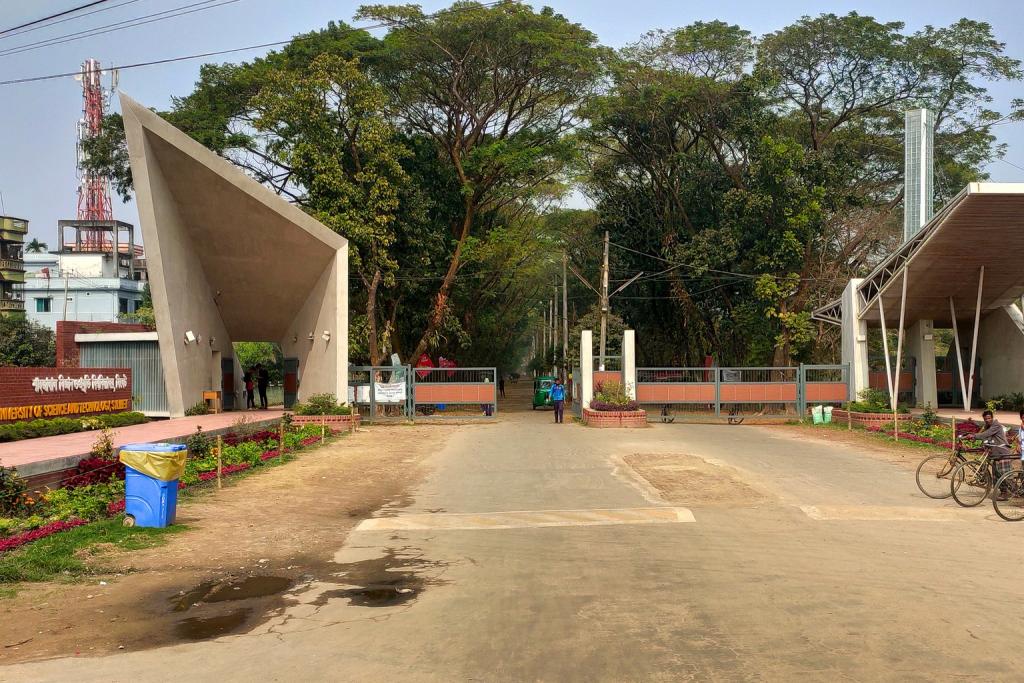
The main campus occupies about 320 acres at Kumargaon, in the Akhalia area roughly five kilometres from the centre of Sylhet city. It is one of the most admired campuses in Bangladesh: rolling, tree-covered ground on the edge of the haor-and-hill country of the north-east, greener and more spacious than the dense urban sites of most public universities. Students arrive along the tree-lined entrance avenue — often called simply the "one-kilometre road" — which leads to the Gol Chattar roundabout, the social heart of the campus. Around it stand the academic buildings, the central library, the central auditorium, the Shaheed Minar and the Chetona '71 sculpture, which commemorates the Liberation War.
Residential life is organised through the halls of residence. As of 2026 the university has six operating halls — three for men and three for women — named for figures including Shah Paran, Syed Mujtaba Ali and Begum Sirajunnesa Chowdhury, together with a hall for international students, and more halls are under construction. In September 2025 three halls were renamed in the wake of the 2024 political change; the former Bangabandhu Sheikh Mujibur Rahman Hall, for example, became Bijoy 24 Hall. Even so, places in halls fall well short of demand, and many students live in rented rooms in the neighbourhoods around the campus — a pressure that has grown with the university and remains one of its defining practical problems.
Schools and study
According to the university's published figures, SUST today has six schools and 27 departments, with approximately 8,900 students and 597 academic staff, alongside specialist institutes that include the Institute of Information and Communication Technology (IICT) and the Institute of Modern Languages. The largest school is Applied Sciences and Technology, which carries the engineering core of the university: Computer Science and Engineering, Electrical and Electronic Engineering, Civil and Environmental Engineering, Chemical Engineering and Polymer Science, Industrial and Production Engineering, Mechanical Engineering, Petroleum and Mining Engineering, Architecture, and Food Engineering and Tea Technology — a department found nowhere else in the country, shaped by the tea industry of the surrounding Sylhet region. The School of Physical Sciences covers Physics, Chemistry, Mathematics, Statistics, Geography and Environment, and Oceanography; Life Sciences brings together Biochemistry and Molecular Biology with Genetic Engineering and Biotechnology. Around this scientific core sit the School of Social Sciences (among them Economics, English, Bangla, Political Studies, Sociology and Anthropology), the School of Management and Business Administration, and the School of Agriculture and Mineral Sciences, whose single department, Forestry and Environmental Science, reflects the ecology of the region.
Study is organised by semesters, and the university awards undergraduate degrees, taught master's degrees and research qualifications including MPhil and PhD. Alongside its Sylhet base, SUST draws students from every district of Bangladesh and a notable body of international students, particularly from Nepal. The competition for places explains much of the university's self-image: SUST students tend to describe their institution as selective, technically serious and slightly apart from the rest of the system — a reputation the admission figures largely bear out.
The admission pioneer
No Bangladeshi university is more closely identified with admission reform than SUST. For the 2025–26 session, 75,023 applicants competed for 1,566 advertised places (with 77 further seats under quota categories) — roughly one place for every 48 candidates. Yet it is the machinery of admission, as much as its competition, that made the university's name.
In September 2009, SUST introduced a paperless admission registration system based on ordinary mobile-phone text messages — the first of its kind in Bangladesh. An applicant with a Teletalk mobile phone could register for the admission test, and pay the fee, by SMS, without filling in a paper form, buying a bank draft or travelling to Sylhet. Inaugurated by the prime minister on 13 September 2009, the system was widely reported as a landmark in digital public services, and other universities followed its lead; the university's digital admission work was recognised with a National ICT Award in 2017. A central figure in designing and championing the system was Professor Muhammed Zafar Iqbal, then head of the computer science and engineering community at SUST, who argued that technology should remove the middlemen, cost and harassment that surrounded university admission.
Four years later SUST went further. For the 2013–14 session it held, jointly with Jashore University of Science and Technology, the country's first combined admission test — one examination for two universities — an idea long championed by Zafar Iqbal as a way to spare applicants repeated journeys and fees. When the authorities postponed the combined test in November 2013, he and his wife, Professor Yasmeen Haque, applied to resign in protest, withdrawing their resignations the next day only after the decision to proceed was restored. The combined principle later spread nationally through the GST cluster admission system, in which SUST participated for a time. In a characteristically independent turn, however, SUST subsequently withdrew from the GST cluster and returned to holding its own admission test; it remained outside the cluster for the 2025–26 session, one of five universities to do so despite the University Grants Commission's hopes of bringing them back.
Research and campus life
Research at SUST is conducted through its departments, laboratories and research centres, spanning computing, engineering, the physical and life sciences, and environmental and social research tied to the north-east region. In the Nature Index, which tracks output in a selected set of leading journals, SUST stood tenth among Bangladeshi academic institutions by fractional research output for the period July 2025 to June 2026. Its students have also carried its name abroad: in the 2018 NASA International Space Apps Challenge, a SUST team called Olik won the global Best Use of Data award for Lunar VR, a virtual-reality application built on space data, with the award announced in February 2019. In February 2026 the Department of Political Studies opened an Election Lab — reported as the first of its kind in the country — for systematic research on elections, voters and electoral processes.
Campus life has a strong cultural tradition, from the cultural organisation Shikor to theatre, debating, film and science societies, and the university has a long history of student activism. In January 2022, protests against the then vice-chancellor, Farid Uddin Ahmed, over hall management and police action on campus culminated in a hunger strike, which ended on 26 January after Zafar Iqbal and Yasmeen Haque travelled to Sylhet and personally persuaded the students to eat. SUST students joined the nationwide quota reform movement of July 2024, during which the university was closed indefinitely amid the unrest. The revival of the central students' union, SUCSU — last elected in 1997 — became the dominant campus question of 2025–26: elections for its 23 posts, with 97 candidates, were scheduled for 20 January 2026, but on the eve of voting the High Court stayed the polls for four weeks on a writ arguing that they breached the Election Commission's suspension of organisational elections ahead of the February 2026 national election. Furious students confined the vice-chancellor overnight and boycotted classes, and the vote did not take place as scheduled — a reminder that at SUST, as across Bangladeshi higher education, the politics of the campus is never far below the surface.
Notable people
The founding generation set the university's tone. Sadruddin Ahmed Chowdhury, its first vice-chancellor, gave the institution its early academic shape, while Arun Kumar Basak, founding head of Physics, taught its first class in February 1991 and went on to become a professor emeritus at the University of Rajshahi.
The figure most associated with SUST, however, is Muhammed Zafar Iqbal (born 1952). A physicist who took his PhD at the University of Washington and spent some eighteen years as a scientist at Caltech and Bell Communications Research in the United States, he gave up that career to return to Bangladesh, joining SUST in December 1994 as an associate professor of Computer Science and Engineering. He became a professor, headed the CSE department and later the Department of Electrical and Electronic Engineering, and was simultaneously the country's best-known science-fiction writer and a tireless campaigner for science education among schoolchildren. At SUST he was the driving force behind both the SMS admission system and the combined admission test. On 3 March 2018 he survived a knife attack by a religious extremist while speaking at a campus programme, an assault that drew nationwide condemnation; he recovered and returned to teaching. He retired on 3 October 2018 — notably, without an emeritus title; he is a former professor of the university — and settled in Dhaka, declining offers from private universities on the grounds that he wished to remain, simply, a teacher of SUST. His post-retirement years have brought a dramatic reversal of public standing: in September 2026 the International Crimes Tribunal accepted prosecution charges against him in a crimes-against-humanity case arising from the July 2024 uprising — the case against him rests in part on a note he published during the protests referring to student demonstrators as "razakars" — and issued an arrest warrant for him. The proceedings have been condemned by human-rights campaigners and remain ongoing; he has not been convicted. His wife, Yasmeen Haque, a professor of Physics who held senior academic posts at the university, shared both his 2013 resignation protest and his 2022 peace mission to the campus.
SUST today
As of November 2026, the vice-chancellor is Professor Dr Md. Khairul Islam, who was appointed on 23 May 2026 by the Ministry of Education, with the President's approval, under Section 11(1) of the SUST Act 1987, for a term of four years or until his retirement, whichever comes first. A professor of Business Administration who chaired that department and formerly served as a dean, he succeeded A. M. Sarwaruddin Chowdhury, who had led the university through the unsettled period that followed the political upheaval of 2024 — including the January 2026 SUCSU crisis. The university's annual budget for 2024–25 stood at about ৳170.8 crore.
Internationally, SUST sits in the 1201–1500 band of the Times Higher Education World University Rankings 2026 and the 1401+ band of the QS World University Rankings 2027; in the QS Asia University Rankings 2027, published in November 2026, it placed 352nd in Asia and eighth among the 52 Bangladeshi institutions ranked. Domestically, the pressures are more mundane: a shortage of hall places and student services that June 2026 reporting found still vexing students even as hall allocation was made less political, and the unresolved question of the students' union. In August 2026 the university marked forty years since its establishment. Four decades on, SUST remains what it was designed to be — the north-east's own university, and the system's habitual first mover: the institution that tried the semester system, the text-message application and the combined admission test before anyone else, and which still insists, against the grain of national policy, on running its own entrance examination.