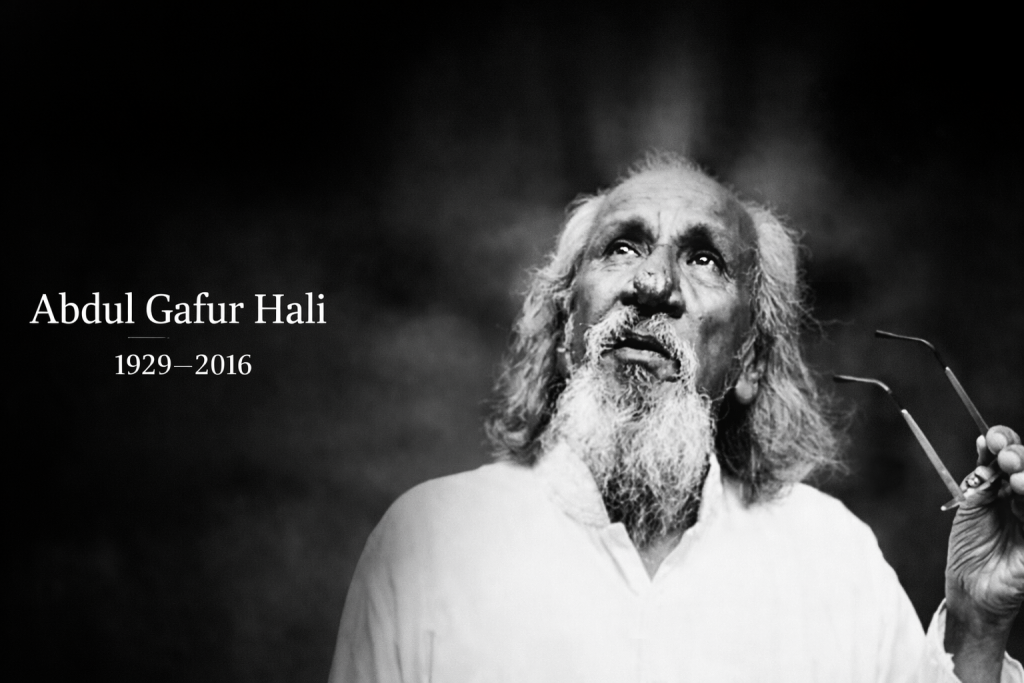
Abdul Gafur Hali(6 August 1929 – 21 December 2016) remains one of the most influential yet underrecognized figures in the history of Bangladeshi folk music. A lyricist, composer, singer, and playwright, he played a defining role in shaping the musical identity of Chittagong and preserving the spiritual and cultural depth of the Maizbhandari.
With a career spanning over six decades, Abdul Gafur Hali created thousands of songs rooted in the Chittagonian language, blending spirituality, rural life, and human emotion into a unique artistic expression. His work not only preserved regional traditions but also redefined them for future generations.
Early Life: A Foundation Built on Culture and Struggle
Abdul Gafur Haliwas born in Rashidabad village under Patiya Upazila in 1929. His early life was deeply connected to the rural and cultural environment of the region, where music, storytelling, and spiritual practices were integral parts of everyday life.
From childhood, he was captivated by jatrapala and punthipath—traditional forms of performance that combined storytelling, music, and drama. These early exposures laid the foundation for his later artistic journey.
Despite his passion for learning, Hali’s formal education was cut short due to the devastating Bengal famine of 1943. However, this limitation did not hinder his intellectual and creative growth. Instead, he turned to nature and lived experiences as his primary sources of inspiration.
He once reflected that songwriting is not dependent on institutional education but on emotional depth—an idea that became central to his creative philosophy.
The Making of a Self-Taught Artist
Unlike many of his contemporaries, Abdul Gafur Hali never received formal training in music. He did not learn from any institution, nor did he have structured guidance in composition or performance.
Instead, he developed his skills through continuous observation and practice. Influenced by legendary figures such as Askar Ali Pandit and Ramesh Shil, he absorbed the essence of traditional music and gradually developed his own style.
His journey reflects a rare form of artistic evolution—one driven entirely by passion, intuition, and persistence.
Musical Career: From Local Performer to Cultural Icon
Abdul Gafur Hali’s musical career began in the 1950s, a time when regional music was rarely documented or formally recognized. His early performances were rooted in local gatherings and spiritual events.
A turning point came when he participated in an audition at the Agrabad radio station in Chittagong, where he secured first place. This recognition opened the door for his songs to be broadcast on the radio.
By 1963, his compositions were regularly aired, and he later became associated with East Pakistan Radio as a registered artist. Over time, he established himself as a professional lyricist, composer, and singer.
Throughout his career, he wrote and composed over 2,000 songs, including more than 1,500 Maizbhandari and mystical compositions. His ability to maintain such productivity over decades is a testament to his dedication and creative energy.
Music as Resistance: Contribution During the Liberation War
During the Bangladesh Liberation War, Abdul Gafur Hali used his music as a powerful tool of resistance. His songs captured the emotional and political realities of the time, inspiring both freedom fighters and civilians.
His lyrics often emphasized identity, dignity, and unity, reinforcing the spirit of Bengali nationalism. In a time of crisis, his music provided both solace and strength, demonstrating the transformative power of art.
Literary Contributions: Folk Theatre and Language Preservation
In addition to his musical achievements, Abdul Gafur Hali made significant contributions to folk theatre. He wrote several plays in the Chittagonian language, including Gulbahar, Nilmoni, and Ashek Bondhu.
These works played a crucial role in preserving regional dialects and storytelling traditions. By using the Chittagonian language in both music and drama, he elevated its status as a legitimate medium of artistic expression.
Songs of the Soil: Folk and Socio-Cultural Compositions
A Reflection of Life in Chittagong
Abdul Gafur Hali’s folk songs are deeply rooted in the everyday life of Chittagong. His lyrics capture the rhythms of rural existence, the beauty of nature, and the complexities of human relationships.
His songs often reference rivers like Karnaphuli, boats, marketplaces, and village life—creating a vivid portrayal of the region’s cultural landscape.
Iconic Folk Songs
Some of his most widely recognized folk and socio-cultural songs include:
- Shona Bondhu Tui Amare Korli Re Dewana
(সোনাবন্ধু তুই আমারে করলি রে দিওয়ানা) - Panjabiwala
(পাঞ্জাবিঅলা) - Banu Re! O Banu! Ai Jaiyum Gui Chatga Shohorot Tuarlai Ainnum Ki
(বানুরে অ বানু আঁই যাইয়্যুম গই চাটগাঁ শঅরত তোঁয়ার লাই আইন্নুম কি?) - O Shyam Rengum Noo Jaio
(অ শ্যাম রেঙ্গুম ন যাইও) - Moner-o Bagane Fotilo Phoolre
(মনের বাগানে ফুটিল ফুলরে) - Noo Matai Noobulai Gelire Bondhua
(ন মাতাই ন বোলাই গেলিরে বন্ধুয়া) - Tui Jaiba Shonadia Bondhu, Mach Dhoribar Lai
(তুঁই যাইবা সোনাদিয়া বন্ধু, মাছ মারিবার লাই)
These songs are not merely musical compositions; they are cultural documents that preserve the language, emotions, and traditions of Chittagong.
Spiritual Depth: Maizbhandari and Mystical Songs
The Essence of Sufi Expression
Abdul Gafur Hali’s Maizbhandari songs represent the spiritual core of his work. Influenced by Sufism, these compositions explore themes of divine love, devotion, and the search for spiritual truth.
Notable Mystical Compositions
His most celebrated Maizbhandari and mystical songs include:
- Dui Kul-er Sultan Vandari
(দুই কূলের সোলতান ভান্ডারী) - Dekhe Jare Maizbhandere Hoiteche Nurer Khela
(দেখে যারে মাইজভাণ্ডারে হইতেছে নূরের খেলা) - Koto Khela Janore Moula
(কতো খেলা জানরে মওলা) - Maizbhandere Ki Dhoon Ache
(মাইজভাণ্ডারে কি ধন আছে) - Cholo Jai Ziyarote Mohsen Auliyar Dorbare
(চল যাই জিয়ারতে মোহছেন আউলিয়ার দরবারে) - Allahr Fokir More Jodi
(আল্লাহর ফকির মরে যদি)
These songs continue to be performed by renowned artists and remain central to spiritual gatherings and cultural events.
Influence and Cultural Impact
Abdul Gafur Hali played a crucial role in promoting the works of other regional artists. Through his efforts, the contributions of artists like Askar Ali Pandit gained wider recognition.
He is often credited with shaping a new era of Chatgaiya music, bridging traditional forms with modern cultural expressions.
Global Recognition and Academic Interest
Despite limited recognition within Bangladesh, Abdul Gafur Hali’s work attracted significant attention from international scholars.
German researcher Hans Harder conducted extensive studies on his music and published research that introduced his work to a global audience.
His songs were translated into German and analyzed as examples of mystical expression in East Bengal, highlighting their universal relevance.
Books and Documentation
Abdul Gafur Hali authored several important works that preserve his legacy:
- Totyobidhi(1969)
- Gyanjyoti(1989)
- Surer Bondhon(2012)
- Shikor(2014)
- Abdul Gafur Halir Chatgaiya Natoksomogro(2015)
These publications serve as valuable resources for researchers and enthusiasts.
Final Years and Death
Abdul Gafur Hali remained active in music until his final years. He passed away on December 21, 2016, in Chittagong at the age of 88.
Legacy: A Voice That Transcends Generations
Abdul Gafur Hali’s legacy is defined by his dedication to preserving and enriching the cultural heritage of Bangladesh. His work continues to inspire musicians, researchers, and cultural enthusiasts.
His songs remain alive in performances, his writings continue to be studied, and his influence persists in the evolving landscape of Bangladeshi music.
Conclusion
Abdul Gafur Hali stands as a towering figure in the history of Bangladeshi folk and spiritual music. His contributions go beyond entertainment—they represent a deep connection to culture, identity, and spirituality.
In preserving the traditions of Chittagong and elevating them to a broader cultural context, he ensured that his voice would continue to resonate for generations to come.