Table of contents [Show]
Overview
Amar Bondhu Rashed (আমার বন্ধু রাশেদ — "My Friend Rashed") is a Bengali novel by Muhammed Zafar Iqbal, first published in 1994. Written for children and young readers, it is set in a small Bangladeshi town during the Liberation War of 1971 and is told through the eyes of a schoolboy, Ibu, whose new friend Rashed turns out to be the bravest person he will ever know. In Bangladesh the book is classified among Liberation War novels for children, and its standing is unusual for a children's title: the Dhaka Tribune has called it "the most famous children's book on the liberation war", and Scroll.in has described it as an iconic children's book in the culture of 1971 remembrance. Few books for young readers anywhere carry the weight this short novel carries — a story of friendship that ends, as the war itself ended for so many families, in loss. The novel has been reprinted repeatedly, translated into English as Rashed, My Friend by the author's daughter Yeshim Iqbal, and adapted into a well-known 2011 film directed by Morshedul Islam.
Muhammed Zafar Iqbal was born on 23 December 1952 in Sylhet, into a family that the war would mark directly. His father, Faizur Rahman Ahmed, was a police officer; after the Pakistan Army's crackdown began in March 1971, he was captured and killed by the army — biographical accounts date his killing to 5 May 1971. Zafar Iqbal, eighteen years old that year, spent his childhood moving around the country with his father's postings, an upbringing that gave him the small-town Bangladesh he would later recreate in fiction. His elder brother was Humayun Ahmed, who became the most popular Bengali novelist of his generation; his younger brother Ahsan Habib became a well-known cartoonist.
By training, Zafar Iqbal is a physicist. He passed his SSC from Bogra Zilla School in 1968, took a BSc in physics at the University of Dhaka in 1976, and earned a PhD at the University of Washington in 1982, followed by research years at Caltech and Bell Communications Research in the United States. In 1994 — the year Amar Bondhu Rashed appeared — he returned to Bangladesh and joined Shahjalal University of Science and Technology (SUST) in Sylhet as a professor, heading first Computer Science and Engineering and later Electrical and Electronic Engineering; he retired in October 2018. In March 2018 he survived a stabbing attack at a SUST prize-giving ceremony, an event that underlined his public profile as an outspoken secular voice. Writing, though, began long before the physics: he wrote his first science fiction story at the age of seven, and alongside the academic career he became Bangladesh's most popular writer of science fiction and of books for children and teenagers — the dual identity that produced, in Amar Bondhu Rashed, a war novel written with a scientist's clarity and a bereaved son's knowledge of what 1971 cost. His family connects the book to its own afterlife: his wife Yasmeen Haque is a physicist at SUST, and of his two children, his daughter Yeshim would become the English translator of this very novel.
Plot and Setting
The novel is set in a small town in East Pakistan in 1971, and its frame is memory: the adult Ibu (full name Rakibul Hasan) looks back on the year that defined his childhood. Into his school arrives a new boy whose real name is Laddu — a nickname no school register could carry. On his second day at school, the teacher gives him a proper name: Rashed Hasan. Rashed remains something of a mystery. He is fearless in ways the other boys are not, and he understands, long before they do, what is happening to the country. As the political crisis of early 1971 deepens and the Pakistan Army's violence reaches their town, it is Rashed who explains events to his classmates and Rashed who draws them, step by step, from spectators into participants.
The boys resolve to help the Mukti Bahini, the liberation forces. Their chance comes when a freedom fighter of their acquaintance is captured; a daring plan devised by Rashed frees the man from certain death. As the war closes in, Ibu's family evacuates the town to safety. Rashed does not escape. He is caught and killed by the Pakistan Army, and when the townspeople return to the liberated town after victory, his friends learn what has happened to him. The story closes the circle of its title: the adult Ibu, now a father, names his own son Rashed.
Themes
The novel's first theme is childhood inside a war. Zafar Iqbal does not show 1971 from the battlefield or the negotiating table but at a child's eye level — through schoolyards, rumours, and the bewildering sight of adults suddenly afraid. That perspective is the book's moral engine: the war's enormity is measured by what it does to children who should have been worrying about examinations. The telling itself serves the themes. The prose is plain and direct, pitched so that a reader of Ibu's own age can follow it, and the retrospective first-person voice — a grown man remembering — lets the book hold two truths at once: the excitement the boys felt, and the grief the man knows was coming. Rashed's near-mythic calm is therefore never the whole picture; it is filtered through the memory of a friend who survived him, and who tells the story as a form of repayment.
Its second theme is friendship as formation. Ibu is ordinary — cautious, curious, easily led — while Rashed is preternaturally clear-sighted. The friendship is an education: through Rashed, Ibu learns what courage is before he is old enough to name it, and the adult narrator's voice carries the debt. A third theme is sacrifice, presented without sentimentality. Rashed's death is not dressed up as glory; it is sudden, wasteful and final, and the novel insists that this, too, is what liberation cost — children among the price. Finally, there is the theme of memory itself. The book is structured as an act of remembrance, and its ending — a son named Rashed — argues that keeping the dead alive in the next generation is a duty, not a comfort. Patriotism runs through all of this, but it is a patriotism of moral clarity rather than slogans: Rashed serves the liberation cause because he understands, earlier than anyone around him, that it is right.
Publication and Reception
The novel was first published in 1994, twenty-three years after the war it describes, and it has remained in print through repeated editions — a longevity few Bangladeshi children's books achieve. Its reach widened with the English translation, Rashed, My Friend, translated by the author's daughter Yeshim Iqbal and published by Somoy Prokashon (the translation's hardcover edition is catalogued from 2003). Reference works on the war's literature list the novel among the juvenile novels of the Liberation War, and its subject matter has entered formal reading culture: questions on the book appear in national teacher-registration (NTRCA) examinations. Critical and popular judgement has converged. The Dhaka Tribune, surveying Liberation War popular culture in 2015, called it the most famous children's book on the war; Scroll.in, in a similar survey, called it iconic. For generations of Bangladeshi children, it has served as a first encounter with 1971 — the book through which the war stops being a date in a textbook and becomes a story about a boy like themselves, and his friend.
Film Adaptation
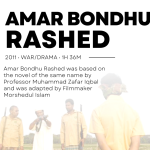
The novel reached the screen in 2011 in a film of the same name directed by Morshedul Islam, his second Zafar Iqbal adaptation after the acclaimed Dipu Number Two. Morshedul Islam wrote the screenplay with Barkat Ullah Maruf; the film was produced by Faridur Reza Sagar for Monon Chalachitra and Impress Telefilm, with partial funding from a Government of Bangladesh grant, and released on 1 April 2011. The young cast is led by Chowdhury Zawata Afnan as Rashed and Rayaan Ittesham Chowdhury as the young Ibu, with Raisul Islam Asad as the adult Ibu; Arman Parvez Murad plays Shafiq, the freedom fighter, alongside Humaira Himu, Inamul Huque, Pijush Banerjee and Wahida Mollick Jolly. Emon Saha composed the music.
Reviews were respectful and warm, if not uncritical. The Daily Star's Tamana Khan called the film "a commendable effort to bring something entertaining for children but one that could have been done with a little more finesse", regretting scenes dropped from the novel that had developed the boys' relationships; a second Daily Star review, "Young Courage Under Fire", praised the subject while noting the child cast's inexperience. Afnan's performance as Rashed won him wide acclaim and multiple awards. The film has had an unusually long public life: it has been screened at Shahjalal University, at the South Asian Film Festival and the International Children's Film Festival, and in 2018 it was shown in thirty schools and colleges in Pabna in a district police initiative. The Daily Star has placed it on its lists of essential Bangla movies for children and of memorable films on the Liberation War, and Asian Movie Pulse included it in a survey of the twenty great Bangladeshi films of the twenty-first century.
Place in Bengali Children's Literature
Bangladeshi children's literature has many adventure stories and a growing shelf of science fiction — much of it written by Zafar Iqbal himself — but serious historical fiction for the young is rare, and war fiction rarer still. Amar Bondhu Rashed occupies that space almost alone. It is not the author's only beloved book for the young — Dipu Number Two, filmed by Morshedul Islam before he turned to this novel, holds a similar place in readers' affections — but it is the one that carries the nation's founding trauma. It treats its readers as capable of understanding occupation, resistance and death, and it refuses the two easy options of war writing for children: it neither hides the killing nor turns it into pageantry. Written by a novelist who lost his own father to the Pakistan Army in 1971, for readers born long after the war, it performs the act of transmission that post-war societies depend on — and it does so in the form children actually read voluntarily, a gripping story about a friend. Its presence in examinations, its translation, its film, and its continued reprinting have made it less a single book than a shared reference point: the Rashed through whom successive cohorts of Bangladeshi children first meet the Liberation War.
Conclusion
Three decades after its publication, Amar Bondhu Rashed remains what it quickly became: the best-known children's novel of the Liberation War, and one of the most beloved Bangladeshi books of any kind. Its power lies in its proportions — a small town, a schoolboy narrator, an extraordinary friend — set against the largest event in the nation's history. The ending offers no consolation except continuity: a new Rashed, named for the boy the war took. The novel's own afterlife repeats that gesture. Each reprinting, translation, film screening and classroom reading hands Rashed's name to another generation, which is precisely what Ibu, narrating, set out to do.