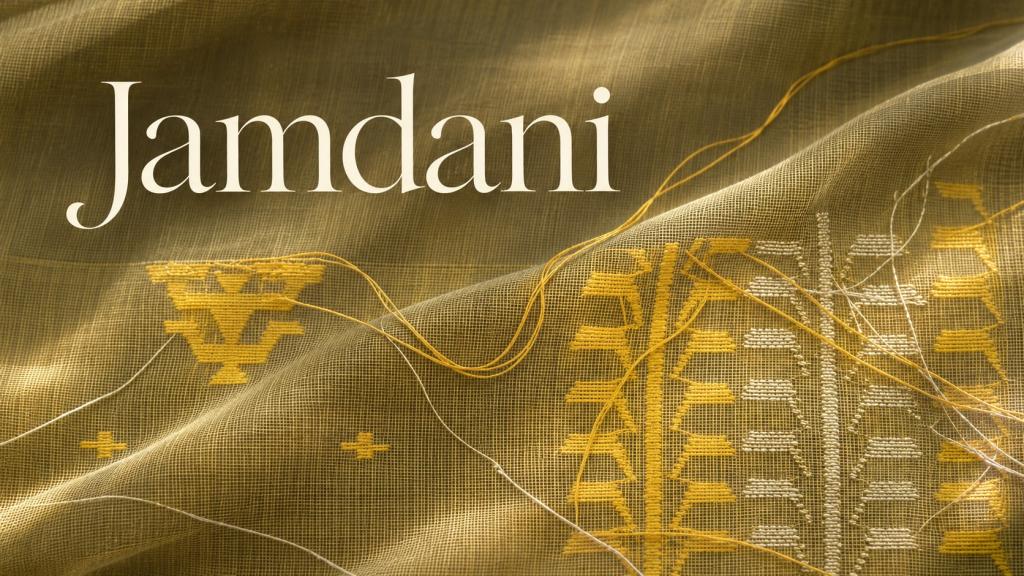
Hold a genuine Jamdani sari up to the light and the pattern seems to float. The motifs — tiny flowers, paisleys, sprigs of jasmine — are not printed on the cloth, not embroidered onto it afterwards, and not woven by any programmed machine. Each one was placed there by hand, thread by thread, as the fabric itself was being woven, by two people sitting side by side at a bamboo loom in a village east of Dhaka. Jamdani is the most celebrated handloom craft of Bangladesh: the figured descendant of the legendary Dhaka muslins, a UNESCO-listed heritage, and the first product the country ever registered as a Geographical Indication. It is also, by the weavers' own account, an industry in which a month of skilled work can earn less than the yarn in a single machine-made imitation costs its seller nothing to undercut. Both of those things are true at once, and the tension between them is the story of Jamdani today.
What Jamdani is: a motif woven, not printed
Jamdani is a fine, sheer cotton fabric — woven also in half-silk and full silk — patterned all over with motifs created during weaving by the discontinuous supplementary-weft technique. The ground cloth is woven plainly with a fine warp and weft. Then, for every motif, the weaver takes a separate, slightly thicker thread of cotton, silk or zari and interlaces it by hand through exactly the warp threads the design requires, using a pointed bamboo or horn tool called a kandul. The motif thread appears only where the motif is; it does not run the width of the cloth. Row by row, motif by motif, the pattern grows with the fabric, which is why a real Jamdani looks almost the same from the back as from the front, and why no two pieces are perfectly identical.
The loom is a pit loom of bamboo and wood, called a tant, worked by two weavers sitting side by side — usually a master weaver and an assistant, often his son or apprentice. Before weaving, the yarn is washed and sized with rice starch, traditionally a gruel of kalma rice, to give the fine threads enough strength to survive the loom. Modern Jamdani is woven in yarns of roughly 40 to 120 count — fine, though far short of the 300-count and above yarns of the lost muslins. A simple sari may take a week on the loom; a dense, high-quality piece takes months, and the finest work up to a year.
The design vocabulary is old and codified, though it is carried in memory rather than in pattern books. Scattered small floral sprays across the field make a butidar; diagonal arrangements are tercha; a continuous network covering the whole sari is jhalar. Within those layouts sit hundreds of named motifs: panna hajar, "a thousand emeralds"; kalka, the paisley; bagher paa, the tiger's paw; chameli, jasmine; ashrafi, the gold coin; kainchi, scissors; duria, polka dots. The name Jamdani itself is commonly derived from the Persian jam, a flower, and dani, a vase — a vase of flowers, which is a fair description of what the weavers produce. Saris remain the principal product, but the same looms now turn out three-piece outfits, panjabis, scarves, curtains and wall hangings.
From muslin to Jamdani: the history
Jamdani is the surviving branch of a much older tree. Bengal's fine cottons were famous in the ancient world: Kautilya's Arthashastra, compiled around the third century BCE, is thought to describe the fine fabrics of the region, and the first-century CE Periplus of the Erythraean Sea praised the muslins of the Ganges delta. These texts do not name Jamdani — figured weaving under that name belongs to a later age — but they establish the craft tradition, the delta-grown cotton and the spinners' skill from which it grew.
The golden age came under the Mughals. From the sixteenth to the eighteenth century, imperial workshops around Dhaka produced muslins of a fineness never matched before or since, spun from the local phuti karpas cotton at counts of 300 and far beyond. The finest court cloth, mulmul khas, was given names that were themselves a kind of advertising: baft hawa, "woven air"; ab-i-rawan, "flowing water"; shabnam, "evening dew". Figured muslin — muslin with its pattern woven in — was the most prized variety of all, and it is this figured branch that carried the name Jamdani.
The collapse, when it came, was swift. Dhaka's muslin trade peaked in the late eighteenth century — the period figures conflict, with James Wise putting exports to England in 1787 at five million rupees and James Taylor at three million — and then fell away: by common account exports had shrunk to about 850,000 rupees by 1807 and stopped altogether by 1817. The causes were several and reinforcing: the East India Company's agents used their power to force weavers' prices down, the Mughal court that had been the craft's greatest patron disappeared, and cheap machine-made cloth from Britain's mills undercut handloom production across India. Plain muslin, dependent on court demand and on the phuti karpas cotton that faded from cultivation, died out entirely in the nineteenth century. Jamdani survived — at lower yarn counts, for local and regional wear — because its weavers retreated to the villages along the Shitalakshya river east of Dhaka, in Rupganj, Sonargaon, Siddhirganj and Demra, and kept weaving for the market that remained.
The weaving villages and the Jamdani Palli
That river belt is still the heart of the industry. The humid air off the Shitalakshya was traditionally prized by weavers — fine cotton yarn breaks less in moist air — and the villages of Rupganj and Sonargaon in Narayanganj district remain synonymous with the craft. Weaving is a family enterprise: the loom stands in a home workshop, the master and his assistant weave, and women and other family members wind bobbins, prepare yarn and finish the cloth. Skill passes from parent to child at the loom, which UNESCO would later single out as the craft's main line of transmission.
The industry's one piece of purpose-built infrastructure stands at Noapara in Tarabo, Rupganj, a few kilometres north of the Kanchpur bridge. There, in the early 1990s, the Bangladesh Small and Cottage Industries Corporation (BSCIC) established the Jamdani Industrial Estate and Research Centre — universally known as the Jamdani Palli, the Jamdani Village — on 20 acres of riverbank land, at a reported cost of about Tk 6 crore. Of its 416 plots, 407 were allotted to weaver-entrepreneurs who live and work on site. Estate officials have put the Palli's strength at about 1,665 looms employing some 3,500 people; about 1,600 weavers were counted as resident there in 2023. Every Friday a wholesale haat at the Palli draws traders from Dhaka and beyond, and in the Eid season — the industry's peak — BSCIC officials have projected sales across the estate of Tk 150–160 crore.
Yet the Palli also illustrates the industry's neglect. Reporting by The Daily Star in 2021 found the estate had seen no development work for a decade, and that its weaver numbers had fallen below 2,000, against more than 2,500 counted in a BSCIC survey in 2002. Estate entrepreneurs earned an estimated Tk 30–32 crore in 2020 from some 60,000 pieces — respectable, but well down on the Tk 45–50 crore a year the estate had earned two decades earlier.
UNESCO and GI: recognition on paper
Official recognition, when it arrived, came in two forms. In 2013, at its session in Baku, UNESCO inscribed the "Traditional art of Jamdani weaving" on the Representative List of the Intangible Cultural Heritage of Humanity, as an element of Bangladesh. UNESCO's citation describes a "vividly patterned, sheer cotton fabric" whose motifs are "created directly on the loom using the discontinuous weft technique", and notes that the Jamdani sari has become "a symbol of identity, dignity and self-recognition" for Bengali women. Three years later, in November 2016, Jamdani became the first product ever registered as a Geographical Indication (GI) of Bangladesh, under the country's GI Act of 2013, on the application of BSCIC; the registration certificate was handed over on 17 November 2016. Jamdani thus opened a register that has since filled steadily — the hilsa followed, and by 2026 Bangladesh had more than sixty GI products — but Jamdani remains entry number one.
Two qualifications belong with the celebration. First, the GI system needed defending from the start: India had registered an "Uppada Jamdani" from Andhra Pradesh under its own GI law in 2009, a different product from a different weaving region, but one whose name continues to blur Bangladeshi Jamdani's identity in outside reporting — a confusion Bangladeshi commentators still protest. Second, a GI certificate is a legal instrument, not a market outcome. It gives registered users rights against infringement, but it does not by itself police the bazaars, stop power looms anywhere from copying a motif, or put one extra taka in a weaver's hand. Bangladeshi legal commentary a decade after registration makes exactly this point: recognition has outrun enforcement.
The weavers' livelihoods
How many Jamdani weavers there are depends on who is counting, and when. In 2013 the industry was estimated to employ about 15,000 weavers from some 3,000 families, producing roughly 2,000 saris a week in the Dhaka region. A decade later the picture given by the craft's own masters is narrower: demonstrating at a Jamdani exhibition in New Delhi in September 2025, master weavers spoke of about 1,500 weaver families in twenty villages keeping the craft alive. The two figures measure different things — a broad industry including part-time and ancillary workers, against full-time weaving households in the historic belt — but the direction of travel is not in doubt.
The economics explain why. Reported average earnings for Jamdani artisans run to roughly Tk 10,000–12,000 a month for working days of ten to twelve hours. The squeeze is visible in a single comparison recorded by UNB at the Jamdani Palli: the yarn alone for one handloom sari costs about Tk 2,000, so a genuine Jamdani cannot be sold below about Tk 5,000 — while machine-made saris imported from India, sold as Jamdani, retail at Tk 2,000 apiece. Piece rates cut the weaver's share further down the chain: reporting from a newer weaving village in Netrokona in 2026 found an artisan receiving about half the Tk 80,000 market price of a fine saree he had woven, with the rest absorbed by owners and middlemen; selling directly, the weavers estimated, could add Tk 10,000 a saree to their side of the ledger. There are better arrangements — a skilled weaver employed in a small entrepreneur-run workshop in Faridpur was reported in 2025 to earn Tk 22,000–25,000 a month — but they are the exception, and they sit alongside the trade's physical costs: the back pain and failing eyesight that fine-yarn work inflicts, and which push experienced weavers out of the craft altogether.
The market, the fakes and the fightback
Set against Bangladesh's industrial giants, Jamdani is a minnow: its recorded sari exports — $10.41 million in the best-documented year, FY2010-11, with India the largest buyer — are a rounding error beside the ready-made garment industry, and much of its trade has always moved informally, in travellers' luggage and unrecorded border commerce, escaping the statistics entirely. The domestic market is the industry's real foundation: Eid and Puja seasons, weddings, and a loyal urban clientele reached through the Friday haat at the Palli, Dhaka boutiques, craft retailers and, increasingly, online sellers.
That market is contested by imitation. Weaver complaints, recorded as far back as 2016 and repeated at the Palli today, describe saris imported from India or woven on power looms elsewhere in Bangladesh being sold as Dhakai Jamdani; one Palli producer told UNB his monthly sales of a hundred saris had halved because of Indian machine-made competition. Printed cloth carrying Jamdani-style motifs is cheaper still. Against the fakes, genuine producers carry rising costs: fine cotton and silk yarn, and real metal zari where it is used, are expensive and price-volatile — handloom traders in Tangail reported yarn prices jumping by around 30 per cent within days in October 2026 — and the Shitalakshya itself, whose air and water the craft grew up with, now carries industrial pollution down the weaving belt.
The fightback runs on several tracks. The state's muslin revival project, run by the Bangladesh Handloom Board from 2018, has been the most ambitious: researchers rediscovered the lost phuti karpas cotton, retrained spinners to yarn counts above 300, won GI status for Dhakai Muslin in December 2020, and in 2022 opened a Dhaka Muslin House at Tarabo in Rupganj — the same neighbourhood as the Jamdani Palli — where a small team of artisans, 116 of them by late 2026, keeps the sister craft alive. Jamdani itself has gained new showcases, from the long-running Jamdani fairs to the September 2025 exhibition at the National Crafts Museum in New Delhi, where Bangladeshi master weavers demonstrated at the loom before international buyers. And the craft is quietly spreading: new weaving pockets reported in 2025–26 at Bataniapara in Netrokona, in Faridpur and in Chandpur suggest the loom's geography is widening beyond the old river belt for the first time in generations.
Jamdani today
Jamdani enters the late 2020s holding both of its identities at full strength. As heritage, it has never been more secure: UNESCO-listed, GI-registered, exhibited abroad, and joined since 2020 by a revived Dhaka muslin that restores the other half of its family story. As a livelihood, it has rarely been more exposed: squeezed between machine-made imitations above and rising yarn costs below, dependent on middlemen, and losing weavers to any trade that pays steadier money. The instruments that would close the gap between the two identities are known and mostly administrative — enforcing the GI where fakes are sold, cheapening weavers' access to yarn and credit, and shortening the road between the loom and the buyer so that more of a sari's final price stays in the village that wove it. Until then, the pattern will keep floating above the cloth exactly as it has for three centuries: beautiful, unmistakable, and made by hands the market still underpays.