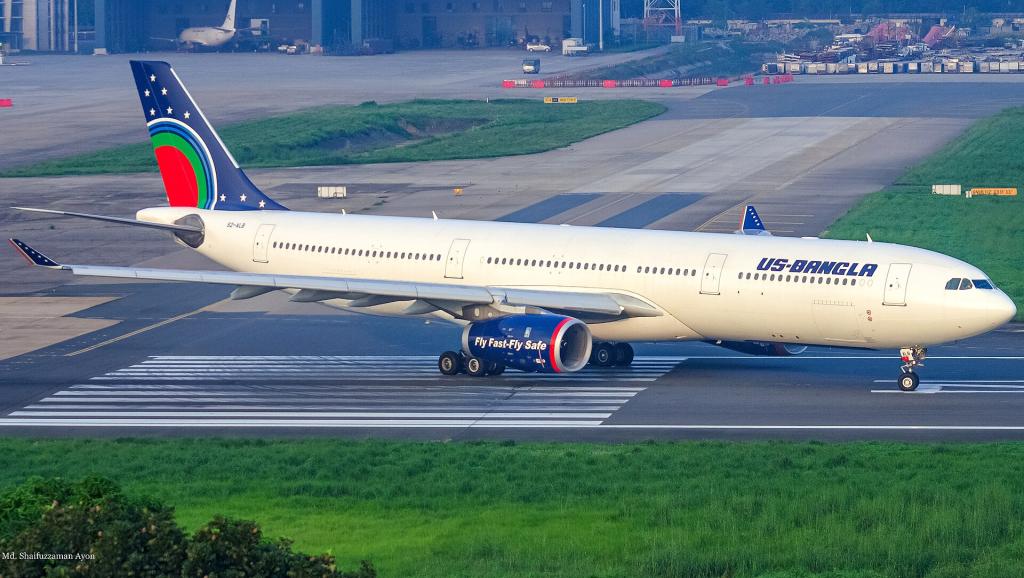
US-Bangla Airlines is the largest private airline in Bangladesh by the measure its own industry uses most often: the size of its fleet. Founded in 2010 and flying since 17 July 2014, the Dhaka based carrier has grown in just over a decade from two second hand turboprops on domestic routes into an operator of Boeing 737 jets and Airbus A330 widebodies, serving cities across Bangladesh, South and Southeast Asia, China and the Gulf. It is the flagship company of the US-Bangla Group, a privately held Bangladeshi conglomerate, and it is led by its managing director and chief executive, Mohammed Abdullah Al Mamun. Its story also includes the crash of flight BS211 at Kathmandu in March 2018 and a cost environment its own management describes as punishing. Figures are attributed throughout, because the airline is private and does not publish audited accounts.
Foundation and the US-Bangla Group
US-Bangla Airlines was registered in 2010 as a sister concern of the US-Bangla Group. Early company descriptions, including the announcement of its first aircraft in February 2014, described the group as a United States and Bangladesh joint venture company. More recent profiles describe it simply as a privately owned Bangladeshi group, and no public source sets out detailed shareholding or ownership percentages, so this article does not assign any. What is consistent across sources is the leadership: Mohammed Abdullah Al Mamun has been the public face of the airline from before its first flight, quoted as managing director in 2014 and still serving as managing director and chief executive in 2026.
The group behind the airline began in property. It traded as US-Bangla Assets before adopting the US-Bangla name in 2009, and its best known development is Purbachal American City, a large housing project east of Dhaka. From that base it expanded into education, where it owns Green University of Bangladesh and the US-Bangla Medical College and Hospital, into media, where its holdings include the online newspaper Dhaka Post, and into consumer businesses including the Foodi food delivery service and the Cartup e-commerce platform. It also has leather, footwear, courier and technology ventures. The airline, headquartered in the Baridhara Diplomatic Zone of Dhaka and based at Hazrat Shahjalal International Airport, is described by the group itself as its flagship company. That structure matters: US-Bangla presents itself not as a standalone carrier but as part of a diversified private group, and there are no listed company filings against which to check its claims.
First Flights and the Domestic Build Out
US-Bangla commenced operations on 17 July 2014. The airline had acquired two previously owned Bombardier Dash 8 Q400 turboprops, and its first services linked Dhaka with Jessore and Chittagong. Anniversary accounts published by BSS and by Bangladeshi newspapers in July 2026 describe the maiden service as the Dhaka to Jessore flight. Flights to Cox's Bazar followed in August 2014 and to Saidpur in October 2014, giving the new carrier a basic national network within its first months.
Within eight months the airline was telling The Bangladesh Monitor that it had taken close to 60 percent of the domestic market. That is the airline's own claim from the time, but US-Bangla quickly became the carrier to beat on domestic routes. For the wider market, see Airlines of Bangladesh.
The fleet grew in steps. In July 2016 the airline announced its first three Boeing 737-800 jets for that September. In February 2019 it announced an order for four ATR 72-600 turboprops, the first delivered from Toulouse to Dhaka on 22 March 2019. By September 2019, reporting in Prothom Alo and The Independent recorded US-Bangla as the second largest airline in Bangladesh by fleet size, behind only the flag carrier Biman Bangladesh Airlines. The Dash 8 Q400s that launched the airline were retired by 2023, leaving the ATR 72-600 as its domestic turboprop.
Going International
US-Bangla began international flying on 15 May 2016 with the Dhaka to Kathmandu route. Expansion after that was deliberate and, in two cases, genuinely first. On 31 March 2019 it started Dhaka to Chennai services, becoming, by its account and contemporary reporting in The Daily Star, the first Bangladeshi carrier to fly to southern India. On 29 April 2019 it started flights to Guangzhou, becoming the first Bangladeshi airline to operate to China. Those two routes explain the strategy: follow Bangladeshi workers, patients, students and traders to the cities they already travel to, and arrive before Biman does.
The COVID-19 pandemic interrupted plans announced in early 2020, and the network that emerged afterwards leaned harder into the Gulf, the labour market that sustains Bangladeshi aviation. US-Bangla added or expanded services to Jeddah, Riyadh, Dubai, Sharjah, Abu Dhabi, Doha and Muscat alongside its Asian routes. Riyadh was added in the second quarter of 2025, according to route reporting. The airline also runs a frequent flyer programme called Sky Star.
Fleet: From Turboprops to Widebodies
On 9 February 2024 US-Bangla received its first widebody aircraft, an Airbus A330-300 leased from the Maltese division of Hi Fly, configured with 436 seats in an all economy layout. The Business Standard reported the same day that, with a Boeing 737-800 arriving alongside it, the fleet had reached 23 aircraft: one A330-300, nine Boeing 737-800s, ten ATR 72-600s and three Dash 8 Q400s, making US-Bangla the largest airline in Bangladesh by fleet size at that moment, ahead of Biman's 21. The widebodies were intended for high density routes to the Gulf and Malaysia and for Hajj flying. A third A330-300 followed by 2025, and fleet listings record the three A330s as leased until 2029.
Current fleet totals need care, because the sources do not agree. The airline's own statements in July 2026, repeated in November 2026, put the fleet at 25 aircraft, including three Airbus A330-300s and nine Boeing 737-800s. By contrast, the fleet table drawn from the Global Airline Guide 2025, as carried in reference listings in August 2025, counts 16 aircraft in service: three A330-300s, nine ATR 72-600s and four Boeing 737-800s. The gap most likely reflects different counting rules for aircraft in induction, maintenance or lease transition, but neither side publishes a tail by tail reconciliation, so both figures are given here with their dates rather than merged. What is not disputed is the shape of the fleet in November 2026: A330-300 widebodies, Boeing 737-800s on regional routes and ATR 72-600s on domestic sectors.
On 29 July 2026, at an event in Dhaka called Beyond with Boeing, the airline unveiled what The Business Standard described as a 1.5 billion US dollar leasing plan to add 21 Boeing aircraft by the end of 2027: fifteen Boeing 737 MAX 8s and six further 737-800s. If delivered in full, that would take the reported fleet from 25 toward 46. In November 2026 it added a ground side commitment, announcing around 22 million US dollars to modernise ground service equipment, including 80 electric vehicles at Dhaka airport, The Business Standard and the Financial Express reported. It also spoke of developing Chittagong and Sylhet as regional hubs.
Network in November 2026
The airline's July and November 2026 statements describe services to 20 destinations in total, with 14 international destinations across 10 countries. Its anniversary release lists domestic flights from Dhaka to Chittagong, Cox's Bazar, Sylhet, Saidpur and Rajshahi; reference listings as of July 2026 also show Jessore and mark Barisal as terminated. The international list given by the airline is Kolkata, Chennai, Male, Guangzhou, Bangkok, Kuala Lumpur, Singapore, Muscat, Doha, Dubai, Sharjah, Abu Dhabi, Jeddah and Riyadh. Kathmandu is the uncertain entry: reference listings mark it to resume from September 2026, while the airline's own forward plans have also listed it among routes to be added by 2027, so its status should be checked against the live schedule.
The forward network is ambitious on paper. The airline says it plans further Middle East and Asian points by 2027, including Dammam, Medina, Bahrain, Kuwait, Colombo and Hong Kong, European services to London and Rome by 2028, and New York, Toronto and Sydney by 2030. These are company plans, stated repeatedly since at least 2021 in changing forms, and earlier versions, including European routes promised for 2024, did not open on schedule. They are recorded here as intentions, not routes. The traffic that pays for the present network is more durable: migrant workers travelling to and from the Gulf, medical and education travel to India, and leisure travel within Asia, the same flows that sustain the wider tourism industry in Bangladesh.
Market Position and the Wider Group
By fleet size on its own reported count, and by domestic presence, US-Bangla is Bangladesh's largest private carrier and the principal private challenger to Biman. Its awards record, as announced by the airline, includes Best Domestic Airline honours in 2015 and in each year from 2022 to 2025. Its management argues that the real contest is not with Biman but with foreign airlines. Speaking in July 2026, Mamun put the value of Bangladesh's international air travel market at an estimated 5.8 billion US dollars a year and said foreign carriers carry the majority of international passengers. That is an executive's framing, but the underlying point is widely shared in Bangladeshi policy debate: local carriers hold a minority share of the international traffic their own country generates.
Cargo, Training and the Aviation Group Ambition
In a 2026 interview with The Bangladesh Monitor, Mamun said Bangladesh's international air cargo market is worth around 1.4 billion US dollars a year, that local airlines carry only a small portion of it, and that foreign carriers dominate. His response is to establish a dedicated cargo airline to support exporters and help position Bangladesh as a regional cargo hub. At present the airline carries belly hold cargo on its passenger network rather than operating freighters, and the dedicated cargo carrier remains a plan, not a launched operation, in November 2026. The same applies to its other ambitions: 28 sponsored cadet pilots trained in the United States, by its managing director's account, with plans for 200 more pilots and 100 engineers, a training centre at Purbachal, a catering facility and maintenance capacity. All are announced intentions, not existing operations.
Flight BS211 and the Kathmandu Crash
On 12 March 2018, US-Bangla Airlines flight BS211, a Bombardier Dash 8 Q400 (type DHC-8-402, registration S2-AGU) flying from Dhaka to Kathmandu, crashed while landing at Tribhuvan International Airport. Of the 71 people on board, 67 passengers and four crew, 51 died and 20 survived with injuries. The dead included both pilots and both cabin crew. It remains the deadliest accident involving a Bangladeshi airline in the modern era, and no profile of this company is complete or honest without it.
The official investigation was conducted by Nepal's Aircraft Accident Investigation Commission, constituted on the day of the accident under the principles of ICAO Annex 13. Its final report, dated 27 January 2019, determined that the probable cause of the accident was disorientation and a complete loss of situational awareness on the part of a crewmember. The report found that the aircraft had become offset from the proper approach path, that manoeuvres were then flown at a very dangerous and unsafe low altitude to align with the runway, and that, in the report's words, the landing was completed in sheer desperation after sighting the runway at very close proximity and very low altitude. The aircraft touched down misaligned with runway 20, veered off, broke through the perimeter fence and caught fire.
The report also examined the captain's background. It recorded that he had been released from the Bangladesh Air Force in 1993 due to depression and had been permitted to fly civilian aircraft from 2002 after a detailed medical evaluation, and it found clear evidence, in the commission's assessment, that he was harbouring severe mental stress during the flight. Its recommendations included psychological evaluation for pilots before entering service, and thorough periodic assessment before the licence of any pilot previously grounded on medical grounds is renewed. It also criticised a lack of assertiveness by air traffic controllers at Kathmandu in monitoring the flight path and in not issuing clear instructions to carry out a standard missed approach. Bangladesh's representative to the commission publicly disagreed with the balance of the report, arguing that it blamed the pilot without properly addressing the role of Kathmandu air traffic control. That disagreement is part of the record; the commission's findings as published are as stated above.
Costs, Disruption and Other Challenges
The challenges US-Bangla talks about most are structural, and they are best reported as its management states them. In September 2026, at a policy conclave in Dhaka reported by The Daily Star, Mamun argued that high government taxes, expensive fuel and steep ground handling charges push up fares, and that congestion on Dhaka airport's single runway costs US-Bangla alone around 20 lakh taka a day in delays. He also said the airline had received a ground handling certificate in 2023 but had not been issued the licence to provide the service itself. Those are the airline's claims, made where it was lobbying for change; the Civil Aviation Authority told the same event that the airport handles around 20 to 22 flights an hour and that high speed taxiways could raise that figure.
Weather and geopolitics add episodic costs. The Daily Star reported in February 2025 that winter fog diversions had cost US-Bangla around 6 crore taka in a single season. After political change in Bangladesh in 2024, passenger traffic on India routes fell sharply, and Dhaka Tribune reporting recorded US-Bangla cutting weekly Kolkata flights from 21 to 6 and operating only five of eleven weekly Chennai flights, with its public relations general manager Kamrul Islam saying loads did not cover operating costs. In March 2026, during the Middle East conflict and airspace closures that followed the strikes on Iran, The Business Standard reported the airline losing an estimated 600 to 700 returning passengers a day and cancelling around 30 Middle East flights. None of these figures comes from published accounts, because there are none in the public domain; they are company statements reported by reputable Bangladeshi newspapers, presented here on that basis.
Outlook
US-Bangla enters 2027 with the largest expansion programme ever announced by a private Bangladeshi airline, a widebody fleet it did not have three years ago, and a stated ambition to become a full aviation group spanning passenger flying, cargo, training, maintenance and catering. It also carries the memory of BS211, a cost base its own management calls unsustainable, and a habit of promising long haul routes faster than it opens them. Both halves of that picture are the record. What the airline has demonstrably done, from two leased turboprops in 2014 to A330 operations and a 21 aircraft Boeing programme in 2026, is build scale in a market where most private Bangladeshi airlines before it failed. Whether the next decade turns that scale into a durable international carrier is the open question its own plans now pose.