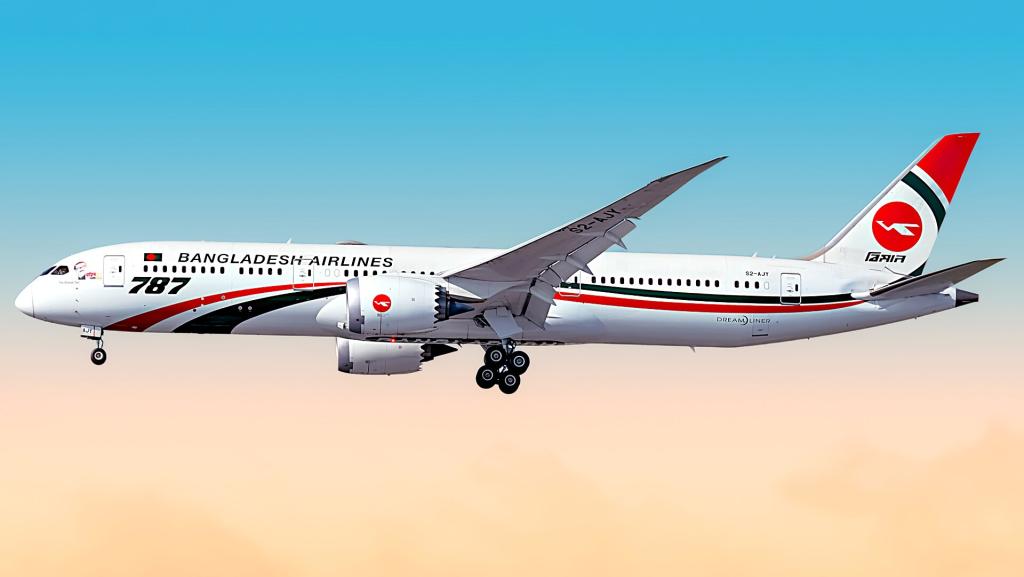
Biman Bangladesh Airlines, known to most travellers simply as Biman, is the national flag carrier of Bangladesh. Founded on 4 January 1972, only weeks after independence, it began with a single Douglas DC-3 and the staff of a dismantled airline, and it has carried the country's flag through more than five decades of expansion, debt, scandal and renewal. Its main hub is Hazrat Shahjalal International Airport in Dhaka, with secondary hubs at Shah Amanat International Airport in Chittagong and Osmani International Airport in Sylhet, and its headquarters, Balaka Bhaban, stands at Kurmitola in northern Dhaka. The airline flies the IATA code BG and the ICAO code BBC.
Biman is more than a passenger airline. It runs the Hajj operation that carries tens of thousands of Bangladeshi pilgrims to Saudi Arabia, it moves belly hold cargo on its passenger network, and, unusually for a flag carrier, it is also the ground handling agent for nearly every airline that lands in Bangladesh. That triple role explains both its importance to the national economy, including the tourism industry in Bangladesh, and many of the arguments that surround it.
Birth of a National Airline, 1972
Biman was established on 4 January 1972 under the Bangladesh Biman Ordinance, Presidential Order No. 126. The initiative came from about 2,500 former employees of Pakistan International Airlines, including Boeing 707 commanders and other pilots, who had submitted a proposal to the new government on 31 December 1971, days after the Liberation War ended. The airline was briefly called Air Bangladesh before taking its present name. In effect, Biman was built from the remnants of PIA's eastern operation: the aircraft had mostly gone west, but many of the people who knew how to run an airline in Dhaka had stayed, and they became the new carrier's founding staff.
Operations began on 4 February 1972 with domestic services linking Dhaka with Chittagong, Jessore and Sylhet, flown with a single Douglas DC-3 acquired from India. The start was fragile. The DC-3 crashed near Dhaka on a test flight on 10 February 1972, and two Fokker F27s supplied by the Indian government entered the fleet as replacements. International flying followed quickly: on 4 March 1972 Biman operated its first international service, a weekly flight to London using a Boeing 707 chartered from British Caledonian. In its first year the airline operated 1,079 flights and carried just over 380,000 passengers.
Building the Network in the 1970s
Four more Fokker F27s joined the fleet in 1973, allowing the Kolkata service to run twice daily, and a Boeing 707 was added that September, making the London flight twice weekly. The network widened year by year: Kathmandu, Bangkok and Dubai in 1974; Abu Dhabi, Karachi and Mumbai in 1976; Singapore in 1977; and Jeddah, Doha and Amsterdam in 1978. Kuala Lumpur, Athens, Muscat and Tripoli followed in 1979, and Yangon, Tokyo and Dhahran in 1980. The pattern set in that decade has never really changed: Biman's map is built around the Gulf, where Bangladeshi migrant workers travel in large numbers, South and Southeast Asia, and a small number of long haul routes to Europe.
In 1977 Biman was converted into a public sector corporation, governed by a board appointed by the government, and it broke even for the first time in 1977 to 1978, making a profit the year after. For its first 24 years the airline held a monopoly on scheduled aviation inside Bangladesh, until private carriers were licensed in 1996.
The DC-10 Era
The aircraft most associated with Biman's middle decades is the McDonnell Douglas DC-10. Three DC-10-30s joined the fleet in 1983, and the airline began phasing out its Boeing 707s; a fourth, factory new DC-10 arrived in 1989. The wide bodied trijet became the backbone of the long haul network, flying to destinations that at the airline's peak stretched from New York in the west to Tokyo in the east. The decade also brought the airline's worst accident: on 5 August 1984 a Fokker F27 arriving from Chittagong crashed near Dhaka, killing all 49 people on board. Two Airbus A310s joined in 1996, with further second hand examples following in 2000 and 2003, but it was the DC-10 that defined Biman for a generation of passengers.
Biman kept the type in passenger service longer than any other airline in the world. On 20 February 2014 its last DC-10, registered S2-ACR and named New Era, operated the final scheduled passenger DC-10 flight anywhere, from Dhaka to Birmingham via Kuwait. The aircraft then flew nine scenic flights for aviation enthusiasts from Birmingham between 22 and 24 February 2014 before returning to Dhaka, where it was offered for sale as scrap. The Airbus A310s were phased out in October 2016, closing the era of the airline's older wide bodies.
From Corporation to Public Limited Company
By the 2000s Biman's weaknesses were as well documented as its route map. A 1996 study cited in later reporting described the airline as poorly managed, overstaffed, undercapitalised and subject to excessive political interference. Losses mounted: in the 2005 to 2006 financial year Biman reported its largest annual loss to that point, over US$120 million, followed by a loss of about US$100 million the next year, while its domestic market share fell sharply as private Bangladeshi airlines grew.
The caretaker government of 2007 responded with a restructuring. A voluntary retirement scheme, financed with World Bank support, cut the workforce by roughly 1,860 people, and on 23 July 2007 Biman was converted into a public limited company, then the largest in Bangladesh. The change was one of legal form rather than ownership: the government remained, and remains, the sole shareholder, although an intention to sell up to 49 percent to private investors was stated at the time and has not been carried out. In 2008 the new company signed agreements with Boeing for ten new aircraft, four Boeing 777-300ERs, four Boeing 787-8s and two Boeing 737-800s, the order that would reshape the fleet over the following decade.
Fleet Renewal: The 777 and the Dreamliner
The first two Boeing 777-300ERs arrived in October and November 2011, with the third and fourth following in February and March 2014. The 419 seat aircraft, 35 in business class and 384 in economy, became the new long haul workhorses, taking over routes such as London from the retiring DC-10s. Two new Boeing 737-800s joined in November and December 2015, and four more second hand or leased examples followed, two of them arriving in May and June 2019.
The Boeing 787 Dreamliner completed the renewal. Four 787-8s were delivered between August 2018 and September 2019, carrying names drawn from Bengali poetry and nature, among them Akashbeena, Hangsabalaka, Gaangchil and Rajhangsa, and two larger 787-9s followed in December 2019. The Dreamliners brought Biman's first onboard WiFi, live television and internet connectivity, and their fuel efficiency suited the airline's long, thin routes to Europe and North America. Biman describes the result as one of the youngest fleets in South Asia, although the fleet is small and every aircraft out of service for maintenance is felt across the timetable.
The Fleet and Network Today
As of November 2026, Biman's fleet in service numbers 19 aircraft, according to Bangladeshi press reports through 2026, including The Daily Star in July 2026 and reporting of the October 2026 Airbus signing: four Boeing 777-300ERs, four Boeing 787-8s, two Boeing 787-9s, four Boeing 737-800s and five De Havilland Canada Dash 8-400 turboprops used on domestic routes. Readers should note that Biman's own website still lists 21 aircraft, including six Boeing 737s; the higher figure appears to be out of date, and the 19 aircraft count is the one used consistently in 2026 reporting. In the 2024 to 2025 financial year the airline carried 3.4 million passengers to 30 destinations, a figure also given by Biman itself.
The network is anchored on Dhaka, with Chittagong and Sylhet acting as secondary international gateways, Sylhet handling direct services to London and Manchester that serve the large Sylheti diaspora in Britain. International flying concentrates on the Gulf and Saudi Arabia (Dubai, Abu Dhabi, Doha, Kuwait, Muscat, Dammam, Riyadh, Jeddah and Medina), South and Southeast Asia (Kolkata, Delhi, Kathmandu, Bangkok, Kuala Lumpur, Singapore, Guangzhou and Karachi, where services resumed in January 2026 after a gap of about 13 years), and long haul points in Europe and North America: London Heathrow, Manchester, Rome and Toronto, the last flown with a technical stop in Istanbul. Domestically, Biman links Dhaka with Chittagong, Sylhet, Cox's Bazar, Barisal, Rajshahi, Saidpur and Jashore. The wider story of the country's carriers is told in Airlines of Bangladesh, and Biman's largest private competitor is profiled in US-Bangla Airlines. Biman is not a member of any global airline alliance, and in 2026 it carried about 20 percent of the country's air passengers, according to the Civil Aviation and Tourism Minister, with private and foreign airlines carrying the rest.
Hajj, Cargo and Ground Handling
No part of Biman's work is more visible at home than the Hajj operation. Under Bangladesh's agreement with Saudi Arabia, Biman carries about half of the country's pilgrims, sharing the work with Saudia and Flynas. The 2026 operation, inaugurated on 18 April 2026, gives a sense of the scale: Biman operated 98 pre-Hajj flights carrying 38,680 pilgrims to Saudi Arabia, and its return operation between 30 May and 1 July brought back 34,464 pilgrims. Across the season it also provided ground handling and passenger services at Dhaka for Saudia and Flynas, handling services for 76,197 passengers in total during the Hajj period, according to the airline.
Cargo is the quieter half of the business. Biman carried 43,918 tonnes of cargo in the 2024 to 2025 financial year, most of it in the holds of its passenger aircraft, and it runs the Cargo Village at Hazrat Shahjalal International Airport, through which much of Bangladesh's air freight passes. That cargo role has had setbacks: The Financial Express reported in April 2026 that Biman's cargo earnings on the London to Dhaka route had fallen from Tk 474 million in 2018 to 2019 to just Tk 28 million in 2024 to 2025, a decline the paper attributed to agent appointments and inefficiencies, citing a senior Biman official.
Ground handling is Biman's most contested business. The airline is the sole ground handler at Bangladesh's airports, serving its own flights and nearly 40 foreign carriers, work that earns it an estimated Tk 1,000 crore to Tk 1,500 crore a year. The service has drawn years of complaints about delayed and damaged baggage and the treatment of migrant workers, and an airport authority survey found that 93 percent of airlines wanted more than one handler at Dhaka's new third terminal. In June 2026 the Civil Aviation Authority of Bangladesh decided to appoint a second operator for passenger handling at the third terminal, while cargo handling would remain with Biman. A fire at the Cargo Village on 18 October 2025 sharpened the debate: the investigation committee that followed recommended, according to Bonik Barta, that Biman's activities be limited to flight operations, a recommendation the government has not adopted in full.
Money: Record Profits and Old Debts
Biman's recent financial reporting contains two stories at once. In August 2025 the airline announced an unaudited profit of Tk 937 crore for the 2024 to 2025 financial year, on revenue of Tk 11,631 crore, describing it as the highest profit in its history. When the audited statements were presented at the annual general meeting on 30 December 2025, the figures were lower but still strong: a net profit of Tk 785 crore, an operating profit of Tk 1,602 crore and revenue of Tk 11,559 crore, a net profit rise of 178 percent on the previous year, when profit had been Tk 282 crore. By Biman's account it has now been profitable for five consecutive years, and in nine of the past ten.
Critics answer that a profitable year is not the same as a settled balance sheet. The Financial Express reported in September 2025 that Biman owed more than Tk 81 billion to state bodies, including about Tk 63 billion to the Civil Aviation Authority, most of it accumulated surcharges, tax and VAT rather than principal, and about Tk 2,100 crore to Padma Oil for jet fuel. Biman's response is that under accrual accounting those liabilities sit on the balance sheet and do not erase a year's operating result. The same newspaper noted in February 2026 that Biman's total assets had declined for a third straight year, to Tk 168.72 billion at the end of 2024 to 2025, even as profits rose. Both things can be true, and readers judging the airline's health should hold the record profit and the disputed arrears side by side.
The Next Fleet: Boeing, Airbus and a 35 Aircraft Pipeline
In 2026 Biman committed itself to the largest fleet expansion in its history, split between both of the world's big manufacturers. On 30 April 2026 it signed a US$3.7 billion agreement with Boeing for 14 aircraft, eight 787-10 Dreamliners, two 787-9s and four 737-8s, with deliveries scheduled between November 2031 and October 2035. A supplementary agreement signed in New York in September 2026 added 11 more Boeing aircraft, five 787-10s and six 737-8s, taking the Boeing total to 25 aircraft worth about US$6.7 billion. Then, on 7 October 2026, Biman signed a firm order with Airbus for ten aircraft, four A350-900s and six A321neos, reported by The Financial Express at about US$2.0 billion, which will make Biman an Airbus operator again for the first time since the A310. The combined pipeline is 35 aircraft and roughly US$8.7 billion at reported values. Delivery dates for the Airbus jets were reported differently, with Biman seeking first deliveries well before the early 2030s dates in most reports, and Airbus has not published a schedule. The Airbus order closes a contest that began in 2023, when French President Emmanuel Macron announced in Dhaka that Bangladesh had committed to ten Airbus aircraft, a plan the governments that followed rebalanced towards Boeing before settling on a mixed fleet.
Because the first new jets do not arrive until 2031, Biman is also looking at the lease market: in July 2026 The Daily Star reported that the airline had invited bids to dry lease three additional Boeing 787-9s for six years, for delivery by the start of 2027. Commentators have noted that Biman has not yet published a consolidated plan showing which aircraft will serve which routes, which of today's fleet will retire, and how the purchases will be financed, and in October 2026 the airline tendered for consultants to assess exactly those questions. What is not in doubt is the direction of travel. An airline founded in 1972 with one borrowed DC-3 now plans a fleet that could approach 47 aircraft by the middle of the next decade. Whether Biman's service, finances and ground handling improve at the same pace as its fleet grows is the question on which its next decade will be judged.