Reflecting on Eid: A Prayer for Peace and Strength for All
Wishing everyone a joyous and blessed Eid! As we celebrate this Eid in peace and happiness, let us not forget the millions of guests facing hardships and challenges in our country.


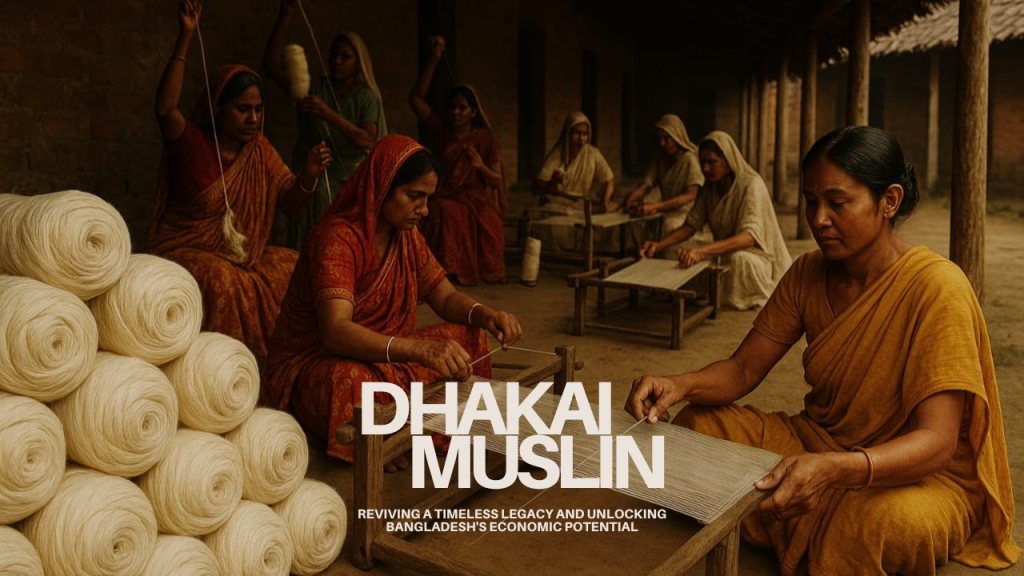
Dhakai muslin was once the finest cotton cloth on earth: spun from a riverside cotton, named like poetry, and worn by emperors. Then the looms, the skills and the plant itself vanished. This documentary feature traces its golden age, its colonial decline, and the scientific search that brought woven air back to Bangladesh.
In the summer of 1851, visitors to the Great Exhibition in London stopped in front of a glass case in the Indian department and stared at cloth they could barely see. The morning papers reported that one plain piece, ten yards long and a yard wide, weighed about three ounces and could be passed through a wedding ring. Allen's Indian Mail recorded that the Dacca muslins excited the special wonder of Queen Victoria and Prince Albert when they were first displayed. Within a few decades the industry behind those glass cases was dead, its weavers scattered, and the cotton plant that made the cloth possible had vanished from cultivation and, seemingly, from the wild. This is the story of how the most celebrated fabric of the preindustrial world was made, how it was lost, and how, after more than a century and a half, scientists and weavers in Bangladesh have brought it back to the loom.
Table of contents [Show]
Dhaka's muslins were famous long before London discovered them. James Taylor, the British surgeon whose 1851 account of the Dacca cotton manufacture remains the most detailed record of the trade, reckoned that the fabrics of the Dhaka region had been renowned for some sixteen centuries. Fine cottons from the Ganges delta were praised in the trade writing of the ancient world, and by the time the Mughals made Dhaka the capital of Bengal in 1610, the city and the older weaving centre of Sonargaon nearby stood at the heart of a global business.
The Mughal court was the muslin's first great patron. Abul Fazl, the chronicler of Akbar's reign, praised the fine cotton fabrics of Sonargaon in the Ain i Akbari, and the finest grade of all, mulmul khas, was woven for royalty alone. The grades of Dhaka muslin were given names that read like poems: abrawan, flowing water; shabnam, evening dew; baft hawa, woven air; nayan sukh, delight of the eye; samandar laher, wave of the sea. One traditional explanation of the name shabnam holds that the cloth was so fine that, spread on grass wet with morning dew, it vanished from sight. A much retold court anecdote claims that the emperor Aurangzeb once scolded his daughter Zeb un Nisa for appearing in a dress he thought indecently transparent, only to be told that she was wearing seven layers of muslin. The story cannot be verified, but its long survival says something true about how the fabric was perceived.
By the seventeenth and eighteenth centuries, Bengal was the world's leading muslin exporter and Dhaka was the capital of the trade. The East India Companies of England, France, the Netherlands and Denmark all bought through the weaving towns around the city: Sonargaon, Demra, Titabad, Jangalbari and Bajitpur. In the late 1700s, European fashion fell for the fabric completely. Muslin gowns became the dress of fashionable women in London and Paris, and Marie Antoinette was famously painted in a simple white muslin dress, a portrait that caused a scandal of its own. Company records cited by historians put the value of Dhaka's textile exports in the millions of rupees a year at the trade's height. Of the many varieties woven around Dhaka, one survives in strength today: Jamdani, the figured muslin whose weavers still work the looms of Rupganj and Demra.
True Dhakai muslin began with a plant. Phuti karpas, known to botany as Gossypium arboreum variety neglecta, was a local cotton that grew on the high, silty banks of the Meghna, the Brahmaputra and the Shitalakshya, in a narrow belt around Dhaka and Sonargaon. Its fibres were short, which should have made them hard to spin, but they were exceptionally fine and flattened into ribbons that clung to one another when damp. No other cotton has ever been spun so fine by hand.
Researchers who reconstructed the process count sixteen stages between the cotton field and the finished cloth. The seeds were picked out, the fibres cleaned with the jawbone of the boal, a river catfish whose fine teeth worked as a comb, and the cotton was bowed and rolled before spinning began. Spinning was women's work, done with a takli, a slender spindle, in the humid hours around dawn and dusk, because the thread of phuti karpas snaps in dry air. Weaving, too, followed the weather: the finest muslins were woven in the monsoon months, sometimes in the open air, so that the warp threads would not dry and break.
Taylor's figures convey what this meant in practice. A skilled spinner, working every morning for a month, produced less than six grams of the finest yarn. Two weavers at a pit loom needed between ten days and six months to finish a single length of cloth, depending on its fineness. Historians of the craft say that true muslin demanded yarn of at least 300 count, finer than anything the early mills of Manchester could produce: the textile writer Andrew Ure admitted in 1836 that Dhaka's hand spinners exceeded the finest yarn of England's most modern factories. Modern comparisons of surviving pieces describe warp densities many times higher than the 40 to 80 threads per inch of ordinary muslin, although the very highest figures quoted for Dhaka muslin are difficult to verify and should be read with care.
The decline, when it came, was driven from outside. After the East India Company took political control of Bengal in 1757, it bound Dhaka's weavers into a system of cash advances that forced them to sell to the Company alone, at prices the buyer set. Historians record that the advances routinely undervalued finished cloth by a wide margin, and that weavers who fell behind faced coercion from Company agents and brokers.
Then came the tariff wall and the machine. In the early nineteenth century, Indian cotton goods entering Britain faced import duties reported at 70 to 80 percent of their value, while British machine made cloth entered India almost duty free. Company purchases from Dhaka collapsed: by one reconstruction from Company records, they fell by more than 90 percent between the 1790s and 1813. In 1817 the Company wound up its Dhaka commercial residency altogether, and within two decades the export trade in Dhaka muslin had effectively ended. Dhaka itself emptied. Estimates of its population vary widely and are much argued over, but every account agrees that a great weaving city shrank to a fraction of its former size.
Popular memory in Bengal adds a grimmer charge: that the British cut off the thumbs of muslin weavers. The story is repeated to this day, including in Bangladeshi press coverage of the revival, but historians trace it to a single eighteenth century source, William Bolts, who wrote about silk winders rather than muslin weavers and described men mutilating themselves in protest against forced labour. No evidence has been found of a systematic campaign of mutilation. The documented record of tariffs, coercive buying and abandoned markets is damning enough without it.
As demand died, so did the plant. Phuti karpas had always been a low yielding, demanding crop, grown for one purpose. When the looms stopped, farmers stopped planting it, and within a few generations the cotton of Dhaka's riversides had disappeared from fields and markets alike.
Through the twentieth century, Dhaka muslin existed only in museums and in memory. The Victoria and Albert Museum in London holds hundreds of historic muslin sarees and pieces, among them a saree woven in 1710 that would later play an unexpected role in the fabric's return. In Bangladesh, muslin survived as a founding legend of Bengali craft, retold in textbooks and exhibitions. A private research initiative, Bengal Muslin, begun by Saiful Islam of the Drik picture library in 2014, spent years documenting surviving pieces and techniques and hunting for the lost cotton. But no living weaver knew the technique, no spinner could make the yarn, and the plant was gone. Any revival would have to begin with a seed that did not exist.
The state effort began in October 2014, when the government of the day directed the Ministry of Textiles and Jute to bring muslin back. The Bangladesh Handloom Board formed a committee of botanists, textile engineers and cotton specialists, and in January 2016 a joint research team drawn from Rajshahi University, the Cotton Development Board, the Bangladesh University of Textiles and the Handloom Board began the search in earnest. The research was led by Monzur Hossain, a professor of botany at Rajshahi University, and the project was directed by Md Ayub Ali, a planning officer of the Cotton Development Board. The first phase of the project was approved in June 2018 with a budget of Tk 12.1 crore, and the work formally began that November.
The team's first problem was botanical. Working from old descriptions and a morphological sketch of the plant, the researchers reasoned that a species usually takes centuries to vanish completely, and that muslin had been gone for less than two hundred years. They collected 39 candidate cotton varieties from Kapasia in Gazipur, from Baghabari, from Rajshahi and elsewhere, and then turned to the museum pieces. DNA taken from the yarn of centuries old muslin, including historic pieces preserved at the Victoria and Albert Museum, was sequenced and compared with the DNA of the candidates. One wild variety, found growing in Kapasia, matched. Phuti karpas had been found alive.
Finding the plant was only the beginning. The team had to reconstruct an entire technology: more than fifty specialised tools were remade, the sixteen stages relearned, and spinners and weavers retrained for a yarn far more fragile than anything they had handled. Oliullah Pradhan, a master weaver of Rupganj who had spent fifty years at the loom weaving jamdani, has described needing three to four months of retraining before he could weave muslin yarn without breaking it.
By the end of 2020, the team had done what many considered impossible. Following the design of the saree woven in 1710 and preserved in London, its weavers produced the first true Dhakai muslin sarees in more than a century and a half. Six were completed, and one was presented to the then prime minister, Sheikh Hasina. Across the first phase, artisans produced 58 pieces of muslin, including 27 sarees, kept for research and display rather than for sale. In December 2020, Dhakai Muslin was registered as a Geographical Indication product of Bangladesh, and in 2021 the project received the national Public Administration Award. A production centre, the Dhakai Muslin House, was built at Tarabo in Rupganj, on the banks of the Shitalakshya, in the same river country where the cotton once grew.
The economics remain formidable. The first recreated sarees cost about Tk 3.6 lakh each to produce, and heavily worked muslin jamdani sarees have been reported at Tk 7 lakh to Tk 8 lakh, the product of many months of labour by several weavers. More than 300 women from marginalised communities have been trained to spin the ultra fine thread, work that project reports describe as transformative for the households involved. A second phase of the project, worth Tk 18.5 crore and delayed by about eighteen months, is now under way. It aims to improve the cotton variety, which is still essentially a wild plant, to expand cultivation through contract farming in Kapasia, Rajshahi and Cumilla, and to transfer the technology to private producers. State news reports in October 2026 said that a first international order, for 500 yards of muslin fabric, had been completed, and that luxury buyers in the United States, France and Japan had expressed interest. Officials say the goal is to bring the price of a plain muslin saree down toward Tk 1 lakh to Tk 3 lakh as production grows.
For all the celebration, honest questions remain. The identification of phuti karpas rests on DNA comparisons reported by the project itself, and independent, peer reviewed confirmation in the international scientific literature has been limited. The fineness figures quoted for the new yarn vary between reports and mix different measures, yarn count, thread count and metres per gram, and even the project director has observed that the finest yarns of the British era, at around 500 count, set a standard the revival is still chasing. Above all, it is unproven whether a fabric that takes months to make can find a market large enough to sustain its makers, at prices that only the luxury trade can pay.
Yet something irreversible has already happened. A plant written off as extinct is growing again in Kapasia. Women who had never seen muslin yarn now spin it. On the Shitalakshya, in the humid dawn hours that the old spinners insisted upon, the thread holds. Bangladesh built its modern economy on a textile industry of vast mills and a ready made garment sector that clothes the world by the million. Dhakai muslin is the opposite proposition: a fabric whose value lies precisely in how little of it can be made, and in how much knowledge each metre contains. Two centuries ago the world called it woven air, and then let it vanish. This time, the looms are being watched.