Twice a year, Bangladesh changes its rhythm completely. Offices close, the capital empties, trains and launches fill beyond capacity, and tens of millions of people travel in one direction: home. The reason is Eid, the twin festival that stands at the centre of the country's religious and social life. In a nation where more than nine in ten people are Muslim, Eid al-Fitr and Eid al-Adha are not only holy days. They are the largest family reunion, the biggest shopping season, the busiest travel period and the most generous season of charity, all at once. This article explains how Bangladesh celebrates its two Eids: what each festival means, how the country prepares, where the great prayers are held, what is eaten and given, and why, for a few days each year, the whole nation seems to be on the road.
The Two Eids
Islam has two festivals called Eid, and Bangladesh celebrates both as national occasions. Eid al-Fitr, known locally as Ramadan Eid, falls on the first day of Shawwal, immediately after the fasting month of Ramadan. It rewards a month of fasting, prayer and charity with feasting and visiting. Eid al-Adha, called Qurbani Eid in Bangladesh, comes about seventy days later, on the tenth day of Dhul Hijjah, during the Hajj season. It commemorates the Prophet Ibrahim's willingness to sacrifice his son in obedience to God, and its centre is the qurbani, the ritual sacrifice of cattle, goats and sheep. The two festivals feel different. Eid al-Fitr is sweet, social and dressed in new clothes. Eid al-Adha is solemn, generous and organised around sacrifice and the sharing of meat. Together they divide the Bangladeshi year into two great seasons of homecoming.
Waiting for the Moon: Chand Raat
Neither Eid begins until the new moon is seen. On the twenty-ninth day of Ramadan, the National Moon Sighting Committee meets in Dhaka and the whole country waits for its announcement, broadcast live on television and radio. If the crescent of Shawwal is sighted, Eid is the next day, and the night erupts. This last night of Ramadan is called Chand Raat, the night of the moon. Markets and shopping malls stay open until the early hours, tailors deliver the last Eid outfits, women and girls decorate their hands with mehndi, and barbershops work through the night. If the moon is not sighted, Ramadan completes thirty days and the anticipation stretches one more day. The same waiting, in a quieter form, precedes Eid al-Adha. Few national moments are as universally shared as the announcement that the moon has been seen and Eid is tomorrow.
The Morning Prayer: Eidgahs and Great Congregations
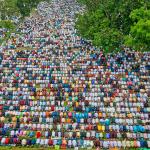
Eid begins with prayer. On the morning of Eid al-Fitr, after a month of fasting, men and boys in new or best clothes walk to open grounds called eidgahs and to mosques for the special Eid prayer, held a little after sunrise. The scene repeats in every city, town and village: rows of worshippers standing shoulder to shoulder on prayer mats spread over open ground, followed by the embrace, the kolakuli, as friends, neighbours and strangers greet each other with "Eid Mubarak". In Dhaka, the main congregation is held at the National Eidgah beside the High Court, attended by the President, judges, ministers and diplomats, while the Baitul Mukarram National Mosque holds a series of successive congregations through the morning. The most famous gathering of all is at Sholakia Eidgah in Kishoreganj, where a tradition said to date back to 1828 draws several hundred thousand worshippers to a single field in strong years, served by special trains. Congregations are also held in historic settings, in the courtyards of old mosques such as those of the Mosque City of Bagerhat, where Eid prayer has been offered for centuries. The Eid prayer has not always been secure in Bengal's history: in the nineteenth century, the reformer Haji Shariatullah's Faraizi movement controversially declared the congregational prayers of Friday and Eid suspended under foreign rule, a measure of how central this gathering was understood to be.
Food, Fitra and Eidi
No Bangladeshi Eid is complete without semai. The fine vermicelli, especially the crisp lachha semai cooked in milk, is the signature dish of Eid al-Fitr, served to every guest alongside firni, jorda, payesh, polao and biryani. Houses prepare far more than the family can eat, because Eid day is a round of visiting: relatives, neighbours, colleagues and friends move from home to home, and everyone must be fed. Before the Eid al-Fitr prayer, every able Muslim gives Zakat al-Fitr, or fitra, a fixed charity of food or its cash value, announced each year by the Islamic Foundation, so that the poor can also celebrate. Charity runs through the whole Ramadan and Eid season, from iftar shared with strangers to zakat given to village relatives. For children, the happiest custom is eidi, called selami in Bangladesh: after bowing to touch the feet of elders in salam, children and juniors receive cash gifts, traditionally in crisp new banknotes, which the Bangladesh Bank issues in extra supply before Eid. A child's Eid wealth is counted, compared and remembered for the rest of the year.
The Great Homecoming
The days before each Eid produce one of the largest regular movements of people anywhere in the world. Dhaka, a capital of more than twenty million people, visibly empties as garment workers, rickshaw pullers, office staff, students and traders return to their village homes. Bus terminals, railway stations and launch ghats overflow; trains carry passengers on their roofs in famous, if now discouraged, scenes; highways slow to a crawl. The government declares public holidays of three days around each Eid, often lengthened by adjoining weekends, and factories close so that workers can travel. For many families, Eid is the only time in the year when all siblings, scattered across cities and abroad, sit in the same courtyard. The return journey, a week later, reverses the flow. This homecoming is why Eid in Bangladesh cannot be understood from the prayer ground alone: it is a festival of return, in which the village, for a few days, is full again.
Eid al-Adha: The Festival of Sacrifice
Eid al-Adha is organised around the qurbani. In the weeks before it, cattle markets, called haats, open across the country, the largest at Gabtoli in Dhaka, and farmers who have raised a bull or goat through the year bring their animals to sell. Families inspect animals carefully, bargain hard, and lead their purchase home, where it is fed and cared for until Eid morning. After the Eid prayer, the sacrifice is performed, by professionals in cities and by family and community members in villages. The meat is divided into three parts by tradition: one for the family, one for relatives and neighbours, and one for the poor, and in cities much of the charitable share is collected door to door and through community organisations. The festival also drives an industry: the hides of millions of sacrificed animals supply a very large share of the raw material collected each year by Bangladesh's leather industry, making Eid al-Adha a turning point of the economic calendar as well as the religious one. In recent years, online cattle markets and digital haats have joined the physical ones, but the essence is unchanged: sacrifice, sharing, and a great deal of beef cooked in every style from rezala to kala bhuna.
Eid in the Culture: Songs, Screens and Shopping
Eid al-Fitr arrives in Bangladesh to one song. "O Mon Romzaner Oi Rozar Sheshe Elo Khushir Eid", written by the national poet Kazi Nazrul Islam in 1931, is sung in homes, schools and television studios as Ramadan ends, and for most Bangladeshis its opening lines are the sound of Eid itself. The festivals anchor the cultural calendar: television channels fill the Eid holidays with special dramas, the famous Eid natok, cinemas release their biggest films of the year, and newspapers and magazines publish expanded Eid issues, the Eid sonkhya, carrying fiction, fashion and essays. Eid is also the peak of the commercial year. Clothing retailers do their largest trade in the month before Eid al-Fitr, new collections are launched for the festival, and remittances sent by Bangladeshis working abroad surge in the Eid seasons, as families send money home for celebrations, new clothes and qurbani. In this way Eid joins the village courtyard to the global economy: a brother in Dubai or Riyadh is present at the family table through the money he sent and the video call on Eid morning.
A Prayer for Peace and Strength
This article began, in April 2025, as a short Eid message on this website: a prayer for peace and strength for all. That prayer belongs at the heart of any account of Eid in Bangladesh, because the festival is, at its root, about renewal. Eid al-Fitr celebrates the strength to complete a month of discipline and the peace of reconciliation, as old quarrels are set aside in the Eid embrace and forgiveness is asked and given. Eid al-Adha celebrates trust, sacrifice and the duty to share good fortune with those who have less. In a country that knows hardship, from floods to economic strain, the two Eids return each year as proof that endurance is rewarded and that nobody celebrates alone. For the more than a million Rohingya sheltering in the camps of Cox's Bazar, Eid is also a measure of exile, marked by prayer, charity and memory: see Eid in the Rohingya camps. Eid Mubarak, from Bangladesh to the world.
Photo: Azim Khan Ronnie / Wikimedia Commons (CC BY-SA 4.0)