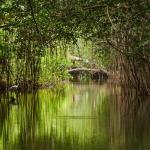
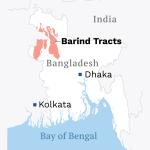
In the flat, green country south of Bagerhat town, where the old Bhairab River winds toward the Sundarbans, a whole city of brick mosques stands in the clearings of what was once deep forest. There is no palace and no fort. Instead there are domes — dozens of them, low and weathered, rising over prayer halls built five and a half centuries ago — together with great excavated tanks, embanked roads and the tomb of the man who built it all. In the fifteenth century this was Khalifatabad, a planned city founded on the edge of the mangrove wilderness by the Sultanate governor and saint Khan Jahan Ali. Today it is the Mosque City of Bagerhat, a UNESCO World Heritage Site since 1985, and home to the largest mosque of Sultanate Bengal: the great prayer hall the world knows, slightly inaccurately, as the Sixty Dome Mosque.
The city's afterlife is as remarkable as its founding. When its patron died in 1459, Khalifatabad faded, the forest closed over it, and its mosques slept under the vegetation for centuries — a disappearance complete enough that Forbes once listed Bagerhat among the world's fifteen lost cities. What survives, some fifty monuments scattered over roughly 50 square kilometres of the old city, is the most concentrated group of early Muslim buildings in Bangladesh, and the purest surviving expression of a regional building style found nowhere else.
Khan Jahan Ali and the founding of Khalifatabad
Almost everything solid that is known about Khan Jahan Ali comes from a single document: the inscription on his own tomb. From it, and from the inscriptions and coins of the period, historians reconstruct a Turkic military officer — Ulugh Khan Jahan, honoured with the title Khan-i-Azam — appointed by Sultan Nasiruddin Mahmud Shah I (reigned 1442–1459) of the Bengal Sultanate to govern the Sundarbans frontier in the south. UNESCO's official description calls him simply "the Turkish general Ulugh Khan Jahan". Whether he ruled as a loyal governor or as a near-independent frontier lord is still debated: his inscriptions style him the Sultan's subject, yet at Bagerhat he plainly acted like a founder-king, and the city even struck Sultanate coinage — Khalifatabad, the "city of the Caliph's deputy", was a mint town whose name is preserved on period coins.
In popular memory he is something else again: Pir Khan Jahan Ali, a Sufi saint who brought Islam and settled agriculture to the forest frontier. The two portraits — general and saint — have coexisted for centuries, and the honest summary is that the documentary record is thin and the devotional one immense. What is not in doubt is the building. From roughly the 1440s until his death in 1459, Khan Jahan raised a planned township in the delta: mosques and tombs in fired brick, embanked roads and bridges across a waterlogged landscape, and enormous excavated tanks — dighis — to store the fresh water that a city on the saline frontier could not live without. Tradition credits him with 360 mosques; the number is best read as a measure of his legendary industry, since rather more than fifty monuments have actually been identified on the ground. Two of the great tanks still anchor the site today: the Ghora Dighi beside the Sixty Dome Mosque, and the vast tank beside his tomb.
The buildings share a family likeness so strong that scholars give it a name of its own: the Khan Jahan style. It is Sultanate architecture re-engineered for the Bengal delta — massively thick, slightly tapering brick walls in a manner recalling Tughlaq Delhi, curved cornices, restrained terracotta ornament, and roof forms borrowed from the Bengali hut. UNESCO, in inscribing the city, called this style an example known from nowhere else in the history of architecture.
The Sixty Dome Mosque: a forest of pillars under 77 domes
The Sixty Dome Mosque — Shat Gambuj Masjid in Bengali — was built between about 1442 and 1459, late in Khan Jahan's career, and tradition and scholarship agree it was more than a place of prayer: it also served as the governor's court and assembly hall. It is the largest mosque of the Sultanate period in Bangladesh. The commonly quoted dimensions make it about 160 feet long by 108 feet wide (49 by 33 metres), though a measured survey used by Archnet gives a slightly smaller 148 feet 6 inches by 101 feet 4 inches; the discrepancy is a reminder that even the basic facts of this famous building come in competing versions.
Nothing about the exterior prepares a visitor for the interior. The walls, some six feet (1.8 metres) thick, taper gently as they rise, and at each corner stands a hollow round tower, more like the bastion of a fortress than part of a mosque — the towers are said to have doubled as platforms for the call to prayer. Eleven arched doorways pierce the eastern front, with seven more on the north and south sides for light and air. Inside, the hall is divided into seven aisles and eleven bays by rows of slender stone pillars — stone that does not exist in the delta and had to be brought from far away, at a cost local legend explains by having Khan Jahan float the blocks down from Chittagong on the water. (One modern press count distinguishes 55 stone pillars from 5 of brick; the accepted total is sixty.) The west wall carries eleven mihrabs, the central one of carved stone, and even with all its doorways the interior remains famously dim — a cool, shadowed forest of columns and arches.
Then there is the name. Shat Gambuj means "Sixty Domes", but count the roof and the arithmetic fails: the hall is covered by 77 low domes, arranged in seven rows of eleven — the seven domes of the middle row being not true domes at all but chauchala, the four-sided pitched vault of the Bengali hut — and four further domes crown the corner towers, making 81 in all. The "sixty" of the name, most scholars and guides conclude, almost certainly belongs not to the domes but to the sixty pillars that carry them: the building was in effect a sixty-pillared mosque, and somewhere in the retelling the number migrated from the columns to the roof. It remains a theory rather than a documented fact — the mosque itself offers no inscription to settle it — but it is the only explanation that makes the building's own numbers add up.
The wider city: mosques, tomb, tanks and roads
The Sixty Dome Mosque is the giant of Khalifatabad, not its entirety. A short walk away stands the Singair Mosque, a square, single-domed chamber across the road to the south-east — the Khan Jahan manner in miniature, its one great dome carried on massive walls under a cambered cornice. Near the tomb, west of the great tank, the Nine Dome Mosque gathers its nine domes into a single composition, a large central dome ringed by eight smaller ones. Further out lie the big single-domed mosques of Bibi Begni — whoever Bibi Begni was remains unknown, though tradition attaches her to Khan Jahan's household — and Chunakhola, and the Ronvijoypur Mosque, whose solitary dome, some 11 metres (36 feet) across, is described as the largest in Bangladesh. The six-domed Reza Khoda Mosque and the ruined complex of the Zinda Pir complete the roll of named survivors, and around them runs the city's working fabric: embanked roadways, bridges, cisterns and tanks, the infrastructure of a deliberate act of city-making in a swamp.
At the eastern end of the old city, on the northern bank of its great tank, stands the building from which the whole story hangs. The tomb of Khan Jahan Ali is a square, single-domed chamber of cut stone raised on an embankment of earth dug from the tank itself. Its walls carry Quranic verses in Arabic and Persian, and the inscription on the tombstone records the founder's death on 27 Dhu al-Hijjah 863 AH — 25 October 1459. Beside it, in an annexe of identical plan, lies his associate Pir Ali. The tomb has never ceased to be a living shrine: it is an active mazar, drawing pilgrims who come to pay homage to the saint, and its annual fair remains one of the great gatherings of the south-west.
The tank below the tomb — the Thakur Dighi, by some accounts some 200 acres of water — holds the city's most beloved tradition. Khan Jahan, the story goes, released a pair of freshwater crocodiles into the dighi, and their descendants were kept there for centuries, hand-fed by the shrine's attendants and treated as sacred creatures to whom devotees still make offerings of food. The original lineage eventually died out; in 2005 four crocodiles were brought from Madras in India to renew the tank's population, and recent reports describe a small number of the great reptiles still rising to be fed at the water's edge. Like much at Bagerhat, the crocodiles sit exactly on the boundary between documented history and living legend — and the shrine has never much cared to separate the two.
Decline and rediscovery
Khalifatabad was, in the end, a one-man city. When Khan Jahan Ali died in 1459 there was no successor of comparable authority, the Sultanate's attention moved elsewhere, and the frontier settlement withered. The Sundarbans did the rest: creepers, fig trees and jungle closed over the brickwork, roofs vanished into the canopy, and for roughly four centuries the mosque city survived mainly as mounds and memories in the forest clearings of a district that had moved on.
The monuments were cleared, measured and argued over under British-era archaeology in the late nineteenth and early twentieth centuries — the Sixty Dome Mosque was formally gazetted as a protected monument in 1913 — and after independence the Department of Archaeology of Bangladesh took them into care under the Antiquities Act of 1968. In 1982–83 UNESCO drew up a master plan for the area, an episode that still confuses the record: many otherwise reliable sources date Bagerhat's World Heritage inscription to 1983, but that was the plan, not the listing.
UNESCO status and conservation today
The Historic Mosque City of Bagerhat was inscribed on the World Heritage List in 1985, under criterion (iv) — as "an outstanding example of an architectural ensemble which illustrates a significant stage in human history". (Some websites cite criteria (i) and (iv); UNESCO's listing rests on criterion (iv) alone.) The citation singles out the Sixty Dome Mosque as one of the largest mosques of its age and the only one of its orthodox plan in Bengal, and Khan Jahan's tomb as an extraordinary work of architecture and calligraphy. Bagerhat had been inscribed in the same decade as Bangladesh's other early cultural listing, the Buddhist vihara at Somapura Mahavihara, Paharpur, and the two together frame the country's deep past — one Buddhist and ancient, one Muslim and medieval.
World Heritage status, however, has not frozen the city's oldest enemy: the delta itself. The same salinity that made Khan Jahan dig his great tanks now attacks his brickwork. Reporting through 2025 and 2026, drawing on a joint study by Khulna University, the National Geographic Society and ICOMOS, describes salt-laden groundwater rising into the Sixty Dome Mosque's walls and crystallising inside the bricks — whitening surfaces with efflorescence, peeling plaster, cracking domes and mihrabs, and corroding the iron clamps that pin its stonework. Experts quoted in that reporting warn that the central mihrab is at risk and that, without a comprehensive conservation strategy, a future "World Heritage in Danger" listing cannot be ruled out. Other pressures are more mundane: repairs carried out a decade ago with modern bricks that absorb more salt than the originals, the vibration of heavy traffic on the regional highway that runs past the mosque, and building creeping into the site's buffer zone.
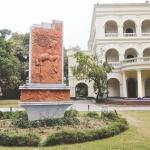
The response, as of 2026, is under way but incomplete. The Department of Archaeology has appointed a five-member expert committee and, with UNESCO's support, is preparing a complete damage map of the mosque as the basis for major conservation; the building has also been laser-scanned in 3D (by CyArk, in 2019) so that its decay can be measured against a fixed record. A small site museum beside the mosque displays objects from the city. What happens next at Bagerhat will decide whether Khan Jahan Ali's frontier capital enters its seventh century as a conserved masterpiece of the Bengal Sultanate — or as a warning about what a changing climate does to brick, salt and time.