In a country where a four-year degree can take six years to finish, Khulna University has built its reputation on a simple promise: students here graduate on time. Set on a green campus at Gollamari in Khulna, beside the Moyur River and within reach of the Sundarbans, it is the public university of Bangladesh's south-west — and, by its own long-standing description, the only public university in the country that has remained free of student politics and session delays since the day it opened. That reputation, more than any ranking, is what draws applicants: when the university held its own admission test for the 2025–26 session, its vice-chancellor put the number of applicants at a record 118,266.
Khulna University — KU for short — is younger than most of its peers. It began teaching in 1991 with just 80 students in four disciplines, and it has grown into a university of 29 disciplines under eight schools, with about 9,500 students by its own Student Handbook and more than 500 teachers. Its motto, "Learn, Lead and Live", and its mascot, a spotted deer from the Sundarbans, both point to its setting: a university shaped by the rivers, forests and coastal problems of the south-west, which has made the region's environment its defining research concern.
Founding and first years
The demand for a university in Khulna is older than Bangladesh's independence-era institutions suggest. The Kudrat-e-Khuda Commission's report of 1974 first recommended a public university for Khulna Division; a cabinet decision of 1979 envisaged a technical university, but local opinion demanded a general one, and after years of campaigning the government finalised the establishment programme on 4 January 1987. Committees settled the academic plan and the site, the foundation stone was laid on 9 March 1989, and Parliament gave the institution its legal existence in the Khulna University Act of 1990, gazetted on 31 July that year. The general university the campaigners had asked for — not the technical one first proposed — is what was built.
The founding vice-chancellor was Professor Golam Rahman of BUET, who had served as the project's director and took office as vice-chancellor in August 1991. The academic programme started on 31 August 1991 with 80 students and about 30 teachers in four disciplines: Computer Science and Engineering, Architecture, Business Administration, and Urban and Rural Planning — a deliberately modern mix, weighted towards the sciences and the professions rather than the traditional arts faculty. The formal inauguration followed on 25 November 1991, performed by the then prime minister, Begum Khaleda Zia, and 25 November is still observed as University Day. Banglapedia counts KU as the ninth public university established in Bangladesh.
Forestry and Wood Technology and Fisheries and Marine Resources Technology were added the next year, planting the university's flag in the two subjects its region demanded. The first convocation was held in 1997 — the sixth followed in December 2019 — and through the 1990s and 2000s new disciplines arrived steadily — the life sciences and environmental science first, then the social sciences, arts and humanities, law, education and fine arts — until the original four disciplines had become twenty-nine.
The campus at Gollamari
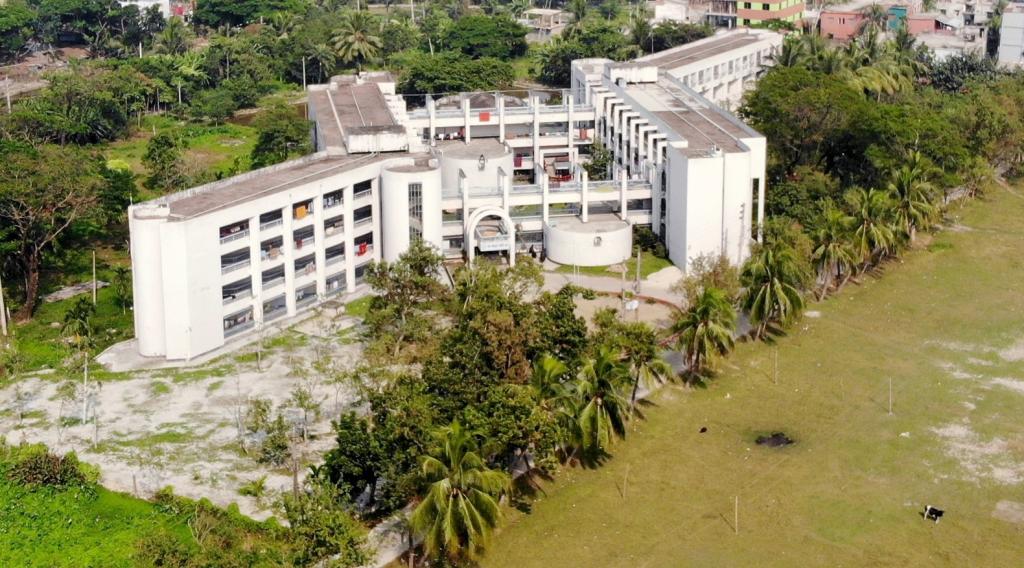
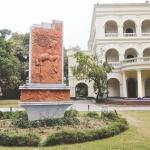
The main campus covers about 106 acres at Gollamari, on Sher-e-Bangla Road — the Khulna–Satkhira highway — beside the Moyur River, roughly four kilometres from the city centre. It is a planned, tree-planted campus of academic buildings, an administrative block, an open stage known as the Mukto Moncho, a central mosque and a central temple, and the Adamya Bangla sculpture that has become the symbol of its Fine Arts school. The Kazi Nazrul Islam Central Library holds more than 45,000 books and 5,000 journals alongside digital resources, and the campus has its own medical centre, cafeteria, bank and post office.
Residential life is organised through five halls: three for men — Khan Jahan Ali Hall, Khan Bahadur Ahsanullah Hall and Birshreshtha Mohammad Ruhul Amin Hall — and two for women, Aparajita Hall and Bijoy-24 Hall. Between them they offer only about 2,900 seats, and that shortfall is the campus's sorest point. Reporting by Prothom Alo in 2025 put the figures starkly: around 73 per cent of male students and 63 per cent of female students have no hall seat and live in private hostels and rented rooms outside the campus. Students have repeatedly demanded full residential accommodation — a 37-point charter of demands was presented after the political upheaval of 2024 — and proposals for three new ten-storey dormitories, adding some 3,000 seats, have been prepared for the ministry. For now, the university that promises an uninterrupted education cannot yet house most of the students it teaches.
Schools and study
Khulna University is organised not into faculties but into eight schools and 29 disciplines: Science, Engineering and Technology; Life Science; Management and Business Administration; Social Science; Arts and Humanities; Law; Education; and Fine Arts, alongside its institutes. The founding disciplines set the tone. Its Computer Science and Engineering discipline, opened in 1991, was the second of its kind in Bangladesh after BUET, and Architecture was among the country's earliest architecture programmes. Around them now sit subjects that map closely onto the south-west itself — Forestry and Wood Technology, Fisheries and Marine Resources Technology, Environmental Science, Agrotechnology, Soil, Water and Environment — balanced by economics, sociology, development studies, English, Bangla, history, law and the fine arts.
Teaching is in English, and the academic year runs on a term system rather than the semester pattern followed by most other universities — a distinction the university guards carefully, since its tightly kept calendar is the machinery behind its no-session-jam record. Degrees run from the bachelor's to the PhD. The range is wide: the Fine Arts school teaches drawing and painting, print-making and sculpture; the business school, which has trained Bangladesh naval officers since 1995, added a regular MBA in 2002 and an Executive MBA in 2005; and the Institute of Education and Research trains teachers. In May 2026 the university reported that it was in the final stage of preparations to secure national accreditation for ten of its disciplines.
Admission is competitive and, since recently, deliberately independent. Khulna University was one of the five public universities that stayed out of the GST cluster admission system for the 2025–26 session and held their own test instead — a decision its pro-vice-chancellor explained by the damage the cluster calendar did to KU's term system. Like Shahjalal University of Science and Technology (SUST) in Sylhet, which made the same choice, KU ran its test in four units covering its schools — 100 marks each, mixing multiple-choice and written questions — held the examinations simultaneously in Khulna, Dhaka, Rajshahi and Chittagong in December 2025, and began classes on 25 January 2026 — on schedule.
Research and the Sundarbans connection
No Bangladeshi university sits closer to the Sundarbans, and Khulna University has made the world's largest mangrove forest its natural laboratory. The Forestry and Wood Technology discipline has studied the forest since 1992, and the environmental science, fisheries and agrotechnology disciplines work across the coastal zone the forest protects — its salinity, its fisheries, its embattled farmland. In May 2026 the vice-chancellor was calling for broader studies of the top-dying disease that afflicts the Sundarbans' Sundari trees, a signature problem of the forest's health.
The connection was formalised in 2026 with the establishment of the Institute for Integrated Studies on the Sundarbans and Coastal Ecosystems (IISSCE), which the vice-chancellor told its first board of governors meeting he intends to develop into a global hub for Sundarbans research. The ambition reaches beyond the campus: leading a KU delegation to an international climate-and-development seminar at Utrecht University in the Netherlands in June 2026, he announced plans for an offshore campus at Paikgacha, beside the Sundarbans itself, to serve as a "living laboratory" where Bangladeshi and international researchers can study coastal ecosystems and climate impacts in the field. For a university whose city lives with cyclones, salinity intrusion and river erosion, this is research with the laboratory on the doorstep.
The Sundarbans work sits within a broader coastal and climate agenda. At that same Utrecht seminar — a meeting of the Cultures of Adaptation Network on the theme "Bangladesh: Climate and Development" — the vice-chancellor argued that climate change is no longer a prediction but a present reality for millions of Bangladeshis, arriving as floods, cyclones, river erosion, salinity intrusion and heatwaves. It is the defining condition of the region Khulna University serves, and increasingly the lens through which its environmental science, agrotechnology and planning research is organised.
Student life and the no-session-jam reputation
The fact every profile of Khulna University leads with is true by design: from its beginning, organised student politics has not been permitted on this campus, and the university describes itself — in words Banglapedia echoes — as free from session delay and student politics. The consequences are structural. Terms begin and end on their published dates; examinations are held when the calendar says they will be; and a student admitted in January can plan, with unusual confidence for Bangladesh, the year of their graduation.
The reputation is self-reinforcing. When admission activities for the 2025–26 session began in January 2026, guardians arriving from across the country told reporters that the politics-free environment and the session-jam-free calendar were precisely why they had chosen KU for their children. Student life is not without its frustrations — the hall shortage dominates them, and students interviewed by Prothom Alo in 2026 complained that facilities, classrooms and cultural life had changed little even after the upheaval of 2024 — but the core bargain of the place, a quiet campus and a degree finished on time, remains intact.
Khulna University today
As of November 2026 the vice-chancellor is Professor Dr Md Rezaul Karim, a professor of the Urban and Rural Planning discipline who joined Khulna University as an assistant professor in 1991 — one of its earliest teachers, now leading it. Appointed by the Ministry of Education on 17 October 2024 for a four-year term and in office since 20 October 2024, he works with Pro-Vice-Chancellor Professor Dr Md Harunur Rashid Khan and Treasurer Professor Dr Md Nurunnabi. An insider's administration has pushed accreditation, the new Sundarbans institute and the university's expansion case.
Internationally, the university sits in the 1401+ band of the QS World University Rankings 2026 and 454th in QS's Asia rankings, and in the 1201–1500 band of the Times Higher Education World University Rankings 2026 — modest positions, but those of a university only thirty-five years old. Its most pressing problem is physical: the 106-acre campus is full, the soil resists simply building upward, and the university has submitted a development proposal to the government seeking more than 200 additional acres for the halls and academic buildings its students need.
Thirty-five years after 80 students sat down to its first classes, Khulna University has become what its founders in the Khulna movement hoped for: the south-west's own university, anchored in its region's landscape and problems. Its distinction was never size or wealth. It is the discipline of the calendar — a campus where the academic year runs as printed, beside a forest the whole world needs understood — and on that twin foundation the university is now trying to build a research reputation to match its teaching one.