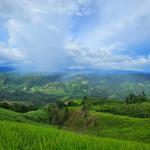
For half the year, the forest at Ratargul does not stand on land at all. In Gowainghat, in the north of Sylhet district, an evergreen forest of koroch and hijol trees spends the monsoon months standing in water that can run 20 to 30 feet deep, and the only way through it is by boat, drifting along flooded channels beneath a canopy that closes overhead like a green roof. Ratargul Swamp Forest is a freshwater swamp forest, a forest built not beside a flood but inside one. It was long described as the only swamp forest in Bangladesh and is still regarded as one of the very few freshwater swamp forests in the world; admiring visitors have nicknamed it the "Sundarbans of Sylhet" and the "Amazon of Bangladesh". The name itself is local: according to the Freshwater Biodiversity Portal of Bangladesh, "Ratargul" comes from the rata or pati plant, the murta that carpets the forest floor. What follows is the story of how this flooded forest works, its waters, its trees and animals, its seasons, the villages that live by it, and the pressures now closing in on it.
The Forest and Its Waters
Ratargul lies in Fatehpur Union of Gowainghat Upazila, about 26 kilometres from Sylhet city, in the wettest corner of Bangladesh, the Sylhet weather centre records average annual rainfall of around 4,162 millimetres. The forest stands on the south bank of the Gowain River (also spelled Goain), a hill river that comes down from the Meghalaya hills of India and eventually feeds the Surma. The river and the forest are joined by the Chengir Khal, a channel through which monsoon water pours into the trees; smaller channels, Kaier Khal and Shiali Chhora among them, thread the same low ground. When the rains come, the Gowain spills through these channels and the whole forest fills like a bowl.
The scale needs care, because Ratargul is measured in layers. The wider wetland under the Forest Department's Sylhet Range-2 covers 3,325.61 acres (about 1,346 hectares). Within it, the dense swamp forest at the core, the Ratargul of the photographs, is about 504 acres (204 hectares). It is a fragment of a much larger flooded world: the same monsoon that drowns Ratargul also fills the great bowl-shaped wetlands described in our account of the Haor Basin, and Ratargul's groves are among the finest surviving stands of the hijol–koroch swamp forest that once fringed haors and beels across the north-east. Bangladesh's other great water-forest, the Sundarbans, is a mangrove built on salt water and tides; Ratargul is its freshwater counterpart, ruled not by the sea but by the rains and the hill rivers.
Trees and Wildlife
A swamp forest is defined by a simple, brutal test: its trees must survive months with their trunks under water, in soil that holds almost no oxygen. Most tree species fail it. Ratargul's canopy is built from the minority that pass.
Trees that live in water
The dominant tree is the koroch, listed in current Forest Department and press usage as Dalbergia reniformis (older botanical literature places the koroch in Millettia pinnata). Koroch is exceptionally tolerant of waterlogging, and at Ratargul it forms dense, even stands whose crowns merge into a canopy up to about 15 metres high. Around it grow hijol (Barringtonia acutangula), whose flowers dangle over the water on long strings; barun (Crateva religiosa); pitali; kadam (Neolamarckia cadamba); banyan; and chhatim (Alstonia scholaris). An IUCN biodiversity survey in 2004 recorded 73 species of plants in the forest, with tree cover over some 80 per cent of its area. Beneath the canopy runs a second, lower layer of murta (Schumannianthus dichotomus), the pati plant whose stems are woven into the region's shital pati mats, along with cane (Calamus tenuis) and swamp grasses. The Forest Department has also planted water-loving species, including cane, kadam and hijol, to thicken degraded patches. These trees do not merely endure the flood; their roots and fallen leaves shelter the young fish on which the whole wetland food web depends.
Wildlife of the flooded forest
Published faunal surveys of Ratargul, cited in the Bangladesh Journal of Ecology, record 175 species of birds, 26 species of mammals, 20 species of reptiles and 9 species of amphibians. Monkeys move through the canopy; fishing cats and otters hunt the channels, according to the Forest Department; mongooses appear on the drier ground in winter, and water monitors swim between the trees. Snakes are everywhere in the flooded months, the forest is famous for them, and visitors are warned to watch the branches as much as the water. The birdlife changes with the seasons: herons, egrets, kingfishers, parrots, bulbuls, doves, eagles and kites are resident, while winter brings migratory waterfowl, including cotton pygmy geese. The water itself is a fish habitat of real weight, surveys have recorded as many as 94 species of fish in the flooded season, among them batasio, rita, pabda and rohu, because a flooded forest is a nursery: fry shelter among the roots where open water would leave them exposed.
The Seasons of the Swamp
Ratargul has two personalities, set by the water. The wet season runs from about May to early October. Rain on the Meghalaya hills sends the Gowain up within days; water backs through Chengir Khal and the forest floor disappears. At the height of the monsoon the water inside the forest can stand 20 to 30 feet deep, according to the Bangladesh Forest Research Institute, deep enough that boats float at the level of the lower canopy and the koroch crowns become islands of green. Even outside the rains, Prothom Alo notes, the channels and low ground hold water about 10 feet deep, so Ratargul never fully dries; it only shallows.
From November the level falls. The forest floor emerges in patches, mammals come down to the ground, and the wintering birds arrive, this is the birdwatcher's season, and the easiest time to see monkeys, mongooses and monitors. By the hot months of March and April the swamp is at its lowest and quietest, before the first pre-monsoon storms refill it. The classic Ratargul experience, a silent boat ride through a drowned green forest, belongs to the high-water months, roughly June to September. There is a hard edge to the cycle: in the flood emergency of May–June 2024, the district and upazila administrations closed Ratargul and Sylhet's other tourist spots until the waters fell, a reminder that the same flood that makes the forest can also shut it without notice.
Local Life and Boats
Ratargul is not an empty wilderness. People from about ten villages around the forest depend on it, a dependence that tourism has deepened rather than replaced. Reporting by BSS and Prothom Alo in August 2025 found about 200 boats a day working from the forest's three ghats, Ratargul Ghat, Motor Ghat and Chiringgi Ghat, carrying visitors through the trees. From Motor Ghat alone, boatmen said, some 45 boats operate. One Motor Ghat boatman, Raju Miah of Aulatuk village, told the reporters he earned about Tk 200 a trip and could make six to eight trips a day in the peak season against two in the off-season: "We depend on tourists. If they do not come, we will fall in trouble." Around the ghats, small shops live off the same traffic. Fishing continues alongside the tours, the flooded forest's fish are food and income for local families, and the murta understorey is cut for mat-weaving. The forest, in other words, is a workplace: its protection has to make sense to the people who row, fish and weave at its edge, or it will not hold.
Conservation: A Forest Under Pressure
Ratargul's protection is layered, and its paper trail is honestly messy. Accounts reported in the press date its reserved-forest status to 1973. On 31 May 2015, the Forest Department declared the 204-hectare core a Special Biodiversity Conservation Area; Forest Department statements reported by Prothom Alo and BSS describe the same 504 acres as a wildlife sanctuary declared in 2015. The sanctuary is run by the Forest Department with a local co-management committee, the body whose name appears on the entry tickets. Visitors and researchers should treat the exact designation history with care, but the direction is clear: the core forest is a formally protected area, not common land.
Protection on paper has not stopped the shrinkage. A satellite study published in Geoplanning: Journal of Geomatics and Planning in 2026 found that between 2016 and 2024 Ratargul's forest vegetation declined at about 1.23 per cent a year while bare land expanded by about 1.04 per cent a year; an earlier study had already recorded high-density forest falling by some 18 hectares between 2005 and 2015 as degraded area grew. The threats are the familiar wetland set: encroachment and clearing at the edges, plastic and litter carried in by visitors, unregulated pressure from the boat trade, a tourist's complaint about overcharging at the ghats was reported as recently as August 2026, and, most subtly, water itself. The swamp's ecology depends on holding water into the dry season, and the same 2026 study examined building a dam at Chengir Khal to raise the dry-season water area from about 80 hectares to 121, a proposal, not a built work, and one that shows how finely balanced the forest's water supply has become. Against the losses stands at least one measured success: a community-based fish sanctuary established in the forest's Rangakuri Beel in March 2019 by Sylhet Agricultural University researchers recorded 65 indigenous fish species, with fish populations in and around the sanctuary tending to increase (Heliyon, 2022).
Visiting Ratargul Today
Ratargul is a straightforward day trip from Sylhet. The road runs about 26 kilometres, roughly an hour by car or CNG auto-rickshaw, towards Gowainghat, to the boat ghats at Motor Ghat, Ratargul Ghat and Chiringgi Ghat (some visitors also enter from the Shringi Bridge side). Entry is by ticket at the gate, under the Forest Department and the co-management committee. Under the government's protected-area fee schedule, a Ministry of Environment, Forest and Climate Change notification of October 2020, with the adult fee still being reported by The Financial Express in November 2025, admission is Tk 50 for an adult (Tk 57.50 with VAT), Tk 25 for children and students, and Tk 500 for foreign visitors (Tk 575 with VAT); a government boat fee of Tk 100 per person applies for trips in non-engine boats. The boatman's own hire is separate and negotiated at the ghat, recent guide reports put a small boat for four or five people at roughly Tk 750 for a few hours, but prices vary by season, ghat and boat, and overcharging complaints are on record, so agree the price, the route and the duration before you cast off. Inside the forest, a watchtower gives a view over the canopy. Wear a life jacket in high water, the channels are deep and the current can run, stay seated, keep plastic out of the water, and take nothing from the forest. Check conditions before travelling in flood periods, when the administration may close the site at short notice.
Conclusion
Ratargul matters out of proportion to its 504 acres. Freshwater swamp forests are rare anywhere on Earth, one research count puts the world's recognised freshwater swamps at just 22, and Ratargul is the largest and best known of Bangladesh's handful, a living fragment of the flooded forest that once fringed the whole haor country. It is also a working landscape, rowed and fished and woven into the livelihoods of ten villages. Its future will be decided by whether the water keeps coming on the forest's terms: enough, clean enough, and long enough each year for koroch roots to hold fish, for fishing cats to hunt, and for a boat to drift, each monsoon, through a forest standing in the flood.