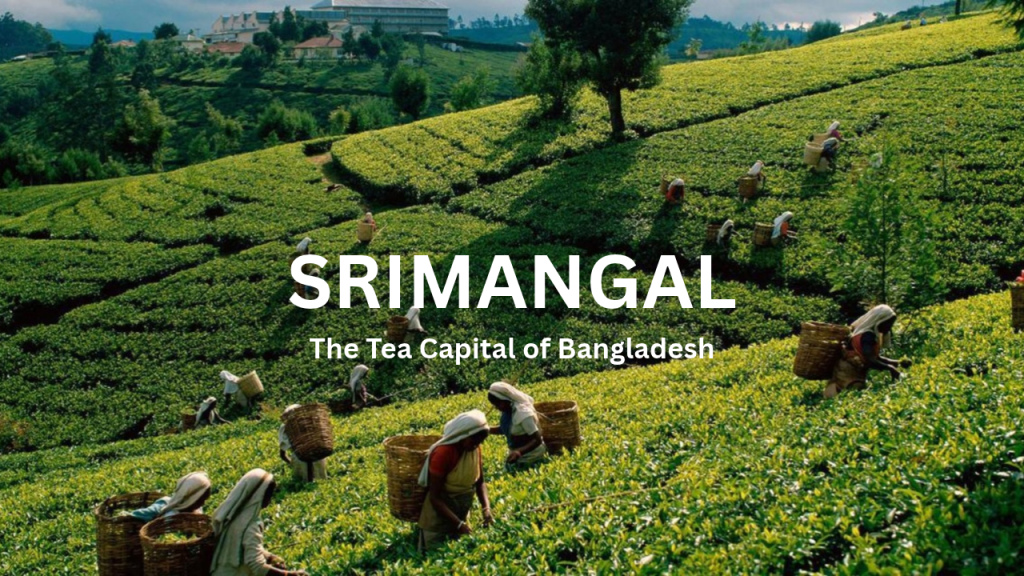
Srimangal (also spelled Sreemangal) is a town and upazila in Moulvibazar District of Sylhet Division, in the far north-east of Bangladesh, and it carries a title no other Bangladeshi town claims: the tea capital of Bangladesh. The phrase is not a marketing invention. Srimangal sits at the centre of the densest tea country in the nation, a landscape of low, rounded hills called tila, folded one behind another to the Indian border, almost every slope clipped into the waist-high green rows of tea gardens. The district around it grows close to half of the national crop. The industry's national research institute stands a few kilometres from the town centre, a second auction centre operates here, and its most famous cup, tea in seven coloured layers, was invented in a roadside cabin at the town's edge. Yet Srimangal is more than its gardens. Manipuri weavers and matrilineal Khasia villagers live among the estates, a rainforest full of gibbons begins eight kilometres away, and a major wetland sanctuary lies in the haor at the upazila's back. This is a profile of the place itself: how tea made it, who lives in it, and what is changing.
Geography and Setting
Srimangal Upazila covers about 451 square kilometres in the south-west of Moulvibazar District. It borders Habiganj District to the west and, to the south, the Indian state of Tripura; the border hills are visible from the higher gardens. The town itself stands where the flat Sylhet plain begins to break into the tila country, low sandstone hillocks, ten to fifty metres high, cut by narrow valleys and sandy-bedded streams. According to the 2022 census, the upazila has about 362,000 people, though fewer than one in ten live in the municipality; the rest are spread through nine unions, most shaped in some way by the estates.
Two kinds of country meet here. To the east and south rise the tea hills. To the north-west the land falls away into Hail Haor, one of the great bowl-shaped wetlands of the Sylhet basin, which fills with monsoon water each summer and drains to grazing land and boro rice each winter. Local tradition holds that the town took its name from two brothers, Sri Das and Mangal Das, who settled on the haor's bank. The climate explains the tea: Srimangal receives around 2,400 millimetres of rain in an average year, spread across a long wet season, and its winters are sharp by Bangladeshi standards, the station's record low is below 3°C, and the town is often described as the coldest place in the country. Tea, which wants rain, humidity, drained slopes and cool nights, found all four here, as, in time, did lemons, pineapples, rubber and betel leaf.
How Srimangal Became the Tea Capital
Commercial tea in what is now Bangladesh began a short distance away, at the Malnicherra estate outside Sylhet town, established in 1854 and in commercial production by 1857, the first commercial tea garden in the region, as Banglapedia and the Bangladesh Tea Association both record. Through the later nineteenth century, British managing agencies pushed planting south and east across the Surma Valley, clearing tila after tila in the valleys around what became Srimangal: the Balishira valley alone, east of the town, holds more than twenty gardens. The estates brought the full apparatus of the plantation, managers' bungalows on hilltops, factories, labour lines in the valleys, and the town grew up as their market and railhead. Srimangal thana was established in 1912 and the town became a municipality in 1935.
The numbers behind the "capital" title need care, because garden counts shift with boundaries and years. The Bangladesh Tea Board's recent reporting puts the national total at around 170 estates, 168 in 2022, and 171 to 172 by 2025–26. Moulvibazar is the largest producing district by a wide margin, contributing about 47 per cent of the national crop on Tea Board figures for 2025, and Srimangal is its centre of gravity: local counts put more than forty tea gardens inside the upazila itself, with scores more in neighbouring upazilas that look to the town as their hub. The estates immediately around the town, among them gardens of the old Finlay group, now run by the Consolidated Tea and Lands Company, and estates such as Zerin, Nurjahan and Satgaon, form the green wall a traveller sees from the train. National production tells the same story of centrality and vulnerability: a record 102.92 million kilograms in 2023, a fall to about 93 million in 2024 when drought and erratic rain hit the gardens, and a partial recovery in 2025. The full account of the industry's economics is told in our profile of the Bangladeshi tea industry; Srimangal is where that industry lives.
The Research Institute and the Tea Establishment
Srimangal's claim to be the industry's capital is institutional as well as agricultural. On 28 February 1957 a tea research station opened here, and in 1973 it was raised to the Bangladesh Tea Research Institute (BTRI), the country's only tea research institute, an autonomous body under the Bangladesh Tea Board. Its campus, a few kilometres south-east of the town on BTRI Road, works on the science the gardens run on: breeding and selecting the clonal varieties (the BT series) planted across the country, standardising manufacture and quality, and advising estates on soil, pests and plucking. BTRI's annual training course for assistant managers, running since 1963, makes the town a finishing school for the industry's officer class. The Tea Board's Project Development Unit is also based here, and the Board keeps a tea museum at its resort complex on the Bhanugach road.
The selling side has a local foothold too. For most of the industry's life, every kilogram of Bangladeshi tea was auctioned in Chittagong, the port city. In December 2017 a second auction centre opened at Srimangal itself, letting valley gardens sell in the producing region; it remains small beside Chittagong, a little over a million kilograms a season against Chittagong's eighty-odd million, but its presence underlines the town's status. Between the institute, the development unit, the museum and the auction rooms, Srimangal is where Bangladeshi tea is researched, taught and, increasingly, traded, as well as grown.
The People Who Pick the Tea
None of this landscape is natural, and none of it is tended by the people who owned the land before the planters came. The tea workforce descends, in the main, from labourers recruited by British companies in the nineteenth and early twentieth centuries from Bihar, Odisha, Jharkhand, Uttar Pradesh, Madhya Pradesh and the Santal Parganas, people drawn by promises of good wages and settled, instead, in estate housing few families ever left. The Tea Board counts about 150,000 tea workers nationally, supporting perhaps half a million dependants. They live in labour lines, rows of estate-built housing in the garden valleys, with estate schools, estate clinics and weekly rations binding the community to the garden across generations. Most pluckers are women, taking two leaves and a bud from each shoot by hand.
Theirs is the lowest-paid organised work in Bangladesh, and Srimangal has repeatedly been where that grievance surfaces. In August 2022, workers across the tea districts struck for a rise from Tk 120 a day to Tk 300; Srimangal's estates, including Bharaura at the town's edge, were at the centre of the stoppage, and the settlement that ended it after nineteen days fixed the wage at Tk 170. A government gazette in 2023 replaced negotiated settlements with a fixed 5 per cent annual increment, which had carried the daily cash wage to Tk 196 by 2026, a figure workers' organisations continue to describe as below the cost of living, and in August and September 2026 garden workers again protested across the tea districts, demanding Tk 500 a day and recognition of their land rights. Any honest profile of the tea capital has to hold both facts at once: the gardens are beautiful, and the community that maintains them remains among the poorest in the country.
Manipuri Paras and Khasia Punjis
Woven through the estate country are older communities with their own geographies. The Manipuri people, whose homeland lies in Manipur across the Indian border, have lived in the Sylhet region for two centuries, and their villages, called para, stand among the gardens around Srimangal. Ramnagar Manipuri Para, at the town's edge, is the best known: a village of handloom weavers whose saris, scarves and phanek cloth are sold from workshops and a local market, and whose Raas Leela dance tradition is one of the cultural signatures of the Sylhet region. The 2022 census counted about 15,400 people of ethnic-minority origin in the upazila, Santal, Garo, Khasi, Munda, Bhumij and others, a reminder that the tea country is a layered society, not a single one.
The Khasia (Khasi) villages follow a different pattern. A Khasia settlement is a punji: a compact, notably orderly village set on a hilltop or forest edge, whose people, matrilineal, mostly Christian, their homeland in the Meghalaya hills, make their living not from tea but from betel leaf. The leaf is grown in enclosures called boroj, where the vines climb living trees under a thinned canopy, so that a Khasia family's income depends on keeping the forest standing around it. The best-known punjis, Magurchara and Lawachara, stand in and beside the forest west of the town, and their betel gardens are among the most distinctive agricultural landscapes in Bangladesh, a cash crop farmed inside a wood, tended by a community whose inheritance passes through its daughters.
Forest, Lake and Wetland: The Nature Around the Town
Eight kilometres west of Srimangal station, in neighbouring Kamalganj Upazila, the tea country gives way to Lawachara National Park, 1,250 hectares of semi-evergreen forest, much of it planted as timber in the 1920s and since grown into something close to rainforest. Lawachara is the best-known Bangladeshi home of the endangered western hoolock gibbon, and its dawn chorus, heard from the garden roads outside the park, is part of Srimangal's soundscape. The Dhaka–Sylhet railway runs through the forest, and the Khasia punjis described above stand within it, so that the park is less a wilderness apart than the wild end of the same landscape the town inhabits.
East of the town, inside the Madhabpur Tea Estate in Kamalganj, lies Madhabpur Lake, not a natural lake but a reservoir, built in 1965 by damming the gullies between three hills to supply the estate, and now a winding, lotus-covered sheet of water of fifty acres, about sixteen kilometres from Srimangal town. Its calm surface, blue water lilies and hill views make it the standard companion stop to Lawachara, and its birdlife is taken seriously: the lake is the only confirmed site in Bangladesh for the great white-bellied heron.
North-west, the upazila's other face looks over water of a different kind. Baikka Beel, a permanent wetland of about 100 hectares on the eastern side of Hail Haor, was set aside as a fish sanctuary in 2003 and has become one of the country's model wetland conservation sites: a count in 2011 recorded 203 bird species there, winter brings migratory waterfowl in thousands, and the reed beds shelter the rare large-billed reed warbler. Together with the swamp forest of Ratargul further north in Sylhet District, Baikka Beel marks the wet pole of the region's ecology, as Lawachara marks the wooded one, and Srimangal sits between the two, close enough to reach both in a day.
Seven Layers in One Glass
Ask a Bangladeshi traveller what Srimangal tastes like and the answer is a piece of theatre: the seven-layer tea of the Nilkantha Tea Cabin, in which seven bands of differently coloured tea sit one above another in a single glass. Its inventor, by his own account, is Romesh Ram Gour, who arrived in Srimangal in 2000 from Muktagachha in Mymensingh with, he says, Tk 1,500 to his name, and set up a small stall near the Kakiachhara garden, beside the research institute. Experimenting with the densities of teas and infusions, he produced a two-layer tea in 2002–03 that drew attention, then three, four and five layers by 2006, and finally seven, a sequence he has always refused to explain, preparing the drink out of sight and guarding the method as a trade secret. The original cabin, Adi Nilkantha, stands at the entrance to Ramnagar Manipuri Para; a second operates at Kalighat, and its walls carry photographs of visiting dignitaries, among them, the cabin records, the then prime minister in December 2012.
The honest way to describe the seven-layer tea is as Gour himself presents it: a local invention and a local claim, famous far beyond what its chemistry needs to justify. Imitators in Srimangal and Dhaka now pour their own versions, and Gour's claim to be the first and only originator is part of the attraction rather than a fact outsiders can settle. What is not in dispute is the effect: the drink made a tea-stall keeper into a destination, and gave the tea capital a souvenir in a glass, seven layers, in the town that grows the leaf.
Srimangal Today
The Srimangal of the 2020s is a small town carrying a national industry and a growing visitor economy at once. It remains a working railway town, the station, on the Dhaka–Sylhet line, is the way most visitors arrive, stepping off the train directly into tea country, and its bazaars still serve the estates first and tourists second. But the balance is shifting. Large resorts, led by a five-star tea resort and golf property on the town's outskirts, have joined the older rest houses; holiday weekends now bring crowds that the roads to Lawachara and Madhabpur Lake were not built for, and the park's managers speak openly of visitor numbers beyond the forest's comfortable capacity. Unplanned building, litter and pressure on water are the familiar costs.
The deeper pressures are the industry's own. The crop that made the town is weather-exposed, the 2024 production fall showed how quickly drought and erratic rain can strip millions of kilograms from the valley's gardens, and the labour dispute that runs through the estate lines is unresolved, as the protests of 2026 made plain. Against that stand the town's assets: the research institute and its science, a district that still grows nearly half the nation's tea, communities whose weaving, betel gardens and dances give the place a cultural depth most industrial towns lack, and a landscape, tea tila, rainforest and haor within a few kilometres of one platform, that exists nowhere else in Bangladesh. Srimangal's title is usually given as a boast. Read closely, it is a description of responsibility: this is the capital, and the whole country's tea story, good and difficult alike, runs through it.