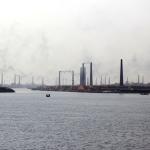
On the morning of 17 November 2026, Dhaka woke to the worst air of the season so far. IQAir put the capital's Air Quality Index (AQI) at 336 at 8:30 am, a level classed as hazardous, and ranked Dhaka first among the world's major cities that morning, according to Prothom Alo's report of the live ranking. The fine particle concentration behind that score was 243.3 micrograms per cubic metre, nearly 49 times the World Health Organization (WHO) annual guideline. Live readings move through the day: The Business Standard recorded 292, classed as very unhealthy, at 11:30 am. It was the ordinary start of the winter pollution season in a country rankings place near the top of the world for dirty air.
A Country Near the Top of the Wrong Table
The benchmark most often cited is the IQAir World Air Quality Report. Its 2025 edition, published in March 2026 and built from stations in 9,446 cities across 143 countries and territories, ranked Bangladesh the second most polluted country in the world, with an annual average PM2.5 of 66.1 micrograms per cubic metre. Only Pakistan, at 67.3, was higher. Bangladesh also ranked second in 2024 and first in some earlier editions, so the position is a plateau rather than a spike. The 2025 average was more than 13 times the WHO guideline of 5 and close to twice the national standard of 35.
PM2.5 means particles no wider than 2.5 micrometres, small enough to pass from the lungs into the bloodstream. Dhaka's own annual average in the IQAir 2025 data was reported at 68 micrograms per cubic metre in secondary analyses of the report, among the highest of any major city and, on the capital cities list, second only to New Delhi. City rankings vary with the list used. The consistent finding in every version is that Bangladesh and Dhaka sit in the top tier, year after year.
A Crisis With a Season
Dhaka's pollution is strongly seasonal, and November is when the bad season locks in. Hourly readings at the United States Embassy monitor in Dhaka for 2016 to 2021, analysed in Atmospheric Environment in 2023, found mean winter PM2.5 of about 165 to 175 micrograms per cubic metre, against about 30 to 35 in the monsoon months. January monthly means ran at 180 to 210, while July and August fell to 26 to 30. A 2020 to 2024 analysis in Discover Environment (2026) found the same pattern, with daily winter peaks up to 284.3.
Three things coincide in winter. The weather traps pollution: cool air, inversions, light winds and almost no rain mean particles accumulate instead of dispersing, while monsoon rain cleans the air each summer. The brick kilns that ring the capital fire only in the dry season, roughly October or November to March or April, because their clay pits and drying yards need dry ground. And construction, road dust and open burning peak in the dry months. The result is a predictable annual emergency, from about November to February, in which a megacity of more than 20 million breathes air that is routinely unhealthy and periodically hazardous. Meteorologists noted in mid November 2026 that the morning murk residents call fog is largely smog.
Where the Particles Come From
The most detailed official answer comes from the National Air Quality Management Plan 2024 to 2030 (NAQMP), prepared by the Ministry of Environment, Forest and Climate Change with the Department of Environment (DoE). Its modelling, based on 2020 data for the Greater Dhaka Area, estimated population weighted PM2.5 exposure at 84 micrograms per cubic metre. About 56 percent originated inside the area itself, about 16 percent came from other regions of Bangladesh, nearly 21 percent crossed in from other countries, and about 7 percent was natural soil dust. That transboundary share is why specialists frame Dhaka's problem as an Indo-Gangetic Plain airshed problem, and why climate change in Bangladesh and air quality are increasingly planned together.
Within the locally generated share, the apportionment surprises many readers. The largest single source is households, at 28 percent, mainly biomass cookstoves. Power plants follow at 24 percent, through sulphur dioxide and nitrogen oxides that convert into secondary particles downwind, a reminder that the power sector in Bangladesh is also an air quality story. Brick kilns account for 13 percent on an annual average, open waste burning for 11 percent, road dust for 8 percent and road transport exhaust for just 4 percent, mainly from heavy duty diesel vehicles. Industry is not broken out separately in the plan's headline table, a gap critics have noted, since an earlier Norwegian Institute for Air Research study attributed a much larger role to industry. The shares are modelled estimates with real uncertainty.
Two qualifications matter. The kiln share is an annual average: because kilns fire only in winter, studies synthesised in a 2026 policy brief estimate kilns contribute 30 to 50 percent of ambient PM2.5 in Greater Dhaka during the firing season, when concentrations are worst. And transport's small share understates its wider role. The Bangladesh Road Transport Authority (BRTA) counted about 6.85 million registered vehicles nationally as of August 2026, including about 5.1 million motorcycles, with more than 2.4 million in Dhaka alone, according to Prothom Alo's reporting of BRTA data. Old diesel buses and trucks emit disproportionate black smoke, and congestion keeps engines idling. Electric mass transit is one structural answer, which is why the Dhaka Metro Rail matters here. A joint DoE and World Bank assessment in 2019 named kilns, vehicle emissions and construction dust as Dhaka's three primary sources. The newer modelling adds two sources public debate had underweighted: household fuel and power generation.
The Brick Kiln Economy
Bangladesh builds with fired clay brick, supplied by one of its largest informal industries. Kiln count estimates differ: the DoE has estimated about 8,500 kilns nationwide, roughly 4,000 without environmental clearance, while research literature more often cites 7,000 to 8,500. The sector employs on the order of a million seasonal workers, by the estimate of a 2026 policy brief on kilns and governance, and its kilns cluster around Dhaka, Narayanganj, Gazipur and Munshiganj and across Rajshahi and Khulna divisions. Most burn low grade coal, some high in sulphur, and the NAQMP attributes about a quarter of national sulphur dioxide emissions to kilns.
The technology story runs in three steps. Fixed chimney kilns were meant to give way to zigzag kilns, in which bricks are stacked so hot air follows a zigzag path and fuel burns more completely. On paper the conversion largely happened: the consortium behind a landmark trial put zigzag kilns at about 81 percent of the sector. In practice most were operated incorrectly, with bricks stacked badly and coal fed in large batches, so much of the advantage was lost. Cleaner modern technologies, such as tunnel and hybrid Hoffman kilns, remain under 2 percent of the fleet, according to the J-PAL research network, because they need formal credit that informal operators cannot raise.
The third step is the most hopeful finding in this case study. In May 2025 Science published a randomised controlled trial of 276 kilns in Khulna Division, run by Boston University, Stanford University, icddr,b and partners during the 2022 to 2023 season. Kilns offered training in correct zigzag operation, principally continuous coal feeding and better brick stacking, a package now called Zigzag 2.0, adopted the practices at a rate of 65 percent. Among kilns that complied, energy use fell by about 23 percent and carbon dioxide and PM2.5 emissions each fell by about 20 percent, while fuel costs per brick dropped and brick quality rose. The researchers calculated a social benefit to cost ratio of 65 to 1, and estimated nationwide adoption could cut about 2.4 million tonnes of carbon dioxide in one season, roughly 2 percent of national emissions. The government backed scale up through Khulna and Dhaka, with more than 800 additional kilns reached by 2025. The lesson is encouraging and uncomfortable: much kiln pollution was never a technology problem. It was a knowledge and incentives problem, cuttable quickly and cheaply, though a 20 percent cut still leaves a very dirty industry.
What the Air Does to People
The health evidence comes from several independent programmes whose estimates differ because their scopes differ. The World Bank's Country Environmental Analysis (2023, base year 2019) linked ambient and household air pollution together to more than 159,000 premature deaths in Bangladesh in 2019, and put the health and productivity cost at 8.3 percent of GDP, within a wider environmental degradation bill of 17.6 percent of GDP. The Bank's earlier Dhaka focused work produced a lower range, 78,000 to 88,000 deaths in 2019, on narrower accounting. The State of Global Air 2025 report, from the Health Effects Institute and the Institute for Health Metrics and Evaluation, estimated 271,000 deaths in Bangladesh in 2023 on the broadest definition, over 90 percent from noncommunicable diseases. Its 2024 edition had estimated 236,300 deaths for 2021, including about 19,000 children under five.
Narrower studies land lower, as expected. The Centre for Research on Energy and Clean Air (CREA), in a January 2025 study of fine particle pollution alone, attributed about 102,456 deaths a year to PM2.5, including 5,258 under five deaths, and put the cost of ambient pollution at about 4.4 to 4.8 percent of GDP. Meeting the WHO guideline would prevent about 81,282 of those deaths each year, CREA calculated. The Air Quality Life Index (AQLI), from the University of Chicago's Energy Policy Institute, expresses the burden as lost life: its 2025 update found particulate pollution cuts average life expectancy in Bangladesh by 5.5 years, and by 6.9 years in Dhaka, relative to the WHO guideline. AQLI found pollution had risen 66 percent between 1998 and 2023, with all 166.8 million people living above both the WHO guideline and the national standard. These figures should not be averaged into one number. Read together, they say that on any methodology air pollution kills well over 100,000 Bangladeshis a year and costs several percent of GDP, and that household smoke and outdoor air must be counted together to see the full burden.
What Policy Has Tried
Bangladesh does not lack laws, plans or court orders. It lacks consistent enforcement. The Brick Kiln Act of 2013, amended in 2019, restricts where kilns can operate and what they can burn. The Air Pollution Control Rules of 2022 created the first dedicated air pollution framework under the Environment Conservation Act, including powers to declare and manage degraded airsheds. A separate Clean Air Act, drafted in 2019 with support from the Bangladesh Environmental Lawyers Association and BUET, was never enacted: the government of the day chose to proceed by rules instead, and analyses through 2025 and 2026 still describe the act as pending. The NAQMP is the current master plan, with a stated ambition to cut Greater Dhaka's PM2.5 by about 30 micrograms per cubic metre by 2030.
Money arrived in 2025. The World Bank's Board approved the Bangladesh Clean Air Project on 18 June 2025, with 290 million US dollars for expanded monitoring, continuous emissions monitoring for large industrial sources, vehicle emissions control and 400 zero emission electric buses. Reporting in August 2026 noted its financing agreement had still not been signed, so the money had not begun to flow.
Enforcement became visibly more aggressive under the interim government and continued under the government elected in February 2026. The DoE reported 1,823 mobile court drives between 2 January and 6 November 2025, with 4,614 cases, fines above 27 crore taka, 496 kilns shut by chimney demolition and 222 more ordered closed. In December 2025 the environment adviser announced 3,491 unlicensed kilns were set to be shut down. The recurring weakness, noted by journalists and researchers: many closed kilns have historically resumed within months. The High Court's nine point directives of 2020, issued on a writ by Human Rights and Peace for Bangladesh, order water sprinkling on roads, covered trucks, enclosed construction sites, bagged waste removal, seizure of black smoke vehicles and closure of illegal kilns around Dhaka. The court demanded compliance reports again on 30 October 2025 and on 2 November 2026. On 12 November 2026 a bench ordered the DoE director general and all divisional commissioners to close every illegal brick kiln in the country and report compliance by 14 December 2026.
The newest moves are political as much as administrative. In July 2026 the prime minister chaired a follow up meeting on pollution control whose decisions included front number plates for motorcycles, so camera based enforcement can identify vehicles, with a deadline of 15 November 2026. On 1 November 2026 the state minister for environment, Shaikh Faridul Islam, told a Dhaka University and Stockholm University dialogue that the government planned to shut down 200 conventional brick kilns and replace them with concrete block facilities, which produce no smoke. As of November 2026: a plan exists, a large loan is approved but not yet flowing, courts are setting deadlines in weeks, and the winter now under way is the first real test of whether enforcement can outlast the season.
What Would Actually Move the Needle
Across the NAQMP, the World Bank's analysis, the 2026 kiln governance brief and the CREA and AQLI programmes, a consistent expert consensus emerges. First, treat households as a front line source: with biomass cooking the largest single share of Dhaka's locally generated PM2.5 in the official apportionment, clean cooking fuel access is air policy, not only energy policy. Second, scale what already works in the kiln belt: universal Zigzag 2.0 training, which the Science trial showed pays for itself, combined with satellite monitoring so closures stick, and a shift of construction demand toward concrete blocks, as the 200 kiln replacement plan anticipates. Third, clean up power and industry through the emissions monitoring the Clean Air Project finances and through fuel quality. Fourth, fix transport quality rather than only quantity: retire the oldest diesel buses and trucks, make inspection real, and expand electric buses and metro capacity. Fifth, govern the airshed, not just the city: with about a fifth of Dhaka's PM2.5 arriving from abroad, the Indo-Gangetic Plain regional cooperation platform attached to the Clean Air Project, and airshed management under the 2022 Rules, are treated by specialists as essential. Finally, measure and publish: monitoring is too sparse to enforce against, which is why the expansion in the 2025 project matters.
The case study is, in the end, about the distance between diagnosis and delivery. The sources are apportioned, the health costs counted several times over, a cheap partial fix for the most visible industry proven in a randomised trial, and the courts have said, repeatedly, what must happen. The winter of 2026 to 2027, with a High Court deadline in December, a kiln replacement programme announced in November and a clean air loan awaiting signature, will show whether the documentation finally turns into cleaner air.