Bir Shreshtha, Bir Uttam, Bir Bikrom and Bir Protik are the four gallantry awards of Bangladesh, created to honour the fighters of the Liberation War of 1971 who showed extraordinary valour in the face of the enemy. They form a single ladder of honour, from Bir Shreshtha at the top, the highest military award in the country, down through Bir Uttam and Bir Bikrom to Bir Protik, the most widely given of the four. Every name on the roll was earned in the nine months of the war itself, and the complete list was published in one place: a gazette notification of the Government of Bangladesh issued on 15 December 1973, on the eve of the second Victory Day.
Banglapedia, the national encyclopedia of Bangladesh, gives the gazette figures plainly: Bir Shreshtha was conferred on seven martyr freedom fighters, all of them posthumously, Bir Uttam on 68, Bir Bikrom on 175 and Bir Protik on 426. Together that is 676 awards, a closed roll of honour that has shaped how Bangladesh remembers its war ever since. The titles are not decorations alone. They are carried as part of a recipient's name for life, they bring state allowances and a place of honour at national functions, and the highest of them, held by seven men who all died in action, has become the moral centre of the country's military memory.
Origins: A New State Honours Its Fighters
The awards were introduced immediately after the Liberation War, as the new state set about recording who had fought and how. The war of 1971 had been fought by a mixed force: regular soldiers of the East Bengal Regiment and the East Pakistan Rifles who had revolted in March 1971, Bengali officers and men who escaped from West Pakistan, naval and air force personnel, police, and a vast guerrilla movement of students, workers and villagers organised in eleven sectors. A gallantry system had to recognise all of them on one scale, from the sector commander who planned an operation to the teenage volunteer who held a position alone.
The solution was a four grade structure modelled in spirit on the great gallantry systems of other countries. The Bir Shreshtho is routinely compared with the British Victoria Cross and the American Medal of Honor: an award so selective that it has been given only once as a group, to seven men, and never again. Below it, the three further grades allowed the state to grade courage without diluting it, distinguishing command level valour, conspicuous gallantry in a single action, and distinguished service in combat. Recommendations came up from sector commanders and service headquarters, working from wartime reports in a country whose records had been scattered by nine months of guerrilla war, and the consolidated result was the gazette of 15 December 1973, which remains the legal foundation of all four titles.
The Four Grades and What Each One Means
Bir Shreshtha: The Most Valiant Hero
Bir Shreshtha (The Most Valiant Hero) is the highest gallantry award of Bangladesh. The official wording, as carried by the Bangladesh Navy's honours list, reserves it for personnel of any rank who have performed acts of the greatest heroism or most conspicuous courage in circumstances of extreme danger, showing bravery of the highest order or devotion to the country in the presence of the enemy on land, at sea or in the air. In practice it has one further condition that no regulation needed to state: all seven recipients were killed in the action that earned it. The award has been made only in the 1973 gazette, only for 1971, and the seven names form a fixed company that no later war or act of courage has added to.
Bir Uttam: The Great Valiant Hero
Bir Uttam (The Great Valiant Hero) is the second highest award, and in effect the highest gallantry award a living fighter could receive. The official wording covers acts of valour, courage or devotion to duty performed in the face of the enemy. Its 68 recipients in the 1973 gazette include sector commanders, regular officers, guerrilla leaders and ordinary soldiers, and many of the men who went on to lead the armed forces of independent Bangladesh carried the title. Because so many recipients survived the war, Bir Uttam became the grade most visible in public life: the title follows the name in official documents, on memorials and in the press.
Bir Bikrom: The Valiant Hero
Bir Bikrom (The Valiant Hero; the name is also written Bir Bikram) is the third grade, for gallant and distinguished service in combat. Its 175 recipients in 1973 reach further down the ranks than Bir Uttam: sepoys, lance naiks, sailors, riflemen, police and civilian fighters whose citations typically record a single outstanding act, a bunker destroyed, a position held, wounded comrades brought out under fire. It is the grade where the roll of honour stops reading like a list of commanders and starts reading like the war itself.
Bir Protik: The Symbol of Courage
Bir Protik (The Symbol of Courage; also written Bir Pratik, and translated as Idol of Courage) is the fourth grade, for gallantry and distinguished service in combat, and with 426 recipients it is by far the broadest. Its breadth is its meaning. The Bir Protik roll captures the widest social range of the war effort, including the only two women in the 1973 gallantry list, Captain Sitara Begum, who ran a field hospital for the Mukti Bahini, and Taramon Bibi, who joined as a teenager in Sector 11 and fought in direct combat. Taramon Bibi's story also shows the fallibility of the record: her award was gazetted in 1973 but she was traced only in 1995, and received her medal more than two decades after she had earned it.
The Seven Bir Shreshtha
The seven stand apart, and Bangladeshis learn their names at school. They came from every arm of the independence struggle: three from the Army, two from the East Pakistan Rifles (the force now known as Border Guard Bangladesh), one from the Navy and one from the Air Force. Each entry below gives the man's service and the action in which he died.
- Mohammad Mostafa Kamal, Sepoy, Bangladesh Army: at Daruin near Brahmanbaria on 18 April 1971 he stayed at his machine gun and kept firing so that his company could withdraw in the face of a heavy Pakistani attack, and was killed at his position.
- Munshi Abdur Rouf, Lance Naik, East Pakistan Rifles: in April 1971 at Burighat, on the Rangamati to Mahalchhari waterway, he held off Pakistani launches and speed boats with his machine gun and forced them to retreat, covering his company's withdrawal before a mortar round killed him.
- Nur Mohammad Sheikh, Lance Naik, East Pakistan Rifles: at Goalhati in Jessore on 5 September 1971, wounded and with his patrol surrounded, he kept firing alone to cover his comrades' escape, carried on fighting until he died, and his men got away.
- Matiur Rahman, Flight Lieutenant, Bangladesh Air Force: on 20 August 1971 he tried to seize a T-33 trainer aircraft at Karachi and fly it to India to join the Liberation War; the aircraft crashed near the border and he was killed, far from home and still in enemy uniform.
- Hamidur Rahman, Sepoy, Bangladesh Army: at Dhalai in Srimangal on 28 October 1971 he crawled forward under fire to attack a Pakistani machine gun position in Sector 4, silenced it at the cost of his life, and his unit took the position.
- Mohammad Ruhul Amin, Engine Room Artificer, Bangladesh Navy: on 10 December 1971 his gunboat BNS Palash was bombed on the Rupsha river during the advance on Khulna, six days before victory, and he died at the river after the attack.
- Mohiuddin Jahangir, Captain, Bangladesh Army: on 14 December 1971, two days before victory, he led his men across the Mahananda river into Chapai Nawabganj, crawled forward to grenade a machine gun bunker, and was shot dead within sight of the town he was liberating.
Two of the seven had to be brought home long after the war. Matiur Rahman was buried in Karachi in 1971 and his remains were returned to Bangladesh in 2006. Hamidur Rahman was buried across the border in Tripura, India, and his remains were brought back in 2007. Both now rest at the martyred intellectuals' graveyard at Mirpur in Dhaka, a measure of how seriously the state takes its duty to these seven men in particular.
Counting the Awards: 676, 677 and 69
The figures most often quoted for the four grades, 7, 69, 175 and 426, add up to 677, and readers will meet that total in many reference works. The gazette figures given by Banglapedia are slightly different: 7 Bir Shreshtha, 68 Bir Uttam, 175 Bir Bikrom and 426 Bir Protik, which add up to 676. The difference is one man and one later decision. In April 2010 Brigadier General Jamil Uddin Ahmad, who as a colonel in 1975 was killed trying to respond to the assassination of Sheikh Mujibur Rahman, was posthumously awarded the Bir Uttam. Counted with the 68 of 1973, that makes 69 Bir Uttam in total, and 677 gallantry awards in all, but only 676 of them belong to the Liberation War gazette of 15 December 1973. This article uses the gazette figures when it speaks of 1971, and flags the later award where the higher total appears.
The roll has also contracted in one painful respect. In December 2020 the High Court ordered the suspension of the gallantry titles of four recipients who had been convicted of taking part in the assassination of Sheikh Mujibur Rahman in 1975: Shariful Haque Dalim (Bir Uttam), Nur Chowdhury (Bir Bikrom), and Rashed Chowdhury and Moslehuddin Khan (both Bir Protik). The suspensions were ordered to continue until the court's rule on the matter is disposed of. The episode is a reminder that the titles, once given, carry a public trust, and that the courts have been willing to treat them as conditional on the honour they were meant to certify.
Insignia, Titles and Allowances
Each grade has its own medal and ribbon, and on uniform the four gallantry awards stand at the head of the order of precedence, before distinguished service, campaign and long service medals. In the armed forces' own lists the titles carry the abbreviations BS, BU, BB and BP after a recipient's name. In civilian life the fuller form is used: the title is written with the name, as in a name followed by Bir Uttam, and recipients are guests of honour at state functions, including the national observances of Independence Day on 26 March and Victory Day on 16 December. Since 2020 the word Bir has also been required as an honorific before the names of freedom fighters generally, but the four gallantry titles remain a distinct and far rarer distinction, held by hundreds rather than the roughly two hundred thousand recognised freedom fighters.
The honour is also material. Gallantry award holders, and the families of those who died, receive a monthly state honorarium through the Ministry of Liberation War Affairs, paid directly to bank accounts, at rates above the standard freedom fighter allowance. Under the rates notified by the ministry with effect from 1 July 2026, as reported by the state news agency BSS and Prothom Alo, the families of Bir Shreshtha recipients receive Tk 40,000 a month, Bir Uttam holders Tk 30,000 a month, and Bir Bikrom and Bir Protik holders Tk 25,000 a month, with festival allowances of Tk 10,000, a Victory Day allowance of Tk 5,000 and a Bengali New Year allowance of Tk 2,000 in addition. Earlier published rates were lower (in April 2026 the minister told parliament the Bir Shreshtha family rate was Tk 30,000 and the Bir Uttam rate Tk 25,000), and the figures have been revised upward several times, so any single number belongs to its year. Beyond the honorarium, gallantry families are covered by the wider freedom fighter welfare system, including medical support and burial grants administered through the ministry and the Bangladesh Freedom Fighters Welfare Trust.
How the Recipients Are Commemorated
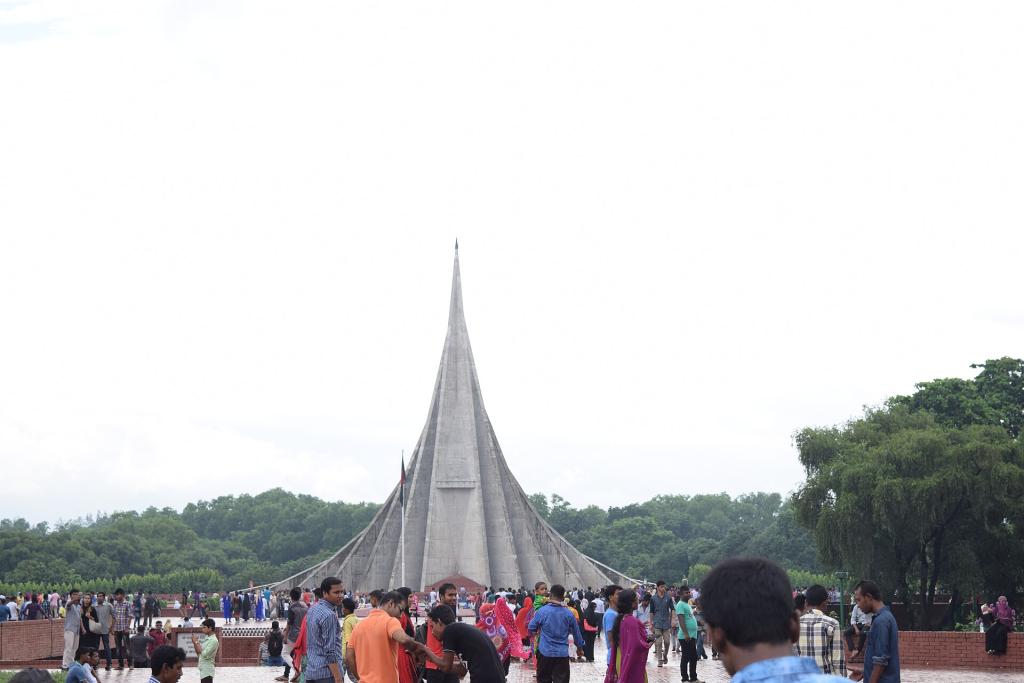
Commemoration in Bangladesh is built into the map. The National Martyrs' Memorial at Savar, with its seven pairs of folded concrete planes rising over the mass graves of the war, is the national shrine for all the martyrs of 1971, and the gallantry holders stand at the head of that memory. For the seven Bir Shreshtha the state went further. Memorial museums and libraries were built at their birthplaces, and in 2008 their home villages and union were renamed for them: Hamid Nagar for Hamidur Rahman, Matiur Nagar for Matiur Rahman, Jahangir Nagar for Mohiuddin Jahangir, Mostafa Kamal Nagar, Ruhul Amin Nagar, Rouf Nagar and Nur Mohammad Nagar. A reader driving through Bangladesh meets the names without trying: the Bir Shreshtha Ruhul Amin Stadium in Chittagong and the Hamidur Rahman Stadium in Jhenaidah, the navy ship BNS Shaheed Ruhul Amin and the ferry named for him, the Bir Shreshtha Ruhul Amin Road in Khulna, roads named for Jahangir in Barisal and Chapai Nawabganj, MA Rouf Square in Rangamati near where Rouf fought, and the busts of all seven that stand in a row at Patuakhali Science and Technology University.
The other grades are commemorated more locally, in the names of schools, roads, cantonment buildings and memorial plaques in the districts where the men fought, and in the armed forces' own ceremonies, where the citations of 1971 are still read as examples to serving soldiers. Press reporting has not always been kind about the upkeep of this landscape of memory: a New Age survey in December 2020 found several Bir Shreshtha memorials, libraries and museums in poor repair, from river erosion threatening the Jahangir memorial museum in Barisal to murals left faded and covered in posters. The contrast is part of the awards' modern story: the titles themselves have never been devalued, but the physical memorials need the same care as the memory they carry.
The Awards Today
More than fifty years on, the four titles remain what the 1973 gazette made them: a finite roll, tied to a single war, that no government has reopened for new Liberation War names beyond corrections and the one exceptional Bir Uttam of 2010. Separate peacetime gallantry and service awards now exist for the armed forces, but they sit below the Bir titles in precedence and in public feeling. The surviving holders are now elderly, and each Victory Day the number of living Bir Uttam, Bir Bikrom and Bir Protik holders who can attend a parade or give an interview is smaller. What does not shrink is the structure itself. A schoolchild who learns the four titles and the seven names at the top of them has learned the country's official answer to what courage is worth: everything, graded carefully, gazetted once, and remembered by name.