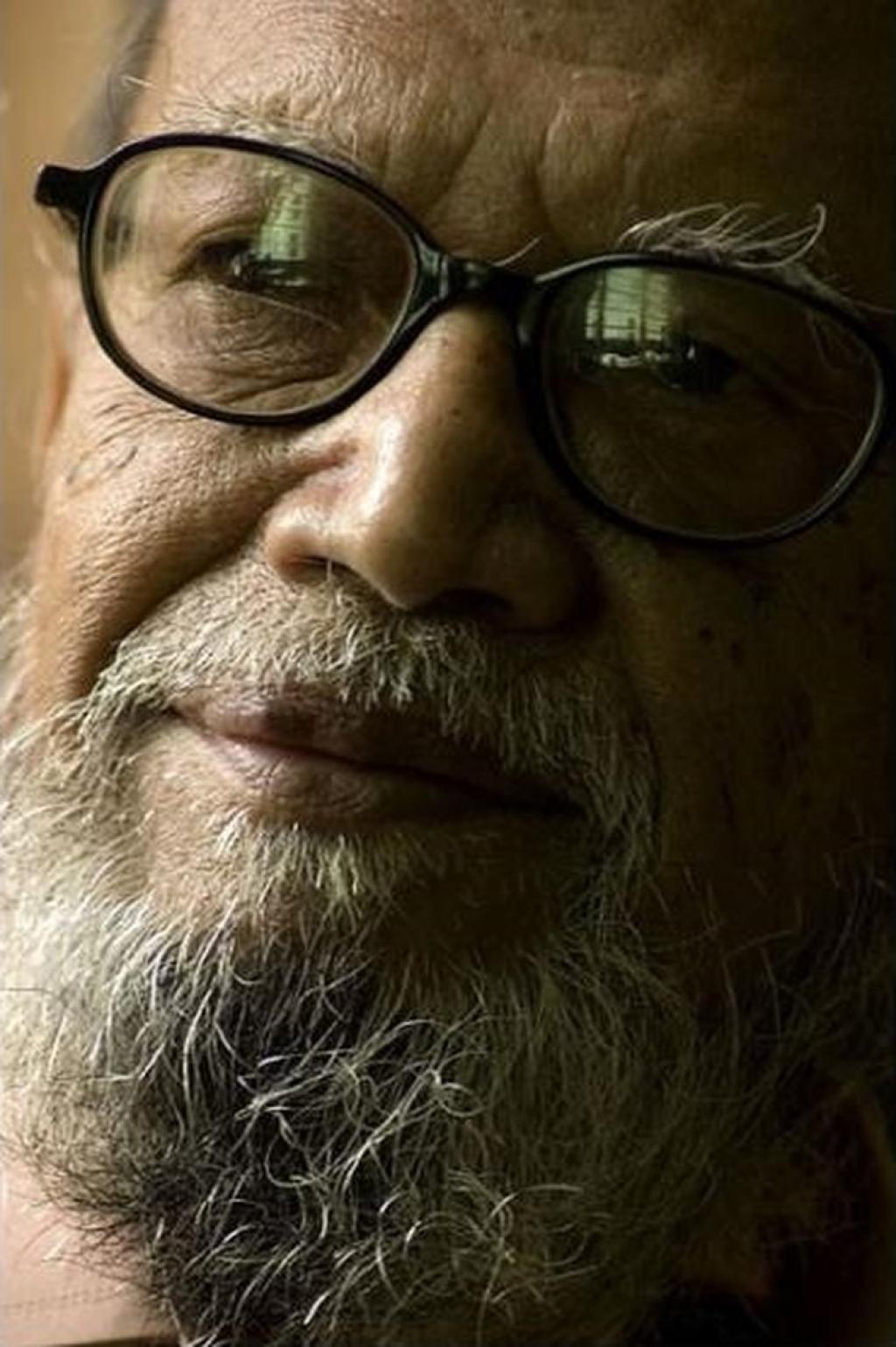
Al Mahmud (11 July 1936 – 15 February 2019), born Mir Abdus Shukur Al Mahmud, was a Bangladeshi poet, novelist and short-story writer who is widely regarded as one of the greatest Bengali poets of the twentieth century. His sonnet collection Sonali Kabin (1973) is treated as a landmark of modern Bengali poetry, the book that carried the rivers, villages and spoken dialect of rural Bengal into the centre of the modern poem. Few literary lives in Bangladesh contain as many turns as his: a schoolboy with an arrest warrant against his name in the Language Movement of 1952, a proofreader who rose to edit a radical newspaper and spent a year in prison for it, the director of the national academy of arts, and, in his later decades, a poet whose turn towards Islamic themes made him the most argued-about writer of his generation. In 2025, six years after his death, the state closed the argument in its own way by giving him the Independence Award, the country's highest civilian honour, for literature.
Early Life
Al Mahmud was born on 11 July 1936 at Morail, a village beside Brahmanbaria town in the east of Bengal, then part of British India. His family, the Mirs of Mourail, were Bengali Muslim landowners who carried the hereditary title Mir; his parents were Mir Abdur Rab and Rowshan Ara. The country of his childhood was the flat, watery land of the Titas river — paddy fields, char lands that rose and sank with the seasons, and villages where Muslim farmers were the great majority. That landscape never left his work. Three decades of his poetry would return to it: the rivers and rice fields, the thick walls of trees, the parting and reunion of men and women in a deltaic world.
He went to school first at Morail High School and then at Niaz Mohammad High School in Brahmanbaria, with spells of schooling elsewhere in the region, but his formal education stayed slight and he was largely self-taught — a fact he never hid. His childhood and adolescence ran through the Second World War, the Pakistan movement and the Partition of 1947, the upheavals that formed his generation before the language question formed him. He began writing poems as a teenager. His first publication was a short story, and his first published poem, as Banglapedia records, was a four-line piece printed not in any book or journal but on a protest leaflet.
The Language Movement and Early Poems
In February 1952, when the movement for Bengali as a state language of Pakistan reached its crisis, Al Mahmud was a tenth-grade student at Niaz Mohammad High School. Together with fellow students including Mohammad Musa and Tajul Islam, he brought out a leaflet from the Jubilee Press in Brahmanbaria carrying verses of protest. The response of the authorities was swift: an arrest warrant was issued against the schoolboy poet and the press was sealed. In 1954 he left home for Dhaka. The experience fixed two things in him — a lifelong subject, the language and the land it belonged to, and an early education in what it cost to print the wrong words.
In Dhaka his poems began to appear in the leading literary journals of both Bengals: Buddhadeva Bose's Kabita in Kolkata, Krittibas, and Dhaka's Samakal among them, and by the late 1950s he had a reputation in literary circles on both sides of the border. Critics placed him in the line of Jasimuddin and Jibanananda Das, the poets who had made village Bengal the home ground of the modern Bengali poem, and his own diction — regional, riverine, full of the speech of the Brahmanbaria countryside — announced a new voice in that tradition. His first collection, Lok Lokantor, appeared in 1963, followed by Kaler Kalosh in 1966. In 1968 the Bangla Academy gave him its Literary Award for the two books, an early official confirmation of what readers already knew.
Sonali Kabin and Fame
The book that made him unavoidable came in 1973. Sonali Kabin is a sequence of Bengali sonnets, dedicated to his contemporary Shamsur Rahman, and it is regularly described as his magnum opus. The title needs one word of explanation: a kabin is the marriage contract, the dower deed, of a Bengali Muslim wedding, so the book's name — often Englished as "The Golden Kabin" — casts the poet's bond with his land as a marriage vow, signed and binding. Inside that frame the sonnets move between love and landscape, patriotism and the village, the woman and the country addressed in the same breath; the closing sonnet insists that the woman is not defeated and that poets are never defeated. Critics have often said that had he written nothing else, this one slim book would still have secured his place in Bengali poetry. The poems travelled, too: a piece from Sonali Kabin was carried in English in Naomi Shihab Nye's world anthology This Same Sky (1996), and the collection itself has been published in English as The Golden Kabin.
Fame did not stop the output. Mayabi Porda Dule Otho followed in 1976, and in all he published some twenty-six collections of poems, among them Arabya Rajanir Rajhans (1986) and Doyel o Doyita (1997). He was never only a poet: his first short-story collection, Pankourir Rakta, came out in 1975, and novels such as Kabi o Kolahal (1993) and Upamahadesh extended his range into prose, alongside memoirs including Je Bhabe Bere Uthi. More than fifty books carry his name.
Journalism and 1971
For two decades, poetry was what Al Mahmud wrote and journalism was how he lived. He arrived in Dhaka in 1954 and joined the Daily Millat as a proofreader; within a year he was editor of the weekly Kafela. There was an unlikely interlude between 1957 and 1962 — gauge reader in the Dredger Division, salesman for Lifebuoy soap — before he returned to the press in 1963, joining the Dainik Ittefaq as a proofreader and rising to junior sub-editor in charge of the mofussil, or district, desk.
When the Liberation War came in 1971, he went to India and worked there to build public opinion in favour of the war; in Bangladesh he is remembered, and described in state media, as a freedom fighter. After independence his journalism took its sharpest turn. In 1972 he became editor of Ganakantha, the newly launched daily that served as the mouthpiece of the Jatiya Samajtantrik Dal (JSD), committed to "scientific socialism" and fiercely critical of the government of the day. In March 1974 he was imprisoned, and he spent about a year in jail — a sentence handed down not by the Pakistani regime he had opposed since school, but by the government of the independent country he had supported in 1971. On his release in 1975 he was appointed assistant director for research and publication at the Bangladesh Shilpakala Academy, the national academy of fine and performing arts, and he stayed there until 1993, retiring as the Academy's director. He returned to newspapers in later life too, editing the Daily Karnafuli of Chittagong from the mid-1990s into the following decade.
Later Work and the Turn in His Themes
The prison year changed more than his career. By his own later account, his wife brought him a copy of the Quran in jail, and he read it through, in translation, from beginning to end. The young poet of the 1960s had moved in leftist, even Marxist, literary circles — one of the Sonali Kabin sonnets could vow faith in the equal distribution of wealth — but from the 1980s his work turned steadily towards faith. Bakhtiyarer Ghora (1984) announced the change publicly: Islamic history, devotion and the vocabulary of belief moved to the centre of the poetry. He grew a beard. The Arabic and Persian words that had always coloured his diction now carried devotional weight.
Bangladesh's literary establishment split over him, and the split was never only literary. Admirers held that faith had deepened the poetry and that the later books stand with the early ones. Many of his former comrades in the progressive camp accused him of fundamentalism, pointed to his presence at events of Jamaat-e-Islami and its student wing, alleged closeness to the Ershad regime, and argued that the later work never matched Sonali Kabin; some obituarists recorded that judgement even while praising the early books, while others argued he had been deliberately pushed into a political enclosure by self-appointed guardians of progressivism and undervalued as a result.
Al Mahmud answered the labels directly. He denied being either a "socialist" or an "Islamist", describing himself as an egalitarian who believed in the spiritual core of Islam. Of the seminar invitations he said that he tried to attend them all, socialist and Jamaat-Shibir alike, and that no one listened to what he actually said there; "I grew a beard, and suddenly I became a fundamentalist," he remarked in one interview, and he spoke bitterly of being called a collaborator after fighting for the country. The writing continued through the argument — new collections, the memoirs, and a final autobiography, Jiban Jakhan Bak Ghore, published in February 2018, a year before his death.
Awards and Honours
The official honours began early and, in the end, ran to the very top. The Bangla Academy Literary Award came in 1968, for Lok Lokantor and Kaler Kalosh. There followed the Joy Bangla Award in 1972 and a long list of literary prizes — among them the Philips Literary Award in 1986, the Sufi Motaher Hossain gold medal, the Kabi Jasimuddin Award and, late in life, the Lalon Award in 2011. The Ekushey Padak, the country's second-highest civilian award, is given as 1986 in the standard recipients' lists and in UNB's and Prothom Alo's reporting, though a number of profiles print 1987. The last word belonged to the Independence Award: in 2025, six years after his death, Al Mahmud was named for literature among the seven recipients of Bangladesh's highest civilian honour, announced by the Cabinet Division on 11 March and conferred posthumously by the Chief Adviser on 25 March 2025.
Death and Legacy
Al Mahmud was admitted to Ibn Sina Hospital in Dhaka on 9 February 2019 and died there on Friday, 15 February 2019, aged eighty-two. The next day his body was kept at the Bangla Academy's Nazrul Mancha for the public to pay their respects, and he was buried beside his parents in the family graveyard at Mourail, in the Brahmanbaria earth his poetry had never left.
His place in the literature is not seriously disputed; almost everything else about him still is. Obituaries in Bangladesh and India alike ranked him among the greatest Bengali poets of the twentieth century — one called him "controversial but one of the greats", noting that no poet courted controversy as much, yet he remained loved in both Bengals. The 2025 Independence Award was read by his supporters as the state's long-delayed recognition and by his critics, at most, as a judgement on the poems rather than the politics. What survives the argument is the work itself: the schoolboy's four lines on a leaflet, the editor's prison year, and above all the golden kabin of 1973 — a marriage deed between a poet and his delta, which Bangladeshi readers have never stopped signing. When the state news agency marked his sixth death anniversary in February 2026, it wrote that his poetry had inspired freedom-loving people from the Language Movement of 1952 to the Liberation War and beyond — evidence that, whatever enclosure politics tried to build around him, the national story keeps claiming him back.