Everyone, Lalon sang, asks the same question about him: "Sab loke koi Lalon ki jat samsare" — all the people ask, what is Lalon's caste in this world? His answer has outlived him by well over a century: "Lalon says, I have never seen what caste looks like." Fakir Lalon Shah (c. 1774–1890), the Baul mystic of Cheuriya in Kushtia, built an entire philosophy out of refusing that question. Singing to the one-stringed ektara, he taught that the divine — the Moner Manush, the Man of the Heart — lives inside every human body, and that caste, creed and sect are cages built by other people. His songs, the Lalon Geeti, became the core repertoire of the Baul tradition of Bengal, and they are still sung wherever Bauls gather, from village fairs in Kushtia to festival stages across Bangladesh and West Bengal.
Yet almost nothing about Lalon the man can be stated with certainty. He left no writings, no photograph, and — deliberately, his followers believed — no account of where he came from. In the line of Bengal's great mystic bards, which runs from Lalon through the Sylhet landlord-poet Hason Raja to the haor country's Baul king Shah Abdul Karim, Lalon stands first and largest, and also most elusive: a figure assembled from songs, legends and the competing claims of communities that have argued over him ever since he died.
A life told in legend
Banglapedia, the national encyclopedia of Bangladesh, gives Lalon's birth as 1 Kartik 1181 BS — 1774 in the Christian calendar — at Harishpur village in what is now Jhenaidah district, while noting a variant tradition that places his birth in a Kayastha family at Bharara village in Kumarkhali, Kushtia. Older reference works long gave the year as 1772, and both dates still circulate. Even his birthplace and his family are disputed: one tradition, drawn from newspapers and essays of his own time, makes him the child of a low-caste Hindu family; another holds that he was born a Muslim. Scholars have pointed out that the quarrel says as much about the claimants as about Lalon — Hindu and Muslim writers alike have tried to recruit him. Lalon himself would not answer. His refusal was not forgetfulness; it was doctrine.
The story every account shares is the stuff of legend, and it should be read as such. Married in boyhood, the young Lalon set out on a pilgrimage and was struck down by smallpox on the road. His companions, believing him dead or doomed, abandoned him. Banglapedia tells that a Muslim fakir, Siraj Sain, found him in a dying condition, nursed him back to health, and in time became his guru; in other widely retold versions he was rescued by a Muslim couple of Cheuriya, Malam Shah and his wife Matijan, and some accounts name Malam Shah among his teachers as well. The smallpox left him blind in one eye — one of the few physical details about him that sources consistently repeat.
When Lalon went home, his wife and relatives turned him away: he had lived and eaten among Muslims, and in the eyes of his community that made him an outcast. So he returned to his guru, took initiation into the Baul path, and after the guru's death founded his own akhra — a hermitage and gathering place — at Cheuriya, on the bank of the Kaliganga river. There, composing and singing, he remained for the rest of his long life.
He died at Cheuriya on 1 Kartik 1297 BS, 17 October 1890, and was buried in the middle of his dwelling at the Akhra, where his mausoleum stands today. Tradition gives his age as 116 — Banglapedia's figure — or, in older tellings, 118; either way the number is awe rather than record. The news of his death was first printed, it is generally reported, in the newspaper Gram Barta Prokashika, run by his own disciple Kangal Harinath Majumder.
Songs and the search for the Man of the Heart
Lalon had no formal education and wrote nothing down. His songs were composed orally, sung by his disciples, and written out by scribes among them — tradition names Bholai Shah, whose hand signed verses in the manuscripts, and Fakir Maniruddin Shah, whose notebooks have since mostly been lost. How many songs there were is one of the great unanswerable questions of Bengali music. Banglapedia credits him with nearly 2,500; researchers more cautiously say about 2,000; rural Bauls, with a devotee's arithmetic, claim more than 10,000. Of those, perhaps 700 or 800 survive in collections, and scholars treat one corpus as the gold standard: the 298 songs Rabindranath Tagore had copied from a manuscript collected at the Cheuriya Akhra, twenty of which he published in the journal Prabasi. Everything beyond that core carries some doubt, because a song passed mouth to mouth for a century changes as it travels.
The philosophy inside the songs is demanding and joyful at once. Its centre is dehatattva — the doctrine that the body is the seat of all truth. God is not in the temple or the mosque but within the person: the Moner Manush, the Man of the Heart, whom the seeker must find through love, devotion and the guidance of a guru. Lalon drew freely on the traditions around him — Vaishnava Sahajiya teaching, Sufi Islam, Buddhist Sahajiya currents, Hindu scripture — and fused them into something that belonged to none of them, which is precisely the point his followers celebrate and his orthodox critics, then and now, have condemned.
His best-known images have entered the language itself. In Khachar Bhitor Ochin Pakhi, the soul is an unknown bird that comes and goes in the cage of the body, and the singer grieves that he cannot hold it. In Barir Kache Arshi Nagar, there is a city of mirrors near his house where a neighbour lives whom he has never once seen — the divine beside us, unmet. Milon Hobe Koto Dine asks how long until the union with the beloved comes; Jat Gelo Jat Gelo Bole mocks the panic over caste lost and caste kept. The tunes draw on Bhatiyali and Kirtan but settle into a distinctive Baul gait, carried by ektara, dotara and the small dubki drum — music made to be walked with, and argued with, and wept to.
Two threads run through everything he sang. The first is the guru: in Baul practice the Supreme Being cannot be reached by scripture or ritual, only by a living teacher who knows the way, and Lalon's songs return again and again to surrender to the murshid who found him — fittingly, for a man whose own life was remade by a rescuer he called master. The second is a society that does not yet exist. In Emon Samaj Kobe Go Srijan Hobe — "when will such a society be created?" — he imagines a world without religious, racial or caste division, a full century before such language entered politics. It is why reformers and revolutionaries, and not only mystics, have claimed him ever since.
The Akhra at Cheuriya
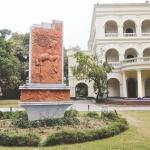
The akhra Lalon founded at Cheuriya, in present-day Kumarkhali Upazila of Kushtia district, stands about two kilometres from Kushtia railway station. In his lifetime it was already the centre of a large Baul community: disciples such as Kangal Harinath Majumder, Dudu Shah and Pagla Kanai carried his songs outward, disciples' disciples multiplied them further, and in the countryside the songs escaped the akhra altogether — Banglapedia notes that they were sung by the common people, even by boatmen on the rivers, while their composer still lived. Through Harinath's newspaper the wider Bengali world first read of the singing fakir of Cheuriya. The estate lay within the Tagore family's zamindari, and the connection mattered. It is said that Jyotirindranath Tagore, the poet's elder brother, sketched Lalon aboard his houseboat on the Padma in 1889 — the only likeness of Lalon ever claimed to have been drawn from life, and the source of every painted face of his since.
That portrait deserves a word of honesty. No photograph of Lalon exists, and none could be expected to be authentic: he died in 1890, before photography reached his world. The Tagore sketch itself is dated 1884 in one reference caption and 1889 in most other accounts, and its attribution rests on tradition rather than documents. Every familiar image of Lalon — the murals, the rickshaw paintings, the book covers — descends from that single fragile pencil drawing of an old man bent over a stick. His face, like his birthplace, is something Bengal has chosen to believe.
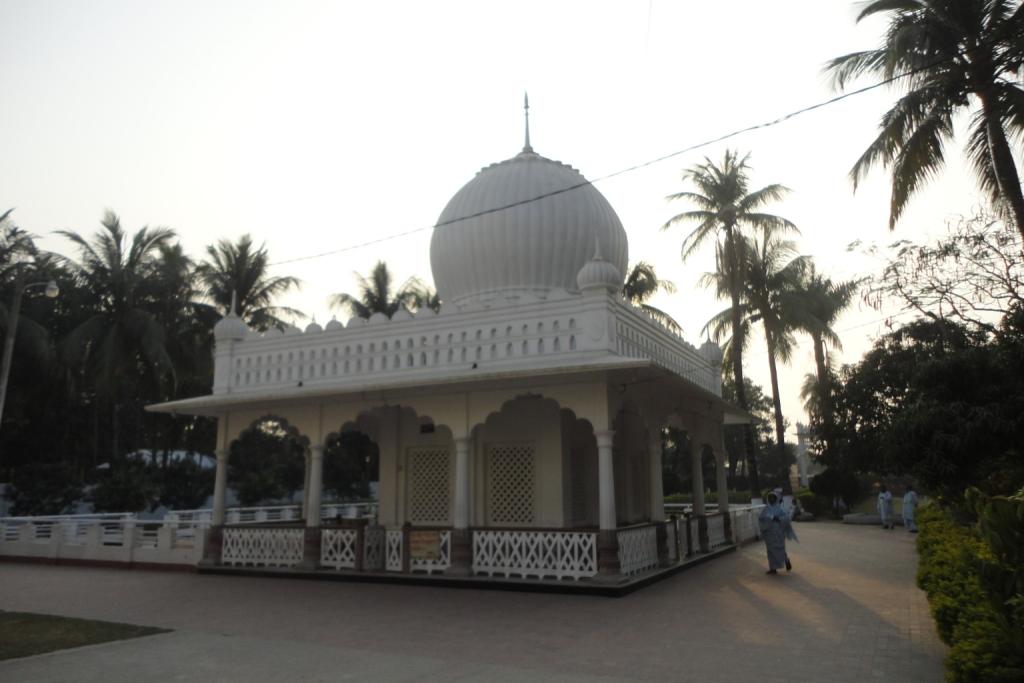
What is solid is the place. In 1963 a mausoleum and research centre were built over his dwelling at the Akhra, and the shrine — tended today with the involvement of the Lalon Academy and the district administration — became one of the great pilgrimage sites of Bengali folk culture, drawing fakirs, Bauls, scholars and the simply curious in numbers that grow with every decade.
Influence and legacy
Lalon's journey from village heretic to national icon runs through Rabindranath Tagore. Tagore published twenty of the songs in Prabasi, quoted him in the preface to Mansuruddin's song collection Haramoni, and in his Hibbert Lecture of 1930, The Religion of Man, presented Lalon's village mysticism to the world as a living religion of humanity; in a 1934 address at Calcutta University he lingered over the prosody of three of the songs. Banglapedia credits Tagore with first drawing the educated class's attention to Lalon. Kazi Nazrul Islam counted himself among the mystic's inheritors, and across the ocean the American poet Allen Ginsberg was among the twentieth-century writers drawn to his work. Lalon, it should be said plainly, did not found the Bauls — the tradition is older than he is — but no one else gave it a voice half as enduring.
The world's formal recognition came in stages. In 2005 UNESCO proclaimed the Baul songs of Bengal a Masterpiece of the Oral and Intangible Heritage of Humanity, and in 2008 they were inscribed on UNESCO's Representative List of the Intangible Cultural Heritage of Humanity — a tradition whose repertoire is, in large measure, Lalon's. In 2010 Goutam Ghose's film Moner Manush, an India–Bangladesh production based on Sunil Gangopadhyay's novel and starring Prosenjit Chatterjee as Lalon, won the Golden Peacock for Best Film at the International Film Festival of India, carrying the fakir's story to audiences who had never heard an ektara.
Lalon today
Twice a year, Cheuriya fills. At Dol Purnima in the month of Falgun comes one great gathering of the faithful; the other marks his death — the sadhusanga, the assembly of saints, held around 17 October. In October 2026, for the 136th anniversary of his death, thousands of devotees, sadhus, fakirs and Baul singers converged on the shrine for three days of ritual meals, all-night singing and discussion, organised by the Lalon Academy with the district administration and the Ministry of Cultural Affairs, while a rural fair spread along the Kaliganga. The scene — orthodox and heterodox, Muslim and Hindu, scholar and pilgrim in one courtyard — is the nearest thing on earth to the society his songs imagined.
The arguments have not ended; they have only found new subjects. Scholars still campaign for the return of a notebook of his songs said to be preserved at Santiniketan, still sift genuine Lalon from the imitations that a century of admiration has produced, and still dispute the year and village of his birth. Heritage workers worry aloud about the commercial packaging of Baul music. None of it dims the singing. In Kushtia they say the questions Lalon refused to answer were his final teaching: that a person is not a caste, not a creed, not a birthplace — only the house where the unknown bird, for a while, comes and goes.