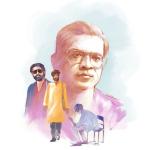
In the last week of May 1896, the London journal Nature paused over an unlikely item: a paper in the Journal of the Asiatic Society of Bengal, a journal it admitted was scarcely found in British chemical libraries, reporting a compound that many chemists believed could not exist. The author was a young professor at Presidency College, Calcutta, named Prafulla Chandra Ray. His mercurous nitrite — a stable substance built from two notoriously unstable ions — made his name in Europe. But it was never the whole of his ambition. Ray, born in 1861 in a village in what is now Khulna District of Bangladesh, set out to do three things at once: to found a modern school of chemical research in India, to prove that Indians could manufacture what science made possible, and to train the students who would carry both projects forward. He founded Bengal Chemicals, the country's first pharmaceutical company, gave away his salary and most of what he earned, and died in 1944 in the single room at Calcutta's Science College that he had made his home. Posterity knows him by two names: the honorific his students gave him, Acharya — the master who leads by example — and the title by which he is now almost universally described, the father of Indian chemistry.
Early Life in Raruli and a Calcutta Education
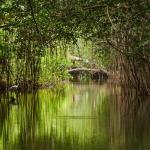
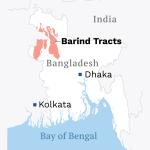
Prafulla Chandra Ray was born on 2 August 1861 in the village of Raruli-Katipara, in the south-western delta of Bengal. At his birth the village lay in Jessore district; today it falls in Paikgacha Upazila of Khulna District, Bangladesh. He was the third of seven children of Harishchandra Ray, a prosperous landowner with a love of learning, Persian and Sanskrit scholarship, and a good library, and his wife Bhuvamohini. The boy's first schooling was at the village school, and the world of his childhood was the tidal, river-cut countryside of the Bengal delta.
In 1870 the family moved to Calcutta, and Ray was admitted to the Hare School. Within a few years a severe attack of dysentery — an ailment that troubled his digestion all his life — forced him out of the classroom for an extended period, during which he read his way through his father's library: literature, history and biography more than science. His first love was always the written word, and he remained a devoted reader of Shakespeare and Bengali literature into old age. After recovering, he studied at the Albert School and then at the Metropolitan Institution, the college founded by Pandit Ishwar Chandra Vidyasagar, passing the First Arts examination of the University of Calcutta in 1881.
The turn towards chemistry came from outside his own college. While still a student of the Metropolitan Institution, Ray attended the chemistry lectures of Alexander Pedler at Presidency College and was captivated by experiment-based science. In 1882, without completing his Calcutta degree, he won a Gilchrist Scholarship — one of the few routes then open for an Indian student to study science in Britain — and sailed for Edinburgh.
Edinburgh and the Return to Calcutta
At the University of Edinburgh, Ray worked under Alexander Crum Brown, one of Britain's leading chemists. He took his BSc and then, in 1887, his DSc, with a thesis on the conjugated sulphates of the copper–magnesium group — a study of isomorphous mixtures and molecular combinations. He won the university's Hope Prize, which supported a further year of research, and was elected vice-president of the Edinburgh University Chemical Society, an unusual honour for an Indian student of the period. Edinburgh also gave him friendships and a model: he saw what a research school looked like from inside, and resolved to build one at home.
Ray returned to India in 1888 and waited about a year for a suitable post before joining Presidency College, Calcutta, as assistant professor of chemistry in 1889. He would spend twenty-seven years there, rising to professor and head of the chemistry department, and securing funds for a new chemistry laboratory that opened in 1894. His colleague at the college was the physicist Jagadish Chandra Bose, and the two men — one in a cramped chemistry laboratory, the other building his own apparatus for work on electric waves — became the twin founders of modern scientific research in Bengal.
Ray's first Indian research, published in 1894, was characteristically practical: a chemical examination of Indian foodstuffs, in particular the adulteration of ghee and mustard oil, staples of the Bengali kitchen. He also began analysing Indian minerals, hunting for elements missing from the periodic table. It was in the course of this work that, in 1896, mercury acting on dilute nitric acid in his laboratory yielded a yellow crystalline solid: mercurous nitrite, Hg2(NO2)2. The compound was remarkable because it joined two unstable ions — mercurous and nitrite — into a stable substance, and its preparation was reported and praised by Nature within weeks. Ray later wrote that the discovery "opened a new chapter in my life".
Building a School of Chemistry
The nitrite work was not a single strike but the start of a research programme. Over the following decades Ray and his students published paper after paper on nitrites and hyponitrites of different metals, on nitrites of ammonia and organic amines, and later on compounds of metals with organic sulphur derivatives. British colleagues dubbed him the "master of nitrites". By 1920 he had written 107 papers; across his career the total ran to well over a hundred, many co-authored with the students he was training.
That training was the real institution he built. At Presidency College, and from 1916 at the new University College of Science, Ray gathered around him a generation of researchers that amounted to the first modern Indian research school in chemistry. Among those who studied or worked under him were Meghnad Saha and Satyendra Nath Bose, who would remake Indian physics, and chemists such as Jnanendra Nath Mukherjee and Jnan Chandra Ghosh. The pattern was set early: a poorly funded laboratory, students taken on as collaborators rather than subordinates, and research problems pursued because they were within reach of Indian resources.
Ray also reached backwards in time. From the 1890s he combed Sanskrit manuscripts and early texts for evidence of chemical knowledge in ancient India, and in 1902 published the first volume of A History of Hindu Chemistry from the Earliest Times to the Middle of the Sixteenth Century; a second volume followed in 1909. The work — part translation, part detective work on treatises such as the Rasarnava — argued that India had its own documented tradition of alchemy and chemical craft, and it remains a foundation text in the history of science. For a colonised country told it had no scientific past, the book was itself an act of institution-building.
Bengal Chemicals and the Swadeshi Enterprise
Ray watched India import nearly every medicine and fine chemical it used, and drew the conclusion that a professorship was not enough. In 1892, working from his home at 91 Upper Circular Road in Calcutta with a capital of about Rs 700, he began making preparations on a small scale under the name Bengal Chemical Works. On 12 April 1901 the venture was reorganised and registered as the Bengal Chemical and Pharmaceutical Works Ltd — the company known today as Bengal Chemicals & Pharmaceuticals, and recognised as India's first pharmaceutical company. Ray never drew a salary from it.
The timing placed the company at the head of a movement. When Bengal was partitioned in 1905 and the Swadeshi campaign urged Indians to buy Indian goods, Bengal Chemicals became its industrial proof: proof that Indian capital, Indian chemists and Indian workers could make products that matched imports. Its hair oil, soaps, naphthalene balls and disinfectants became household names across India, and the works expanded into pharmaceuticals, chemicals and home products, employing more than 5,000 people by the 1960s. Ray lent his name and energy to other indigenous ventures as well, among them the Bengal Pottery Works and the Calcutta Soap Works. The enterprise outlived him by generations: taken over by the Government of India in 1977 and nationalised in 1980, it still operates today as a public-sector company, though it has been loss-making for long stretches and has been earmarked for strategic sale in recent years.
Teacher and Institution-Builder
In 1916 Ray left Presidency College, a year before his retirement was due, at the invitation of Calcutta University's vice-chancellor Sir Ashutosh Mukherjee, to become the first Palit Professor of Chemistry at the newly founded University College of Science — the Rajabazar Science College. He taught and researched there for twenty years. The personal arrangements tell the story of the man: a lifelong bachelor, he lived in a single room in the college, and poor students who had nowhere else to go shared it with him.
His generosity was systematic, not occasional. On completing his sixtieth year in 1921, he made a free gift of his entire remaining salary to the University of Calcutta — an endowment worth about two lakh rupees — to fund chemical research and the development of the chemistry department at the Science College. In 1922 he endowed the Nagarjuna Prize for the best work in chemistry, and later a prize in zoology and botany named for Ashutosh Mukherjee. Near his birthplace he supported the college at Bagerhat that still carries his name, Government P.C. College. When floods devastated North Bengal in 1922, the professor emerged from his laboratory to organise relief, mobilising his students into the work. He was a public advocate of the spinning wheel and khadi, Gandhi's programme of village self-reliance, and put his own money behind it.
He also built the profession's institutions. He served as general president of the Indian Science Congress in 1920, and in 1924 founded the Indian Chemical Society, serving as its first president — giving Indian chemists a society and a journal of their own. His two-volume autobiography, Life and Experiences of a Bengali Chemist (1932–1935), dedicated to the youth of India, is half memoir and half manifesto for the scientific life he wanted his countrymen to adopt.
Later Life and Legacy
Ray retired from the Palit chair in 1936, aged seventy-five, and became professor emeritus. He did not leave: he stayed on in his Science College room, working, writing and receiving students, until the end. The honours of the official world had come steadily — a CIE in 1911, a knighthood in 1919, honorary doctorates from the universities of Durham, Calcutta, Benares and Dhaka, and honorary fellowship of the Chemical Society in London. Though he had been nominated for fellowship of the Royal Society as early as 1912, he was never elected — a slight his admirers noted more than he did. At his seventieth birthday celebrations in 1931, presided over by Rabindranath Tagore, Bengal honoured him simply as Acharya.
Prafulla Chandra Ray died on 16 June 1944, aged eighty-two, in the room at the Science College where he had lived for a quarter of a century, surrounded by students and friends. He left no fortune; he had given it away in advance.
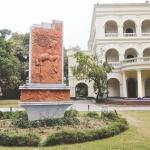
His legacy runs on three tracks. The first is the research tradition: the school he founded normalised the idea that original research could be done in Indian laboratories, and its lineage runs through the chemists and physicists he trained to institutions across the subcontinent — in Bengal, a later chemist of the same Calcutta tradition, Muhammad Qudrat-i-Khuda, would carry it into the twentieth century's second half. The second is industry: Bengal Chemicals demonstrated, a century before "self-reliance" became a slogan, that Indian science could be manufactured and sold. The third is memory. India issued a postage stamp for his birth centenary in 1961, and in 2011, on his 150th birth anniversary, the Royal Society of Chemistry installed a Chemical Landmark Plaque at Presidency University in Kolkata — the first such plaque placed outside Europe. For Bangladesh, he remains something more specific: a son of the Khulna delta who became, from a village school in Raruli, the teacher of a nation's science.