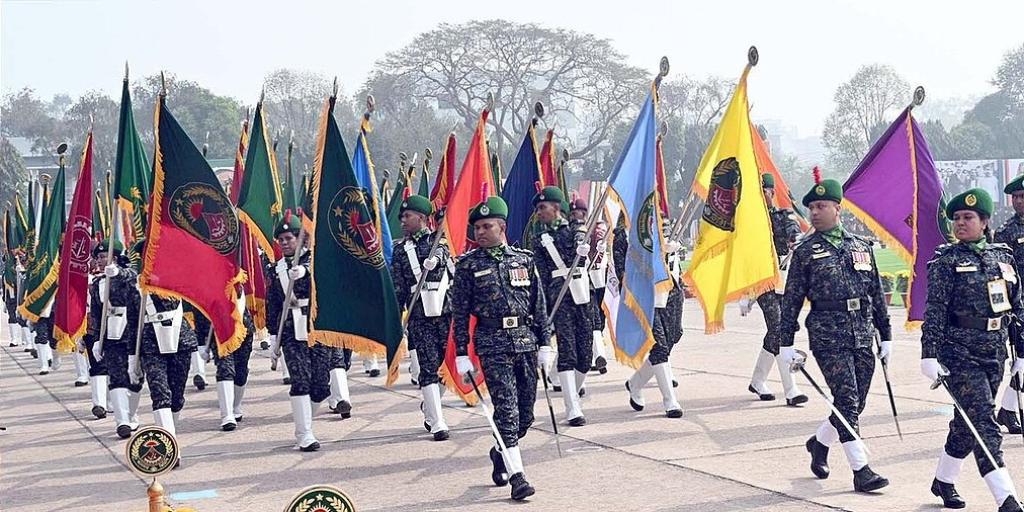
It is the largest security force in Bangladesh, and by most counts the largest paramilitary organisation in the world, yet most citizens could not describe it. The Bangladesh Ansar and Village Defence Party counts some six million members: armed battalions in the districts, part-time guards on the gates of banks, courts and power stations, and, in every village in the country, a platoon of men and a platoon of women enrolled as the Village Defence Party. It guards the polling centres of every national election, stands watch over the state's key installations, and has done versions of this work since 1948, through two states and a liberation war. As of November 2026, the force is led by its Director General, Major General Abdul Motaleb Sazzad Mahmud.
Bangladesh Ansar and VDP at a Glance
- Formed: 12 February 1948, as the East Bengal Ansars
- Headquarters: Khilgaon, Dhaka; training academy at Shafipur, Gazipur
- Parent ministry: Ministry of Home Affairs; senior posts are held in part by army officers on deputation, and the Director General is a serving major general
- Strength: about six million members in total, the great majority of them Village Defence Party volunteers; some 40 Ansar battalions (38 men's and 2 women's)
- Components: three, each under its own 1995 Act: the Ansar Bahini (general and embodied Ansar), the Battalion Ansar, and the Village Defence Party (VDP), with the Town Defence Party (TDP) in urban areas
- Officers: a dedicated Bangladesh Civil Service (Ansar) cadre
- Budget: about Tk 2,185 crore for 2026 to 2027
Origins: The Helpers of 1948
The name is a statement of purpose. Ansar is the Arabic word for the helpers of Medina, the people who sheltered the Prophet Muhammad and his followers when they migrated from Mecca, and it was chosen for a force of volunteers who would help keep order in their own communities. The force was created by the East Bengal Ansars Act of 1948 and officially launched on 12 February 1948, in the first months of Pakistan's existence, to support the police in a new province short of every kind of institution. Its first director was James Buchanan, a British official appointed by the government of the Chief Minister of East Bengal, Khawaja Nazimuddin. From the beginning the idea was distinctive: not a second police force and not an army, but an organised body of the public itself, uniformed, trained and callable, standing between the citizen and the state.
1971: The Guard of Honour
The force's defining moment came in the Liberation War. When the war began in 1971, most Ansar members joined the resistance, carrying local knowledge and basic training into the Mukti Bahini across the country. The force remembers two honours from that year above all: its members presented the guard of honour to the provisional government of Bangladesh at its swearing-in at Mujibnagar, the first salute of the new state given by its own volunteers, and, by the force's own account, nine officers and 661 Ansar members were martyred in the war. After independence the force was reorganised in 1972 under the Ministry of Home Affairs of Bangladesh, and in 1980 its officers were constituted as a separate cadre of the Bangladesh Civil Service, giving the volunteer idea a professional spine.
Three Forces in One
The modern organisation, restated in three Acts of Parliament passed in 1995, is really three forces wearing one name. The first is the Ansar Bahini proper, the general Ansar: enrolled members who live at home and are embodied, called into paid service, when the state needs them, above all to guard offices, banks, courts, industrial sites and key installations, and to reinforce security at national moments. The second is the Battalion Ansar, the force's armed, full-time striking arm: the first twenty battalions were raised in 1976 on the model of the armed police battalions, and there are now some forty, including two women's battalions, deployable anywhere in the country in support of the civil administration. The third is the largest volunteer body of all, the Village Defence Party.
The VDP was founded on 5 January 1976, as part of President Ziaur Rahman's programme of self-reliant village government, and its design is unlike anything else in the security sector. Every village in Bangladesh has a VDP platoon of men and a platoon of women; the Town Defence Party, formed in 1980, does the same for urban wards. Membership runs to nearly six million people, around half of them women, making the VDP at once a security auxiliary, a village-level organisation for disaster response and development work, and the largest organised body of women in the country. The VDP marked its golden jubilee, fifty years since its founding, at the Ansar and VDP Academy in January 2026.
The embodied Ansar deserve a closer look, because they are the members the public actually meets. An enrolled Ansar trains for a short period and is then embodied, posted in small detachments to the places the state must guard every day: bank branches and government offices, courts and hospitals, power and water installations, ports and railway stations. The work is static, long-hour and modestly paid, closer to a national guard service than to a career, and members cycle between embodiment and civilian life. It is this tier, hundreds of thousands strong over the years, that gives the force its everyday presence, and its terms of service, pay, rations and the demand for regularised jobs, have been the force's recurring internal question for decades.
The women's place in the force is structural, not decorative. Alongside the two women's battalions of the Battalion Ansar, the VDP's design writes women into village security as of right: a women's platoon in every village, women union leaders alongside men, and a membership that is roughly half female in a force of millions. In a country where rural women's public roles are still contested, the VDP has quietly normalised the sight of women in uniformed public service for fifty years, and its women members are a standing reserve for election duty, disaster relief and community health and development campaigns in their own villages.
What the Force Does
The statutory objectives of the Ansar, as written in the 1995 Act, are to assist the government in matters of public security, to take part in work for public welfare and socio-economic development, and to assist the Army, Navy, Air Force, Border Guard Bangladesh, Police and Battalion Ansar when directed by the government. In practice, the force's most visible hour comes at elections: in one recent national election, by the Director General's own account, 220,108 Ansar and VDP members were deployed to 18,209 polling centres, more uniformed personnel at the grassroots than any other single agency could field. Between elections, embodied Ansar stand guard at the country's key point installations and public institutions, battalions reinforce districts in emergencies, and VDP members serve as their villages' first organised response to crime, disaster and relief distribution. It is unglamorous, distributed, essential work, which is precisely why it is so rarely noticed.
The disaster role is written into that same design. Bangladesh's calamities are local before they are national: a cyclone makes landfall on particular villages, a flood cuts particular unions, and the first organised hands on the scene are usually the VDP platoons of those villages, who know every household, boat and embankment. The force lists disaster management among its standing functions, and its members work alongside the administration in evacuation, relief distribution and post-disaster recovery, a role that repeats every monsoon and every cyclone season on the coast. The force's breadth also makes it a delivery channel for the state in ordinary times: development and awareness campaigns, from tree planting to public health drives, routinely run through its village structure because there is no other network that reaches every settlement in the country.
The force's modern stress test came in August 2024. In the days after the fall of the government, when police stations across the country stood empty and their personnel absent, Ansar members were among those moved into guard duties at stations and installations to keep a uniformed presence on the street. The same month, embodied Ansar members demonstrated in Dhaka for the nationalisation of their jobs, pressing the long-standing complaint of the force's most deployed tier: that work which is permanent in fact should be permanent in law. Both episodes, the duty and the protest, belong in any honest account of the force today, and the welfare and regularisation question remains open.
Training and Command
The force is commanded from its headquarters at Khilgaon in Dhaka, under a Director General of major general's rank, seconded from the Bangladesh Army, with a mix of army officers on deputation and the force's own BCS (Ansar) cadre officers below him; nineteen officers of the 45th BCS (Ansar) cadre joined the force in November 2026 alone. Its institutional heart is the Bangladesh Ansar and VDP Academy at Shafipur in Gazipur, where battalion recruits pass out, VDP leaders train, and the force holds its national assembly and parade each February around the anniversary of its founding. District commandants and range directors run the organisation's field structure, down through union-level VDP leaders to the village platoons themselves.
The Force Today
The questions around the Ansar in 2026 are those of a force professionalising late. Its leadership speaks the language of modernisation: in July 2026 the force signed a five-year partnership with Grameenphone for the digital transformation of its operations, and headquarters describes ongoing initiatives on members' financial security, professional standing, training and working conditions, particularly for the embodied Ansar who guard institutions on modest terms, alongside new barracks construction. The pay and status of those embodied members, the force's most deployed and least visible personnel, remain its standing welfare question. Leadership itself supplied a brief drama in November 2026: on 15 November the government appointed Major General Towhidul Ahmed as Director General, and two days later cancelled the order, leaving Major General Abdul Motaleb Sazzad Mahmud in post. The episode passed in forty-eight hours; the force beneath it, six million strong and woven into every village in Bangladesh, continued its rounds undisturbed, which is perhaps the most Ansar outcome imaginable.
Measured by visibility, the Ansar will always lose to the army and the police. Measured by presence, nothing else in the Bangladeshi state comes close: no other institution has a uniformed member in every village, a guard on so many gates, and a roster that runs into the millions. It is, in the oldest sense of its name, a force of helpers, and the country runs on more of its quiet labour than it ever stops to count.
Sources
Bangladesh Ansar and VDP official histories and the Ansar Bahini, Battalion Ansar and VDP Acts of 1995; interview of the Director General in The Guardian (Bangladesh); The Business Standard and bdnews24 reporting of November 2026 on the Director General appointment and its cancellation; The Daily Star and TBS reporting on the VDP golden jubilee (January 2026) and the Grameenphone partnership (July 2026); Wikipedia's Bangladesh Ansar article, cross-checked against the above.