The Bangladesh Police is the national police force of Bangladesh and the country's principal law enforcement agency: the service that staffs every police station, guards every highway and election, investigates crime from village theft to transnational trafficking, and sends formed units to United Nations peacekeeping missions abroad. It is one of the largest employers in the country and one of its oldest continuous institutions, with roots in a colonial act of 1861, a founding chapter written in the Liberation War of 1971, and a present defined by an argument about reform that the force itself has joined. As of November 2026, the force is led by Inspector General of Police Md. Ali Hossain Fakir, who took office on 24 February 2026.
Bangladesh Police at a Glance
- Headquarters: Police Bhaban, 6 Phoenix Road, Fulbaria, Dhaka
- Personnel: about 220,000, the largest uniformed civilian service in the country
- Network: 651 police stations, eight metropolitan police commissionerates, and district police across all 64 districts
- Legal basis: the Police Act of 1861, with later laws and rules; the force works under the Ministry of Home Affairs
- Specialised units: Rapid Action Battalion (RAB), Criminal Investigation Department (CID), Special Branch (SB), Detective Branch (DB), Police Bureau of Investigation (PBI), Armed Police Battalion (APBn), Highway, Railway, Tourist, Industrial and River Police, and counter-terrorism units
- Training: Bangladesh Police Academy, Sardah (established 1912); Police Staff College, Dhaka (2000)
- Abroad: UN peacekeeping contributor since 1989, among the largest police-contributing countries
Origins: A Force Built by an Empire
Policing in Bengal is older than the modern force, but the institution Bangladesh inherited was designed by the British after the rebellion of 1857. The Police Act of 1861 created a single, centrally commanded constabulary for British India, organised by province and district, uniformed, and answerable upward to the government of the day rather than to the communities it policed. That design, professional in its record keeping and discipline, colonial in its instincts, passed in 1947 to East Pakistan and in 1971 to Bangladesh, and the 1861 Act, amended but never replaced, remains the legal skeleton of the force today. Reformers have pointed at that skeleton for decades: a law written to control a subject population, they argue, sits uneasily under a republic that asks its police to serve citizens.
Through the Pakistan period the force in the east was the East Pakistan Police, commanded from a headquarters in Dhaka and chronically under-resourced relative to the west wing. Its Bengali officers and constables, however, were woven into the life of the province, and when the crisis of 1971 came, that local rootedness decided which side of history the force's first martyrs would fall on.
1971: The First Resistance
The Bangladesh Police dates its proudest chapter to the first hours of the Liberation War. On the night of 25 March 1971, as the Pakistan Army launched its crackdown on Dhaka, Bengali police personnel at the Rajarbagh Police Lines took up their rifles and mounted what is remembered as the first armed resistance of the war, holding their position against a modern army until they were overwhelmed. Police members across the country joined the resistance in the days that followed, carrying their training and their weapons into the Mukti Bahini, and the force commemorates its 1971 martyrs as founders in all but name.
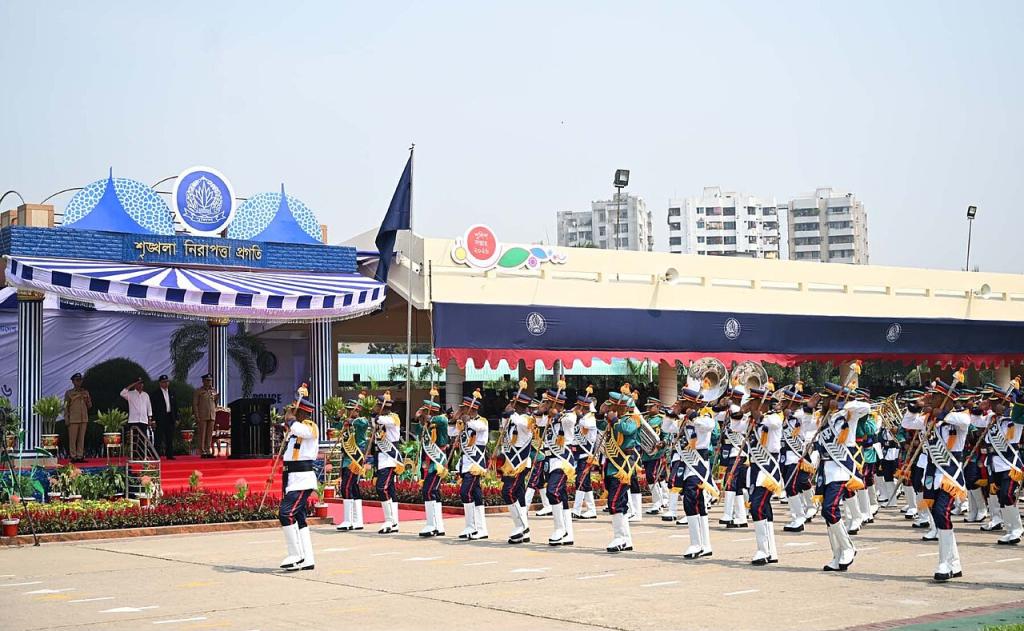
Rajarbagh remains the ceremonial heart of the service: its parade ground hosts the annual Police Week parade, and its memorial honours the policemen and women who have died on duty since. The independent Bangladesh Police formally emerged with the new state in December 1971, and the force dates its formation to 16 December 1971, Victory Day itself. It inherited the stations, the law and the personnel of the old force, and added a founding story no other Bangladeshi institution can quite match; the argument over what a republic's police should be, as against an empire's, has run through the service ever since.
Structure and Units
The force is commanded by the Inspector General of Police from Police Headquarters in Dhaka. Below headquarters, territorial policing runs through ranges and districts: each district's Superintendent of Police commands its police stations, the thanas, which are the public face of the service, while the eight largest cities are policed instead by metropolitan commissionerates, of which the Dhaka Metropolitan Police is by far the largest. Alongside the territorial structure stands a shelf of specialised formations, each built for a problem the thana could not solve alone.
Personnel enter at three levels: as constables, the foundation rank that staffs the thanas and the battalions; as sub-inspectors, the investigating officers of the stations, recruited directly; and as assistant superintendents through the Bangladesh Civil Service (Police) cadre, the officer track that leads through Superintendent of Police, Deputy Inspector General and Additional Inspector General to the IGP. Women first joined the force in 1974 and now serve across its units and ranks, including in formed police units deployed abroad.
The best known is the Rapid Action Battalion, raised in 2004 as an elite, composite force drawing personnel from the police and the armed services, and tasked with counter-terrorism, armed crime and the recovery of illegal weapons; at its height it fielded some 12,000 personnel in battalions across the country. Investigation is carried by the Criminal Investigation Department and, since 2012, the Police Bureau of Investigation for scheduled serious offences; intelligence by the Special Branch; plain-clothes detection by the Detective Branch. The Armed Police Battalions provide armed reserve and guard duties, the Special Security and Protection Battalion guards the state's most senior figures, and single-purpose forces police the highways, the railways, tourist zones, industrial belts and the great rivers. Dhaka's Counter Terrorism and Transnational Crime unit and its SWAT teams handle the capital's gravest threats, and a dedicated MRT Police now guards the metro rail. It is, in effect, not one police force but a family of them under a single command.
Training: Sardah and the Making of an Officer
Every police officer in Bangladesh passes, in spirit if not in person, through Sardah. The Bangladesh Police Academy, established in 1912 on the bank of the Padma at Sardah in Rajshahi, is the force's foundational school: assistant superintendents recruited through the Bangladesh Civil Service examination and sub-inspectors recruited directly complete their basic training on its parade grounds, in a campus of colonial-era buildings that is itself a piece of institutional history. Constables train at regional training centres, and serving officers return through their careers to in-service schools, crowned by the Police Staff College in Dhaka, established in 2000 for mid-career and senior officers. A dedicated Police Peacekeepers' Training School at Rajarbagh prepares personnel for United Nations service, a pipeline that has become one of the force's defining specialities.
Peacekeeping: The Force Abroad
Since its first deployment, to Namibia in 1989, the Bangladesh Police has served in United Nations peacekeeping missions across Africa, the Balkans, the Caribbean and Southeast Asia, in countries including Congo, Sudan, Liberia, Ivory Coast, Kosovo, East Timor, Angola and Haiti. In 2005 it sent its first Formed Police Unit, a self-contained armed contingent, and Bangladesh has ranked among the largest police-contributing countries in the UN system. Bangladeshi women officers have been a deliberate part of the contribution, serving in formed units and individual roles that draw international notice. Mission postings are among the most sought-after in the service, and returning peacekeepers carry home both savings and a standard of professional practice that trainers at Rajarbagh work to spread through the force. For a force often judged at home by its worst headlines, peacekeeping is a point of professional pride and a significant source of training, income and international standing.
The Service Today
The everyday work of the force is less visible than its battalions. It is the thana duty officer taking a general diary entry, the traffic sergeant in the Dhaka rain, the highway patrol on the night bus routes, and, since 2017, the operators of the national emergency helpline 999, which routes police, fire and ambulance calls from a single number. The thana itself, led by an officer-in-charge and covering a defined slice of a district or city, remains the unit on which the whole structure rests: the first report of a crime, the first response to a disaster and the first point of contact between the citizen and the state all happen across its desk, which is why every reform proposal of the last fifty years has, in the end, been a proposal about the thana. Community policing forums attempt, with mixed success, to rebuild the link between stations and neighbourhoods, and online services now allow general diary entries and police clearance certificates to be filed without a visit. The force's scale shows most clearly at national moments: for the 13th parliamentary election of February 2026, the Home Ministry deployed 149,443 police personnel as part of a security operation of nearly nine lakh law enforcers, the largest recurring task the Bangladeshi state performs.
Reckoning and Reform
No honest account of the force can end there. The police's role in the suppression of the July to August 2024 protests, in which large numbers of protesters were killed, inflicted the deepest damage on its legitimacy in its history; its own then chief, IGP Baharul Alam, later acknowledged publicly that some officers had violated the law and failed in their duties during those weeks, and after the fall of the government on 5 August 2024, police stations were attacked and burned and the service briefly collapsed in many areas. The Rapid Action Battalion carries its own burden: the United States imposed sanctions in December 2021 on the battalion and several of its former officials over allegations of extrajudicial killings and enforced disappearances, allegations that remain before Bangladesh's International Crimes Tribunal processes. In October 2026, reported remarks by the sitting IGP appearing to favour a return to so-called crossfire drew public criticism from former police chiefs, a sign of how live the argument remains.
The reform debate is now institutional. A Police Reform Commission appointed by the interim government in October 2024 recommended insulating the force from political interference, including through an independent police commission, a demand senior officers themselves, including IGP Baharul Alam, publicly echoed in calls for the force to be freed from political and executive influence. Whether those recommendations are enacted, and whether the 1861 Act is finally replaced, is the central open question of Bangladeshi policing. The force that fired some of the first shots of 1971 is, by its own account and its critics' alike, still waiting to be remade for the republic it serves.
Sources
Bangladesh Police official histories and Police Headquarters publications; Ministry of Home Affairs statements on the February 2026 election deployment; United Nations peacekeeping contribution records; The Daily Star, bdnews24 and UNB reporting on the reform debate (2024 to 2026); TOB News reporting of October 2026 on the IGP's remarks and the response of former police chiefs.