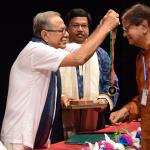
Every country keeps a short list of names it wishes to thank in public, and for Bangladesh's artists the most personal of those thank-yous is the Shilpakala Padak, the Shilpakala Academy Award. It is not the state's highest honour, and it does not try to be. It is the arts world's own medal, given by the Bangladesh Shilpakala Academy, the national academy of fine and performing arts, to the singers, dancers, actors, painters, photographers, filmmakers and folk artists who have spent a lifetime building the country's culture. Since 2013 it has been presented, usually by the President of Bangladesh, at the National Theatre Hall in Dhaka, and for many recipients, especially those from folk and regional traditions far from the capital's spotlight, it is the first national recognition of their lives. This article traces the award from its first class of 2013 through its documented editions.
Shilpakala Academy Award at a Glance
- Instituted: 2013, by the Bangladesh Shilpakala Academy
- Presented by: the President of Bangladesh, at the National Theatre Hall, Shilpakala Academy, Segunbagicha, Dhaka
- The award: a gold medal, a cheque for Tk 1,00,000, a certificate and a traditional uttorio scarf
- Fields: vocal music, instrumental music, dance, theatre, fine arts, recitation, photography, film, folk music and folklore, jatra, cultural research and creative cultural organisation
- Recipients: seven in the first editions; ten a year in the 2019 and 2020 editions, including, for the first time, cultural organisations
- Selection: by an academy selection committee, from the fields' senior and established figures
The Academy Behind the Award
The Bangladesh Shilpakala Academy is the state's principal cultural institution: founded in 1974 as the national academy for the fine and performing arts, it runs the National Theatre Hall and national art gallery at its Segunbagicha headquarters in Dhaka, stages festivals, exhibitions and productions across the country, and works through district and sub-district shilpakala academies in every corner of Bangladesh. An institution with that reach sees, better than any ministry, who has actually carried the country's culture: the jatra artist who has played village stages for forty years, the flute maker and player known in one region, the theatre worker who never left her district town. The Padak, introduced four decades into the academy's life, was designed to let the institution say so formally.
The academy's home ground matters to the award's meaning. The Segunbagicha complex in Dhaka holds the National Theatre Hall, the National Art Gallery and the academy's training and rehearsal spaces, and through the year it hosts the country's central festivals of theatre, jatra, dance and music and its largest art exhibitions. The Padak is presented on that same stage, in the middle of the working home of Bangladeshi art, rather than in a state ceremonial venue. A recipient receives the medal where she may have performed, exhibited or rehearsed for decades, in front of the community that knows the work best.
The award sits within the Ministry of Cultural Affairs' family of honours, but its character is distinct. The great state awards, the Independence Award and the Ekushey Padak, are decided by the government and honour achievement across all national life, with the arts as one category among many. The Shilpakala Padak is narrower and, to its recipients, warmer: it is judged within the arts community, field by field, and it can reach practitioners, folk singers, instrumentalists, photographers, reciters, whose work is immense but whose names may never reach a cabinet committee.
What the Award Honours
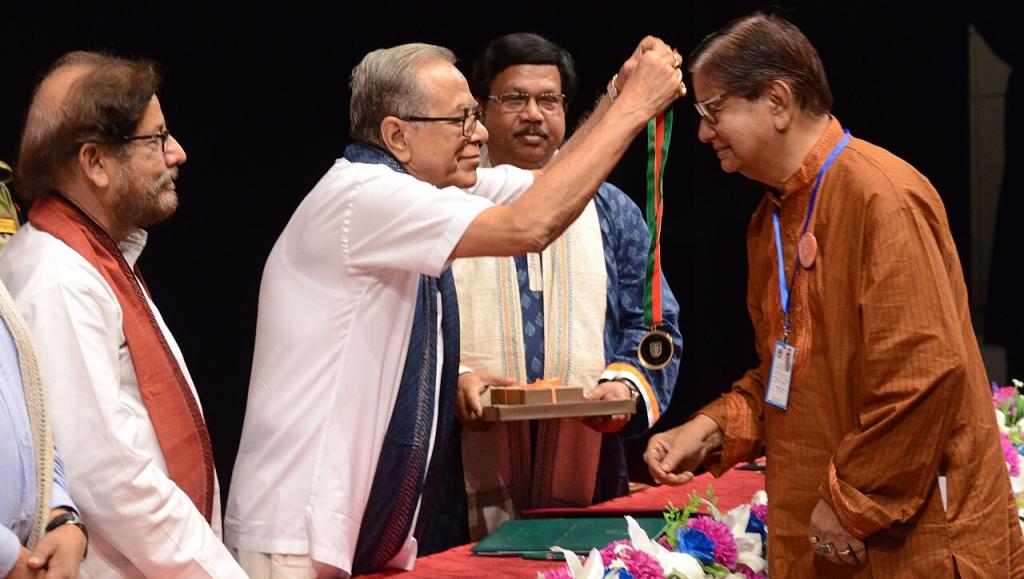
The Padak recognises lifetime contribution rather than a single work. Its categories map the academy's own departments: vocal music and instrumental music; dance; theatre and dramatics; fine arts; recitation; photography; film; folk music and folklore, including jatra, the folk theatre of Bengal; and, in the later editions, cultural research and the creative cultural organisation, a category that admitted institutions for the first time in 2019. A selection committee of the academy, sixteen members in the 2016 cycle, chooses the recipients each year, and the awards are announced before a formal presentation ceremony at the National Theatre Hall, where the President hands each recipient the medal, the cheque for one lakh taka, the certificate and the uttorio.
Two of the categories tell a visitor more about Bangladesh than any other line in the list. Jatra, the open-air folk opera performed on village stages through the winter nights, employs thousands of travelling actors and musicians and has almost no other route to national honour; its presence among the categories is the academy's declaration that the folk stage is art. Recitation, the performed reading of poetry, is likewise a distinctly Bengali art, bound up with the language movement and the public life of Bengali verse, and it too has few other national platforms. An honours list that finds room for the jatra veteran and the reciter alongside the concert vocalist and the gallery painter is describing the country's culture as it is actually practised, not only as it is televised.
The money is modest next to the state awards, and deliberately so: the Padak's currency is standing among peers. For a folk artist from a district town, the journey to Dhaka, the President's medal and the academy's certificate frame a career for the record, and the list of recipients has become, year by year, a working roll of honour of Bangladeshi culture in the early 21st century.
The First Class of 2013
The first Shilpakala Padak, presented on 30 December 2013, went to seven artists who between them sketched the whole map of the fields the award would cover: the dancer Amanul Haque, a pioneer of dance in post-liberation Bangladesh; the classical musician Ustad Matiul Haque Khan; the folk singer Saidur Rahman Bayati, honoured for the baul and folk tradition; the artist Samarjit Roy Chowdhury for fine arts; the Tagore singer Fahmida Khatun; the filmmaker Manzare Hassin Murad; and the theatre activist Khaled Khan, who received the award posthumously. President Abdul Hamid presented the awards, setting the pattern the ceremony has kept since.
The editions that followed widened the roll. The 2014 awards, presented in February 2015, went to the dancer Ustad Bazlur Rahman Badal, the classical singer Pandit Amaresh Roy Chowdhury, the tabla artist Pandit Madan Gopal Das, the sculptor Syed Abdullah Khalid, the recitation artist Ashraful Alam, the actor and director Lucky Enam and the photographer Dr Shahidul Alam. The 2015 awards went to the dancer Saleha Chowdhury, the folk singer Nadira Begum, the dramatist Kazi Borhanuddin, the musician Sujeo Shyam, the recitation artist Nikhil Sen, the artist Syed Abul Barak Alvi and the singer Mihir Nandi. The 2016 award, presented in July 2017, went to seven recipients: the theatre director Syed Jamil Ahmed, the instrumentalist Pabitra Mohan Dey, the dancer Golam Mostafa Khan, the photographer Golam Mostafa, the artist Kalidas Karmakar, the folk artist Sirajuddin Pathan and the vocalist Mita Haque. Read together, the early lists show the award's instinct at work: national figures and regional masters side by side, the concert stage and the village fairground given the same medal.
The ceremony itself follows a settled form. The recipients, announced in advance by the academy, gather at the National Theatre Hall with their families; the President presents the medal, the cheque, the certificate and the uttorio to each in turn, and the evening closes with performances, often by younger artists in the recipients' own fields. For the record, the occasion matters beyond the hall: the academy's announcements are frequently the first time a folk master's name and life's work have been written into the national press at all, and the recipient lists are now consulted as a reference for who shaped each art form in the decades after independence.
2019 and 2020: Ten Fields, and the Organisations Join
By the end of the decade the award had grown to ten recipients a year, one for each field, and had opened its doors to institutions. The 2019 Padak went to Mohammad Moniruzzaman (instrumental music, flute), Lubna Marium (dance), Hasina Momtaz (vocal music), Abdul Mannan (fine arts), Masud Ali Khan (dramatics), M A Taher (photography), Shambhu Acharya (folklore), Hasan Arif (recitation), Anupam Hayat (film) and, in the new creative cultural organisation category, Chhayanaut, the music institution founded in 1961 that stands at the centre of Bengali cultural life. The 2020 list followed the same pattern: Shamsur Rahman (instrumental, shehnai), Shibli Mohammad (dance), Mahmudur Rahman Benu (vocal), Shahid Kabir (fine arts), Malay Bhowmick (dramatics), Shafiqul Islam Swapan (photography), Shah Alam Sarkar (folklore), Dahlia Ahmed (recitation), Shameem Akhtar (film) and the Dinajpur Nattya Samity, a district theatre group, as the organisation honoured.
The pandemic then did to the Padak what it did to every stage in the country. The 2019 and 2020 awards could not be presented on schedule, and the academy finally handed over both years together, eighteen individuals and two organisations, at a single ceremony at the National Theatre Hall in September 2022. The double ceremony was a reminder of both the award's resilience and its fragility: it depends, as all theatre does, on people being able to gather.
The Wider Landscape of Honour
The Padak does not stand alone. Above it in the national hierarchy sit the Ekushey Padak, whose Shilpakala categories honour artists each February, and the Independence Award; beside it, the academy itself runs a second, broader tier of recognition, the District Shilpakala Shammanana, honouring five cultural activists from every district each year, a grassroots roll that feeds names upward. The academy's director general described the two tiers together at the 2022 ceremony: the Padak for the nation's established masters, the district honours for the thousands who sustain culture locally. Between the two, the academy maintains something no other Bangladeshi institution attempts: a complete ladder of recognition for artistic work, from the village stage to the National Theatre Hall.
That ladder is the award's real significance. Bangladesh's honours system is rich at the top and thin in the middle; artists of genuine lifetime achievement, outside the two or three most famous names in each field, can easily go unthanked. The Shilpakala Padak was built for exactly that middle: the flautist, the jatra veteran, the district photographer, the theatre group in Dinajpur. In honouring them, in the President's presence and on the national academy's stage, it states a principle worth the medal itself: that a country's culture is carried by far more people than its headlines remember, and that an institution exists whose job is to remember them. The six editions documented here alone name 48 artists and organisations, a first draft of a national cultural biography, written one medal at a time.
Sources
Bangladesh Shilpakala Academy announcements and ceremony reports; The Daily Star, New Age and Dhaka Tribune coverage of the 2013 to 2020 editions, including the combined 2019 and 2020 presentation of September 2022; Wikipedia's Shilpakala Padak recipient lists, cross-checked against the newspaper record.