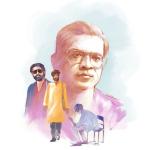
Hason Raja (1854–1922) was a zamindar of Sylhet who owned, by his family's reckoning, one of the largest landed estates in north-eastern Bengal — and who is remembered not for the land at all, but for songs. Singing in the Sylheti dialect, in tunes of his own making, this landlord with no formal schooling composed the mystic verses that boatmen, farmers and bauls across the haor country took up as their own: "Loke Bole Bole Re", "Baula Ke Banailo Re", "Matiro Pinjiri". In his lifetime his fame barely left his home district of Sunamganj. A few years after his death, Rabindranath Tagore quoted him before the Indian Philosophical Congress and in lectures at Oxford, and the "rural poet of East Bengal", as Tagore called him, became a permanent figure of Bengali culture — the landlord who sang himself out of his class, and into the company of Bengal's great mystic poets.
Roots in Lakshmansree
Dewan Hason Raja Chowdhury was born in 1854 at Teghoriya village in Lakshmansree, near Sunamganj, then a subdivision of Sylhet district in the Bengal Presidency. Most accounts give his birthday as 21 December 1854 — the date on which his birth anniversary is still observed in Sunamganj; Banglapedia, the national encyclopedia, gives 24 January 1854 instead. His father, Dewan Ali Reza Chowdhury, was zamindar of Lakshmansree and of Rampasha, the family's ancestral seat across in Bishwanath, and Hason Raja spent his childhood between the two houses, growing up largely with his mother, Hurmat Jahan Bibi, at Lakshmansree, on the bank of the Surma river.
The family was itself a product of Bengal's layered history. By Banglapedia's account, his forefathers had migrated from Awadh in northern India, settling first in Jessore and then in Sylhet, and his grandfather — born a Kshatriya Hindu, Birendra Chandra Simha — had embraced Islam and taken the name Babu Khan. The boy who inherited this estate received no formal education at all; like other sons of the landed aristocracy, he was taught at home, within the family's own world. What that world gave him, instead of schooling, was the Sylhet countryside itself — the rivers, markets and, above all, the vast seasonal wetlands of the haor basin in which Sunamganj sits, a landscape that floods to the horizon in the monsoon and dries to rice stubble in winter, and whose boatmen and ploughmen would one day be his audience.
The Young Zamindar
In 1869, when Hason Raja was about fifteen, death rearranged his life. His elder half-brother Ubaidur Raja died, and his father followed some forty days later; the boy succeeded to the zamindari. Banglapedia records that he administered the estate for fifty-two years. Its extent is hard to fix precisely — family holdings spread across Sunamganj and Netrokona and into Sylhet — but his grandson, the philosopher Dewan Mohammad Azraf, put the estate at some 527,000 bighas, a figure best treated as a measure of its reputation rather than a surveyed fact. By any measure, the young Hason Raja was a considerable landlord, and for years he lived exactly as one.
Banglapedia does not varnish this period: the young zamindar, it says, was not above sensuality, luxury, caprice and whim — though he was also, even then, kind and generous to the needy. He kept horses and elephants, and had a particular passion for the korha, a long-legged bird of the haors, which he reared at home. He founded schools and mosques on his lands and gave land away for public purposes. Nature, meanwhile, gave him an early lesson in the fragility of all this property: the great Assam earthquake of 12 June 1897 levelled his thatched house and killed many of the tame birds and animals he kept, a disaster his son Ganiur Raja would record in a diary decades later.
The Turning
Sometime in middle age, the zamindar's outlook changed altogether. Under the influence of a Sufi teacher, Banglapedia relates, Hason Raja turned from the pleasures of the estate to spiritual seeking, and began to compose the mystic songs for which he is remembered. School textbooks in Bangladesh still tell the story in its starkest form — the landlord who saw that wealth and pleasure were meaningless, and gave himself to the search for the Creator — and while the reality was no doubt slower and less tidy than the legend, the songs themselves document a genuine conversion of life. The man who had administered rents and kept elephants began to sign his verses, in the self-mocking signature line (the bhanita) of Bengali song, as "Pagla Hason Raja" — Crazy Hason Raja.
What he sang about was the oldest question of the Bengal delta's mystic tradition, the one Lalon Shah had sung a generation earlier in Kushtia: where is God to be found? Hason Raja's answer, repeated through his songs, was that God is not in mosque or temple or scripture alone but within the human person — the "Eternal Person" who dwells in the heart. He named that being Allah, Hari and Krishna in turn, and perceived, as Banglapedia puts it, no difference between his own self and the godhead: the Sufi doctrine of Anal-Haq, "I am the Truth", runs through his work. Yet the songs are never abstract. They are built from the materials of his own life — the landlord's house that will crumble, the body imagined as a cage of clay with a captive bird inside it, the intoxication of divine love described in the language of a man who knew intoxication.
The Songs
Hason Raja composed in the regional dialect of Sylhet and in folk forms, and his songs travelled as folk songs travel: from mouth to mouth, singer to singer, long before they were printed. Banglapedia insists on one distinction — that although he used local dialect and folk tune, his style was exclusively his own, so that his works deserve their own name: Hasan Rajar Gan, the songs of Hason Raja.
A handful of them have never stopped being sung. "Loke Bole Bole Re" — "People say, oh, people say my house is no good; what house shall I build in the midst of emptiness?" — turns the zamindar's own mansion into a parable of impermanence, and remains his best-known song. "Baula Ke Banailo Re" asks, in wonder, who made Hason Raja a baul. In "Matiro Pinjiri", the "Cage of Clay", the soul is a bird trapped in the earthen cage of the body, weeping to be free. "Nisha Lagila Re" — "Intoxication has seized me, intoxication in my two bent eyes" — describes the madness of divine love, and characteristically weaves the singer himself into the scene: Hason Raja singing with clapping hands, abandoning Lakshmansree and Rampasha, while his beloved stands nearby and listens. "Sona Bondhe", "Rup Dekhilam Re Nayane" and dozens more carry the same signature — philosophy carried on a tune a boatman could hold.
Hason Udas and the Written Record
Because the songs lived by word of mouth, pinning down their number is impossible. Popular accounts credit Hason Raja with about a thousand compositions; most were never written down, and what survives in print is a fraction of the whole. The foundation of the written record is Hason Udas, the anthology of 206 of his songs published in his lifetime — dated 1907 in most accounts, though Banglapedia gives 1914. A second book, the prose work Saukhin Bahar, is a curiosity of a different kind: drawing on his years of keeping animals, it analyses the appearance, nature and character of the korha bird, the horse and the elephant — and of women, in passages Banglapedia itself finds wanting in taste. Other pieces by him appeared in the periodicals of the day. After his death, editors and descendants continued the gathering: the collected Hason Raja Samagra, edited by his descendant Dewan Mohammad Tasawwar Raja and first published in 2000, brings together some 500 poems and songs.
Tagore Carries the Songs to the World
Hason Raja died with his reputation still a local one, strongest in Sylhet and Sunamganj. What carried it to the world was the advocacy of Rabindranath Tagore. Tagore, who returned to the songs again and again when he spoke on philosophy, religion and folk culture, mentioned Hason Raja at the Indian Philosophical Congress in Calcutta in 1925, and then, in 1930, quoted him in the Hibbert Lectures at Oxford — the lectures published the following year as The Religion of Man. There the Nobel laureate told his audience of "a village poet of East Bengal who preaches in a song the philosophical doctrine that the universe has its reality in its relation to the Person", and quoted the song in which the divine form appears before the poet's own eyes: "Rup dekhilam re nayane" — "I have seen the Form in my eyes, my own form I have seen". Of such a song Tagore wrote that the poet "sings of the Eternal person within him coming out and appearing before his eyes just as the Vedic Rishi speaks of the person who in him, dwelling also in the heart of the Sun". It was an extraordinary act of recognition: the most famous writer in Asia presenting an unschooled Sylheti landlord, dead eight years, as a philosopher to be set beside the seers of the Upanishads.
Death and Afterlife
Hason Raja died in December 1922, in the month of Poush in which he had also been born, and was buried beside his mother's grave at Lakshmansree. Even the day is disputed: his family trust and most modern reports give 6 December 1922 — the date on which his death anniversary is now observed in Sunamganj — while an earlier edition of Banglapedia gave 7 December and one newspaper account gave 8 December; the current Banglapedia says only November 1922, which no other source supports.
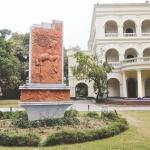
His memory is kept by two small museums run by family trusts: the Hason Raja Museum at his birthplace in Lakshmansree, Sunamganj, and the Museum of Rajas' at Raja Kunjo, Sylhet, his ancestral home, which preserves relics of Hason Raja, of his poet son Eklimur Raja and of later generations of the family. The ancestral house at Rampasha, meanwhile, was found by reporters in 2013 standing in neglect and near ruin — a reminder that the physical remains of his world are perishing even as the songs spread. In Sunamganj, a Hason Mela, or Hason folk festival, has been held every year in Poush since 1967, and his birth and death anniversaries are still formally observed there; the 171st birth anniversary fell in December 2025.
The twentieth century twice reintroduced him to the nation. The writer Humayun Ahmed, himself the defining popular author of modern Bangladesh, wove Hason Raja's songs through his films and television dramas, carrying them to a generation that had never heard a baul sing. Cinema followed: Chashi Nazrul Islam's film Hason Raja (2002), with Helal Khan in the title role, won national film awards for its music and acting, and a second film of the same name in 2017 cast the Indian star Mithun Chakraborty as the poet. As recently as June 2026, a Dhaka concert devoted entirely to his songs, curated by the singer-songwriter Shayan Chowdhury Arnob, drew the capital's contemporary musicians to perform them in new arrangements.
Legacy
Banglapedia calls Hason Raja "a household name in Bangladesh", and the description is exact: his songs are sung by bauls and boatmen, recorded by rock musicians, taught in school textbooks and heard at village fairs a century after his death. His place in the tradition is usually fixed beside Lalon Shah, the other great mystic of the Bengal delta — Tagore himself set him in that line — but Hason Raja's route to the same truth was his own. Lalon was a wandering ascetic; Hason Raja was a prince of the landed world who had everything that world could offer, audited it, and found it wanting. That is why "Loke Bole Bole Re" still lands with such force: when a man with a palace sings that his house is no good and built on emptiness, the renunciation is not a metaphor. The zamindar of Lakshmansree and Rampasha became, as he signed himself, Pagla Hason Raja — and the songs of the mad landlord outlasted the estate, the empire and the century that produced them both.