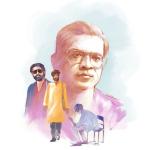
In the villages of Bengal, painters had always shown the peasant as he appeared to the powerful: thin, bent, half-starved — an object of pity. S. M. Sultan, a mason's son from Narail who signed himself with the initials a Calcutta critic gave him, painted him differently. On Sultan's canvases the farmers of the delta stand like wrestlers and kings, their arms thick as tree trunks, driving the plough through heavy soil, hauling nets from the river, threshing the harvest. He spent his youth being exhibited in Shimla, New York, Chicago and London, and then did something no one expected: he went home. For the last forty years of his life he lived beside the Chitra River, teaching village children to draw for free, while the art world largely forgot him — until it came back to Narail and found a master.
Today Sultan is counted among the four pioneers of modern art in Bangladesh, alongside Zainul Abedin, Safiuddin Ahmed and Quamrul Hassan. Yet of the four, he is the one who refused every institution that made the others: no degree, no Dhaka studio, no school of followers gathered in the capital. His story runs in the opposite direction to a normal artist's career — out of the village, around the world, and then deliberately, permanently, back.
Early life in Narail
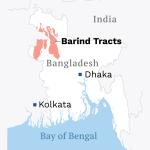
Sheikh Mohammed Sultan was born on 10 August in Machimdia village, in what is now Narail District in south-western Bangladesh. The year itself is disputed: Banglapedia and most older references give 1923, while many recent Bangladeshi accounts give 1924 — the year in which his birth centenary was celebrated in 2024. In the village he was known by his childhood name, Lal Mia. His father, Sheikh Messer Ali, was a mason, and the family was poor. Sultan was sent to the Victoria Collegiate School in Narail in 1928, but after only five years of schooling he left to work beside his father, laying bricks and building the houses of other people.
The talent showed itself early and would not be suppressed. The boy drew constantly — with charcoal on whatever surface offered itself, sketching the very buildings his father was raising. A story still retold in Narail has the schoolboy Sultan drawing a pencil portrait of Dr Shyama Prasad Mukherjee, the scholar and politician, when Mukherjee visited his school, and astonishing the visitor. What the boy wanted was an art education, and in British India that meant one city: Calcutta. His family could not pay for it. In the end it was the local zamindar, Dhirendranath Roy, who gave him the money, and in 1938 the mason's son left Narail for the capital of Bengali culture.
Art education in Calcutta
Calcutta nearly turned him away. Sultan had no matriculation certificate and so did not meet the entrance requirements of the Government School of Art. He was rescued by a second patron: the poet and art critic Hasan Shahid Suhrawardy, who took the young man into his own home, gave him the run of his library, and — as the story is told — restyled "Sheikh Mohammed Sultan" into the initials by which the world would know him, S. M. Sultan. Suhrawardy sat on the art school's governing body, and with his help Sultan was finally admitted in 1941.
He had arrived at a fortunate moment. Under its principal, Mukul Chandra Dey, the school was turning away from its old routine of copying Old Masters and painting mythological subjects, and pushing students towards contemporary landscapes and portraits drawn from their own lives. Sultan absorbed the training — his early work would bear the mark of the Impressionists and of Van Gogh's loaded brush — but he never absorbed the institution itself. After three years, in 1944, he walked out without a degree and became a freelance artist. He had what he needed; the certificate he neither needed nor wanted.
The travelling years
What followed was more than a decade of movement. Sultan wandered across India earning his living as an itinerant portraitist, drawing the Allied soldiers encamped along his route in the last years of the Second World War. He spent a period living and painting in Kashmir, producing the landscapes and portraits of his youth. In 1946 he held his first solo exhibition, in Shimla. After the Partition of 1947 he showed alone again, in Lahore in 1948 and Karachi in 1949. Of all the work of these years, nothing survives — not a canvas, not a photograph — largely because Sultan himself was completely indifferent to preserving it.
Then came the opportunity that took him across the world. Selected by the government of Pakistan, Sultan travelled to the United States in the early 1950s under the International Arts Program of the Institute of International Education in New York, which brought promising young foreign artists to America with their travel and living costs paid. His work was exhibited at the Institute in New York, at the YMCA in Washington, in Boston, at the International House of the University of Chicago and at Michigan University in Ann Arbor. From America he crossed to England, where he took part in the annual open-air group exhibition at Victoria Embankment Gardens in Hampstead, London. Bangladeshi accounts often add that on that London showing his canvases hung alongside works by Picasso, Dalí, Braque and Klee — a claim repeated so faithfully that it has become part of his legend, though the exhibition record that can be firmly documented is extraordinary enough for a self-taught mason's son from Narail.
Back in Pakistan he settled for a time in Karachi, teaching art at a school and forming lasting friendships with the leading Pakistani painters Abdur Rahman Chughtai and Shakir Ali. But the cities — Karachi, New York, London — had all had their chance. In 1953, Sultan returned to Narail for good.
The Narail life
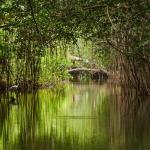
He moved into an abandoned building overlooking the Chitra River and stayed there for the remaining forty years of his life. He never married; around him he gathered an adopted family, a menagerie of pets, and a reputation, in the Dhaka art world, as a whimsical bohemian recluse. For more than two decades he exhibited little and was seen less. The reputation was only half true. The recluse was, in fact, running a school.
In 1969 Sultan founded the Kurigram Fine Arts Institute at Narail, and in 1973 another art school at Jessore — the school now known as Charupeeth. His dearest creation was Shishu Swarga, "Children's Heaven": a free art school for the village children around his home, where any child could come and learn to draw. He built a boat so that the children could travel the river and see the world they were painting, and he kept a small zoo and garden — his foster daughter later recalled that he gathered animals and tree species even from abroad — so that the children could draw living things from life, not from books. The man who had been given his chance by two patrons spent his maturity giving the same chance, free, to other people's children.
Recognition crept back slowly. He showed at the Khulna Club in 1969 and in the first National Art Exhibition in Dhaka in 1975. Then, in 1976, the Bangladesh Shilpakala Academy mounted a solo exhibition of his work — his first major exhibition, and astonishingly his first in Dhaka, though he was by then in his fifties and had exhibited on three continents. The Dhaka art world discovered, thirty years late, what Shimla and Chicago had seen in the 1940s and 1950s. His best work was still to come.
The muscular peasants of Bengal
The paintings of Sultan's maturity are unmistakable. In First Plantation (1975), Char Dakhal (1976), Harvesting (1986) and Fishing-3 (1991), the landscape of the delta — the paddy fields, rivers and village groves he had painted as scenery in his youth — retreats to a backdrop. At the centre stand the labourers themselves: ploughing, planting, threshing, hauling in the nets. And they are enormous. Sultan gave the Bengali peasant a physique no famine could produce: bulging arms, vast torsos, bodies swelling with a vitality that fills the canvas edge to edge.
It was a deliberate philosophy, and he stated it plainly: "The matter of my paintings is about the symbol of energy. The muscle is being used for struggling — struggling with the soil. The power of those arms drives the plough into the soil and grows crops. Labour is the basis, and because of the labour of our farmers this land has been surviving for thousands of years." The catalogue of his 1987 solo exhibition at the German Cultural Centre in Dhaka put it from the viewer's side: the peasants of this land "did not appear to Sultan to be weak, debilitated, starving creatures who deserved pity and sympathy — quite the contrary; he saw their bulging muscles, their vigorous torso, their overpowering vitality." Where an earlier generation of Bengali art had shown the peasant crushed by the land, Sultan showed the peasant as the land's master and maker — its hero.
Everything else about the mature work follows from that conviction. There are no cities in these paintings, no machines, nothing made by modern technology, which he regarded as imported and alien to the world he painted. The art is modern — he had broken decisively with the conventions he was taught — but it stayed figurative and narrative, rooted in oil and watercolour, in the impressionist handling of his youth now turned to monumental ends. In 1952 a Pakistani critic had dismissed him as merely "a landscape artist". By the 1980s the landscape had stood up and taken human form.
Honours and legacy
The state honours arrived in his last decade. Sultan received the Ekushey Padak in 1982, the Bangladesh Charu Shilpi Sangsad Award in 1986, and the Independence Day Award — the country's highest state honour — in 1993, all for fine arts. From 1984 he was also a Resident Artist of the Bangladesh Shilpakala Academy. Bangladeshi profiles frequently add that Cambridge University named him a "Man of Asia" in the same period; the claim is part of his popular legend, though no Cambridge record of it has been produced. His Harvesting (1986) is listed by the Bangladesh National Museum among its hundred renowned objects, and his works are held today by the National Museum, the National Art Gallery, the S. M. Sultan Memorial Museum and the Bengal Foundation.
His image, too, was preserved by others when he would not preserve it himself. Filmmaker Tareque Masud began shooting a documentary on him in 1982 and travelled with him across Bangladesh; the resulting film, Adam Surat — "The Inner Strength" — appeared in 1989, with Sultan cooperating only on condition that the film's true protagonist be not the artist but the Bengali peasant. Photographer Nasir Ali Mamun, who photographed him from 1978 until his death, published 68 of those portraits in the book Guru in 2005. Sultan died on 10 October 1994, at the Combined Military Hospital in Jessore, after a long respiratory illness, and was buried in the soil of Machimdia, beside the Chitra.
The Sultan Complex today
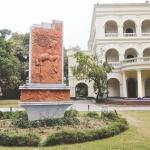
Narail did not let him go. On the homestead where he lived, on the bank of the Chitra River, stands the Sultan Complex — a leafy estate of some twenty-six acres containing his grave, his house and the boat he built for the children of Shishu Swarga, still kept by the river. In 2000 the government built the two-storey Sultan Sangrahashala, the memorial gallery, on the site to preserve his paintings; the S. M. Sultan Memorial Museum that operates there displays his works and belongings, and art schools in Narail — the S. M. Sultan Bengal Art College among them — carry his name to new students. Shishu Swarga itself still teaches: children's classes at his old home have continued, in one form or another, ever since his death.
Each year the town keeps his calendar. A week-long Sultan Mela, a fair of art and craft, fills the complex in February; around his birthday on 10 August, Narail holds the Sultan Festival — art competitions in which hundreds of village children draw on the themes he loved, discussions of his work, and the presentation of honours in his name, among them the SM Sultan Gold Medal of the Bangladesh Shilpakala Academy and the Sultan Sammanana Padak first awarded in 2026. In August 2026 the Shilpakala Academy marked his birth anniversary at the Memorial Collection and at Shishu Swarga with an art camp and a children's painting festival — the painter's two worlds, the museum and the children's school, still side by side on the riverbank.
Visitors and journalists have noted over the years that the museum is thinly staffed and that parts of Sultan's dream — the children's boat working the river again, a gallery worthy of the paintings — remain unfinished. Perhaps that is fitting. Sultan never believed institutions made art; he believed children with charcoal, farmers with ploughs, and one stubborn man by a river did. Narail, which the art world once thought he had retreated to in order to disappear, turned out to be the place he had chosen to be found.