The Bangladesh Navy is the naval service of the Bangladesh Armed Forces, responsible for the defence of the country's territorial waters in the Bay of Bengal, the security of its sea ports and the protection of its exclusive economic zone. It is one of the three services of the armed forces, alongside the Bangladesh Army and the Bangladesh Air Force. Born as a small commando and riverine force during the Liberation War of 1971, it has grown over five decades into a service that the navy itself publicly describes as three dimensional, operating on the surface, in the air and under the sea. This profile is compiled only from publicly available sources, which are listed openly at the end, and fleet and personnel figures are given only where a public source and a year can be attached to them.
Bangladesh is a delta country whose trade moves overwhelmingly by sea, above all through Chittagong Port and Mongla Port. Public summaries of the International Institute for Strategic Studies (IISS) Military Balance put the navy's personnel strength at about 25,100 in the IISS 2024 estimate, though published totals vary between sources and years. A force that began with two converted gunboats in 1971 now operates frigates, corvettes, submarines and maritime patrol aircraft.
Birth in the Liberation War
According to the Bangladesh Navy's own published history, the nucleus of the service was formed in June and July 1971, when a group of Bengali sailors undergoing submarine training at Toulon in France defected to join the Liberation War. Bengali officers and sailors serving elsewhere in the Pakistan Navy also crossed over at great personal risk. From these men, and from young volunteers, the naval commando force of the Mukti Bahini was built.
The Naval Commandos and Operation Jackpot
The commandos' best known action was Operation Jackpot, the coordinated attack of 15 August 1971. The navy's official history records that the commandos were organised in eight groups, built around the defected sailors and about 500 other members, and that they attacked shipping with limpet mines in the sea and river ports of Chittagong and Mongla (Chalna), with simultaneous attacks also carried out at Chandpur and Narayanganj. The official history credits the operation with destroying 26 ships and states that the commandos went on to neutralise sea routes and inflict crippling damage on the ports and inland waterways of occupied Bangladesh over the following months. Published totals for the whole commando campaign of August to December 1971 differ considerably between sources, so this article uses only the figure given in the navy's own history for the opening operation and does not adopt a campaign total.
The operation's significance was as much political as material: simultaneous explosions in ports that Pakistan claimed were functioning normally showed international media that the occupation did not control the country. Operation Jackpot remains the founding story of the Bangladesh Navy.
Padma, Palash and Ruhul Amin
Alongside the commandos, a small surface force took shape. The navy's official history records that two pilot boats were converted into riverine patrol craft in September 1971 at the Garden Reach Shipyard in Kolkata and named Padma and Palash; Banglapedia describes them as tugboats converted into gunboats, fitted with guns and mine pods. Manned by Bengali sailors under Indian Navy officers, the two craft operated in the Sundarbans river routes, laid mines and attacked Pakistani shipping in November 1971.
On 10 December 1971, advancing towards Khulna, both ships came under air attack near Khulna Shipyard and caught fire, according to the navy's official history. Among those killed was Engine Room Artificer Mohammad Ruhul Amin of Palash, who, in Banglapedia's account, was gravely injured when a bomb destroyed the engine room, reached the shore and was killed there. Ruhul Amin was posthumously awarded the Bir Sreshtho, Bangladesh's highest gallantry award, and remains the navy's most honoured Liberation War martyr. Public accounts differ on some details of the two gunboats' last action, and those differences are noted in the sourcing notes that accompany this article rather than resolved here.
Rebuilding After 1971
The navy of independent Bangladesh had to be built almost from nothing. Public reference summaries record that a first small fleet of patrol vessels had already been inaugurated during the war, on 9 November 1971, and after independence the service slowly assembled a fleet from transferred and purchased vessels. Two former Royal Navy frigates joined in 1976 and 1978, and a third in 1982, and published histories of the navy treat the acquisition of those three frigates as the principal foundation of the modern surface fleet. Training institutions, dockyards and shore establishments were built up in parallel, centred on Chittagong, which remains the navy's principal home port area.
Through the following decades the fleet remained small and largely coastal. The long term modernisation programme adopted in 2009, known publicly as Forces Goal 2030, gave the navy a larger place, reflecting the importance of the Bay of Bengal, and set the goal that public statements describe as building a three dimensional deterrent force with surface, air and underwater capability.
Becoming a Three Dimensional Force
The first of the three dimensions to be added after the surface fleet was naval aviation. Public sources record that the Bangladesh Navy opened its aviation wing on 14 July 2011 with the induction of two AgustaWestland AW109 helicopters, and that two Dornier 228NG maritime patrol aircraft followed in 2013, with further aircraft reported in later public summaries. The patrol aircraft give the navy its own long range eyes over the exclusive economic zone, and navy aircraft have since taken part in publicised tasks such as the search for the missing Malaysia Airlines flight MH370 in March 2014, in which navy ships and a Dornier patrol aircraft participated.
The underwater dimension arrived in 2017. Bangladesh had ordered two refurbished Type 035G submarines, the Ming class in NATO reporting terminology, from China in 2013. The boats were handed over on 14 November 2016 and commissioned on 12 March 2017 as BNS Nabajatra (S161) and BNS Joyjatra (S162), the first submarines ever operated by the Bangladesh Navy. With surface ships, aircraft and submarines all in service, official and public descriptions from that point describe the navy as a three dimensional force. A dedicated submarine base to support the boats, BNS Pekua in Cox's Bazar district, was commissioned in March 2023.
The Fleet in Public Sources
Public fleet summaries describe a fleet built around frigates and corvettes, supported by patrol vessels, missile craft, mine warfare vessels, landing craft and auxiliaries. A widely used public summary, dated November 2025, counts five guided missile frigates, two patrol frigates, six guided missile corvettes, two submarines and several dozen smaller combatants and auxiliaries.
Frigates
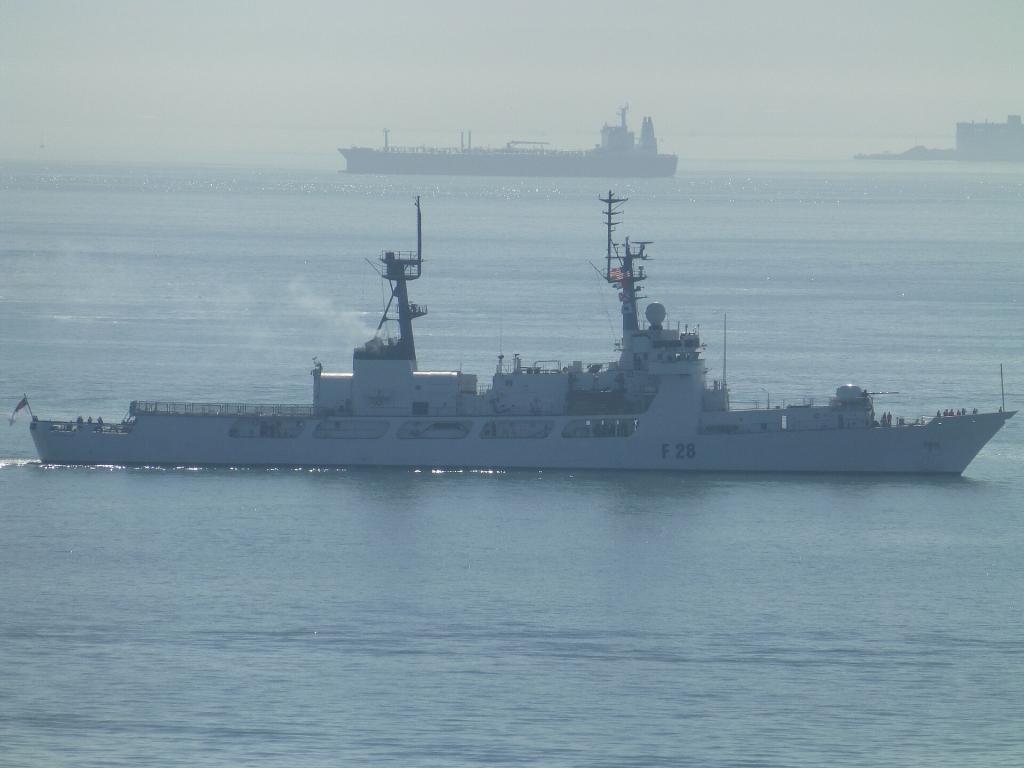
The largest surface combatants are the frigates. They include BNS Khalid Bin Walid (F25), a modified Ulsan class guided missile frigate built in South Korea; the ship was known for most of the period after 2009 as BNS Bangabandhu, and public ship lists record that she reverted to the name Khalid Bin Walid, which she had also carried between 2007 and 2009, following the change of government in 2024. Two Chinese built Type 053H3 frigates, BNS Umar Farooq and BNS Abu Ubaidah, and two Type 053H2 frigates, BNS Abu Bakr and BNS Ali Haider, complete the guided missile frigate force in current public lists. Alongside them serve BNS Somudra Joy (F28) and BNS Somudra Avijan (F29), former United States Coast Guard high endurance cutters of the Hamilton class, transferred in 2013 and 2015 and used as patrol frigates.
Corvettes, Patrol Vessels and Other Craft
Below the frigates, public lists record six guided missile corvettes: four Chinese built Type 056 ships of the Shadhinota class, BNS Shadhinota, BNS Prottoy, BNS Shongram and BNS Prottasha, and two former Royal Navy Castle class vessels, BNS Bijoy and BNS Dhaleshwari, converted to missile corvettes after transfer. The patrol forces include Durjoy class large patrol craft and Padma class patrol vessels, several of them built in Bangladesh at Khulna Shipyard, a point of pride in the country's shipbuilding industry. Offshore patrol vessels, fast missile craft, minesweepers, landing craft for amphibious lift, survey vessels and a range of auxiliaries complete the publicly listed fleet. Precise hull by hull counts change as vessels commission and retire, and public sources differ on totals, so this article names classes and representative ships rather than asserting a single fleet total.
Bases and Headquarters
Naval Headquarters is in Dhaka. The navy's main base areas, as listed in public sources, are Chittagong, where BNS Issa Khan and the dockyard support the bulk of the fleet; Khulna, where BNS Titumir serves the south western riverine and coastal area together with the Mongla establishment; and Dhaka itself, where the full fledged naval base BNS Dhaka at Khilkhet was commissioned for the capital's naval area. The submarine base at Pekua in Cox's Bazar district, commissioned in March 2023, is described in public reporting as a full fledged submarine base able to berth submarines and warships. A further large base, BNS Sher-e-Bangla at Rabanabad in Patuakhali district, has been publicly reported as under development with submarine berthing and aviation facilities.
Readers should note that several naval establishments were renamed by a Ministry of Defence order of March 2025, reported by the state news agency BSS. Under that order the Pekua submarine base, formerly BNS Sheikh Hasina, became BNS Pekua; the Khilkhet base, formerly BNS Sheikh Mujib, became BNS Dhaka; and the New Mooring establishment in Chittagong, formerly BNS Bangabandhu, became BNS Khalid Bin Walid. This article uses the current names throughout. Where a current name could not be confirmed from a public source, the installation is not named.
Command
The professional head of the service is the Chief of Naval Staff. According to an Inter Services Public Relations (ISPR) release of 17 July 2026, Admiral Khondkar Misbah-ul-Azim was appointed the 18th Chief of Naval Staff and assumed office on 23 July 2026 for a three year term running to 22 July 2029; public reporting records his promotion to the rank of Admiral in August 2026, and he was still in post, representing the navy publicly, in November 2026. He succeeded Admiral M Nazmul Hassan, who had held the office from 24 July 2023 to 23 July 2026.
Maritime Roles
Sea Lanes, the Blue Economy and Crime at Sea
The navy's peacetime task, as stated in its own public material, is to protect maritime sovereignty and marine resources, keep the sea lanes on which Bangladesh's trade depends open and safe, and combat crime at sea, including piracy, armed robbery, smuggling and illegal fishing. Successive governments have framed these tasks in the language of the blue economy: the fisheries, ports, shipping and prospective offshore energy of the Bay of Bengal can only be developed if the sea is policed, and the navy, working alongside the Bangladesh Coast Guard, is the state's principal instrument for that policing.
Disaster Relief at Home and Abroad
Bangladesh's cyclone prone coast makes the navy a front line disaster management force, a role its public releases emphasise after every major storm, when ships carry relief to cut off coastal and island communities. The same capability has been used abroad. In 2013 the navy deployed BNS Somudra Joy carrying humanitarian assistance, and in December 2014, during the Maldives water crisis, BNS Somudra Joy was publicly reported as the first relief ship to arrive, carrying 100 tonnes of bottled water.
United Nations and International Deployments
Public sources record that the Bangladesh Navy joined United Nations peacekeeping operations in 1993 and that its first deployment came in 2005, when a naval contingent served in Sudan as a Force Riverine Unit. Its best known deployment began in 2010, when the frigate BNS Osman and the patrol craft BNS Madhumati deployed to the Mediterranean with the United Nations Interim Force in Lebanon (UNIFIL), whose maritime task force Bangladesh has supported with rotating ships since, including BNS Bijoy from 2018 and BNS Shongram from 2020 in public accounts. The navy also takes part in multinational exercises with partner navies.
After the Maritime Boundary Settlements
For decades the navy's operating area was legally uncertain, because Bangladesh's maritime boundaries with both neighbours were disputed. That changed in two judgments. On 14 March 2012 the International Tribunal for the Law of the Sea delivered its judgment in the dispute with Myanmar, and on 7 July 2014 an arbitral tribunal under the Permanent Court of Arbitration delivered its award in the dispute with India. Banglapedia's summary of the settlements records that the 2014 award gave Bangladesh 19,467 square kilometres of the 25,602 square kilometres in dispute with India, and government statements reported at the time put Bangladesh's confirmed maritime area at 118,813 square kilometres of territorial sea, with a 200 nautical mile exclusive economic zone and continental shelf rights extending, off the Chittagong coast, to 354 nautical miles.
The settlements matter to the navy for a practical reason: they fixed, in international law, the waters it exists to protect. Public statements by naval leaders since 2014 routinely connect the service's modernisation, including its submarines and its new southern bases, to guarding the confirmed maritime zone and the blue economy within it.
Sources
- Bangladesh Navy, official website (navy.mil.bd), published service history: the Toulon defectors and the nucleus of 1971, Operation Jackpot and its 26 ships, and the conversion and loss of Padma and Palash.
- Inter Services Public Relations (ISPR), public releases, including the release of 17 July 2026 appointing Admiral Khondkar Misbah-ul-Azim as the 18th Chief of Naval Staff with effect from 23 July 2026, and ISPR reporting of naval ceremonies in 2026 naming the serving chief.
- Banglapedia, the National Encyclopedia of Bangladesh (Asiatic Society of Bangladesh): the entry on Birsrestha Mohammad Ruhul Amin for Padma, Palash and his death on 10 December 1971, and the Maritime Zones entry for the 2012 and 2014 settlements.
- Bangladesh Sangbad Sangstha (BSS), 9 March 2025: the Ministry of Defence order renaming eight establishments, including BNS Pekua, BNS Dhaka and the New Mooring establishment in Chittagong.
- IISS, The Military Balance, as summarised in open sources: personnel estimate for the Bangladesh Navy attributed to the IISS 2024 edition.
- International Tribunal for the Law of the Sea, judgment of 14 March 2012 (Bangladesh and Myanmar), and the Permanent Court of Arbitration award of 7 July 2014 (Bangladesh and India), as summarised by Banglapedia and contemporary public reporting.
- Published open reference lists of active Bangladesh Navy ships and class summaries, cross checked across more than one public source, for frigate, corvette, patrol and submarine classes and names current to November 2025 and November 2026.
- United Nations and public reporting on UNIFIL: the Bangladesh Navy's deployments to Lebanon from 2010 and its earlier Force Riverine Unit service in Sudan in 2005.
Note: This article has been compiled solely from publicly available sources, including official public releases and the published reference works listed below, for general information only. It is not an official publication of the Bangladesh Armed Forces or the Border Guard Bangladesh.