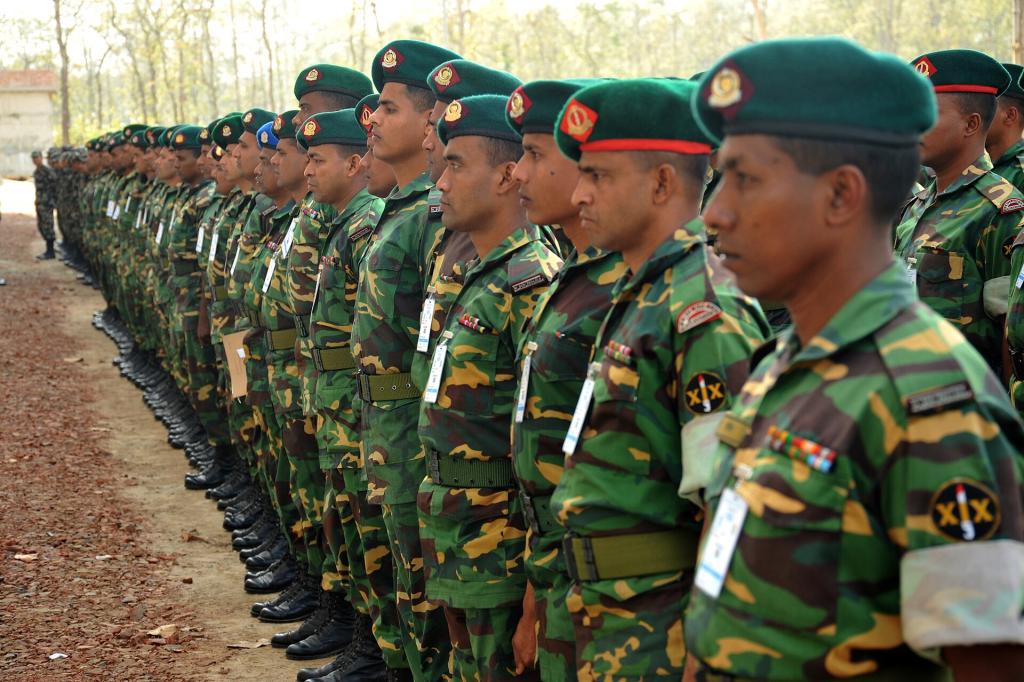
The Bangladesh Army is the land force of the Bangladesh Armed Forces and its largest service. Its public role, as described on its official website (army.mil.bd) and in its published motto, is summed up in the words "In War, In Peace, We are Everywhere for Our Country". The army headquarters is at Dhaka Cantonment, and the force is commanded by the Chief of Army Staff, a four star general. Alongside its primary task of defending the sovereignty and territorial integrity of Bangladesh, the army has a long and publicly documented second life: it is one of the world's leading contributors to United Nations peacekeeping, it is routinely called out in aid of the civil administration during floods and cyclones, and its engineers supervise or build major national infrastructure. This article is a general public profile compiled only from published sources, which are listed openly at the end.
According to The Military Balance 2024, published by the International Institute for Strategic Studies (IISS), the army had about 132,150 personnel, within total active armed forces of 171,250. Those are IISS estimates for that year, not an official establishment figure. The army works alongside the Bangladesh Navy and the Bangladesh Air Force, and alongside the Border Guard Bangladesh.
Origins in the East Bengal Regiment
The army's roots lie in the East Bengal Regiment, raised in the Pakistan period. Banglapedia, the national encyclopedia published by the Asiatic Society of Bangladesh, records that the Pakistan Army's infantry in its eastern wing was at first drawn exclusively from West Pakistan, so a regiment had to be raised in East Pakistan itself. On 15 February 1948 the 1st Battalion, the Senior Tigers, was raised at Kurmitola, Dhaka, from two Bengal Muslim Pioneer Companies, numbered 1256 and 1407, whose men had served on the Burma front in the Second World War. The 2nd Battalion followed in December 1948. Banglapedia credits Major Abdul Gani, who took the initiative to organise the pioneer companies, and Colonel Mohammad Ataul Gani Osmany with the regiment's early development. Eight battalions had been raised by March 1971.
The regiment's place in national memory comes from what happened next. On the night of 25 March 1971 the Pakistan Army began its crackdown in East Pakistan. According to Banglapedia, the five East Bengal battalions then stationed in East Pakistan, at Jessore, Joydevpur, Rangpur, Comilla and Chittagong, revolted and began the armed struggle that became the Liberation War. The three remaining battalions were stranded in West Pakistan. The revolting Bengali soldiers formed the trained core around which a much larger liberation force was built.
The Liberation War of 1971
The provisional government of Bangladesh, formed in exile on 10 April 1971, appointed Colonel M. A. G. Osmany, a retired Pakistan Army officer and member of the National Assembly, as Commander in Chief of the Bangladesh Liberation Forces. The forces, popularly known as the Mukti Bahini, combined the regular Bengali soldiers with members of the paramilitary forces and volunteers from all walks of life. For the full political and military story, see the site's account of the Liberation War of Bangladesh 1971.
Banglapedia records that the Liberation Forces were organised operationally into eleven sectors, each commanded by a senior Bengali officer. As the war progressed, the regular East Bengal battalions were grouped into three brigades. Z Force was raised on 17 July 1971 under Ziaur Rahman, with the 1st, 3rd and 8th East Bengal battalions. K Force followed in September 1971 under Khaled Mosharraf, with the 4th, 9th and 10th battalions, and S Force was raised in September 1971 under K. M. Safiullah, with the 2nd and 11th battalions. Two artillery batteries were also raised and placed under Z Force.
On 21 November 1971 the Bangladeshi and Indian forces were placed under a joint command, led by Lieutenant General Jagjit Singh Aurora of the Indian Army's Eastern Command, a combined force known as the Mitro Bahini, or Allied Forces. Bangladesh still marks 21 November each year as Armed Forces Day, the date on which, in Banglapedia's words, the members of the three services made their concerted effort together for the first time during the war. The joint campaign ended with the surrender of the Pakistani forces in Dhaka on 16 December 1971, now Victory Day. The regular army of independent Bangladesh was built directly out of this wartime force.
Three of the seven Bir Shreshtha, the holders of the highest gallantry award of Bangladesh, were soldiers of the regular forces from which this army descends: Sepoy Mohammad Mostafa Kamal of the East Bengal Regiment, who fell at Daruin; Captain Mohiuddin Jahangir of the Corps of Engineers, who fell at Chapai Nawabganj; and Sepoy Hamidur Rahman of the East Bengal Regiment, who fell at Dhalai. The awards themselves are set out in Wiki Bangla's account of the gallantry awards of Bangladesh.
Growth After Independence
After the war the headquarters moved from Calcutta to Dhaka Cantonment, and in April 1972 the joint headquarters was abolished and separate headquarters for the three services were established under the Ministry of Defence, as Banglapedia records. Bengali officers and soldiers stranded in Pakistan returned and rejoined in 1973. The first infantry division was raised in Dhaka in 1975, followed by further divisions in 1976, 1988 and 1992.
Expansion continued in the present century under the modernisation programme known publicly as Forces Goal 2030. Published accounts of that programme record three newer infantry divisions: the 17th Infantry Division at Sylhet in 2013, the 10th Infantry Division at the new Ramu Cantonment near Cox's Bazar in 2015, and the 7th Infantry Division at Barisal Cantonment in 2018, bringing the total number of infantry divisions to ten.
Structure at a General Level
At the general public level, the army is organised around cantonments, the garrison towns in which units live, train and work. Army Headquarters at Dhaka Cantonment directs ten area commands, each paired with an infantry division commanded by a major general who is both area commander and General Officer Commanding of the division. Published formation lists place the divisions as follows:
- 7th Infantry Division, Barisal Cantonment
- 9th Infantry Division, Savar Cantonment
- 10th Infantry Division, Ramu Cantonment
- 11th Infantry Division, Bogra Cantonment
- 17th Infantry Division, Jalalabad Cantonment, Sylhet
- 19th Infantry Division, Shahid Salahuddin Cantonment, Ghatail
- 24th Infantry Division, Chittagong Cantonment
- 33rd Infantry Division, Comilla Cantonment
- 55th Infantry Division, Jessore Cantonment
- 66th Infantry Division, Rangpur Cantonment
Above the divisions sit a training command, the Army Training and Doctrine Command at Mymensingh Cantonment, and a logistics area headquarters at Dhaka Cantonment, together with independent brigades held under Army Headquarters. This is the published, formation level picture only. This article does not go into unit level operational detail, which belongs to official publications rather than a general encyclopedia profile.
The two infantry regiments
The infantry is organised in two regiments. The East Bengal Regiment, raised in 1948, is the senior regiment and the direct institutional ancestor of the army itself. The Bangladesh Infantry Regiment is the second regiment. Banglapedia dates its inauguration to 1 January 2001 and the formal hoisting of its flag to 21 April 2001. Published regimental accounts explain that it was raised at first by redesignating some East Bengal battalions, before its own recruits were trained at its regimental centre at Rajshahi Cantonment. As the first new regiment raised by the army in the twenty first century, it is known as the Regiment of the Millennium.
Training institutions
Banglapedia lists the army's best known training institutions, several of them joint. The Bangladesh Military Academy, which commissions the army's officers, began at Comilla in 1974 and moved to Bhatiary, Chittagong in 1976. The School of Infantry and Tactics is at Jalalabad Cantonment, Sylhet. The Defence Services Command and Staff College at Mirpur, Dhaka, has run staff courses since 1977, and the National Defence College, also at Mirpur, was established in 1998, as was the Military Institute of Science and Technology. The Bangladesh Institute of Peace Support Operation Training at Rajendrapur Cantonment was raised in June 1999 to prepare personnel for United Nations assignments.
Leadership
The Chief of Army Staff as of November 2026 is General Waker-Uz-Zaman. He was appointed on 11 June 2024 and assumed office on 23 June 2024, succeeding General S. M. Shafiuddin Ahmed. His continued tenure through 2026 is documented in a steady run of Inter Services Public Relations (ISPR) releases reported by the national news agency BSS, including his attendance at corps conferences and parades in September, October and November 2026. It was General Waker-Uz-Zaman who, as army chief, made the public announcement of 5 August 2024 described below.
United Nations Peacekeeping
Peacekeeping is the army's most visible role outside Bangladesh, and the one for which the hardest published figures exist. Bangladesh first took part in a United Nations operation in 1988, when, as Banglapedia and United Nations reporting both record, it sent a team of 15 military observers to the UN Iran-Iraq Military Observer Group, known as UNIIMOG. A second early deployment followed to the UN Transition Assistance Group in Namibia. From those beginnings the contribution grew until Bangladesh spent long periods as the single largest troop contributing country in the UN system.
The ranking changes as missions open, close and draw down, so the figures have to be dated. The UN Department of Peace Operations ranking as of 31 October 2025 placed Bangladesh third, with 5,568 uniformed personnel, behind Nepal and Rwanda. The UN ranking as of 28 February 2026 placed Bangladesh fourth, with 4,148 uniformed personnel, of whom 271 were women. In November 2025 the United Nations, in a statement reported by UNB, thanked Bangladesh as the third largest contributor at that time, with more than 5,600 personnel in seven missions: Abyei, the Central African Republic, Cyprus, the Democratic Republic of the Congo, Lebanon, South Sudan and Western Sahara. Any single ranking is a snapshot of its date, but the standing is consistent: for more than three decades Bangladesh has remained among the very largest contributors, in infantry, engineering, medical, aviation and formed police roles.
Disaster Response and Aid to Civil Power
Inside Bangladesh, the army's most frequent public duty is disaster response. The country faces cyclones, monsoon floods, landslides and river erosion almost every year. Under the government's Standing Orders on Disaster, the armed forces assist the civil administration in emergencies, coordinated through the Armed Forces Division, using boats, helicopters, medical teams and engineer units for rescue, evacuation, relief distribution, embankment repair and rebuilding.
The pattern is documented across successive cyclones, including Sidr in 2007, Aila in 2009, Amphan in 2020 and Remal in 2024. In the severe floods of August 2024, which affected districts including Feni, Comilla, Noakhali and Chittagong and, by published government figures, some 5.8 million people, army units carried out rescue and relief work, and afterwards built housing for displaced families under the Ashrayan programme. The army also supported the health authorities during the COVID-19 pandemic, providing medical personnel and helping to run testing, isolation and vaccination arrangements.
The army is also deployed from time to time in aid to civil power, at the request of the government, to support law and order alongside the civil police. The most recent large example followed the events of August 2024 described below, when troops remained deployed across the country in support of the civil administration, and commissioned officers were given temporary executive magistracy powers by government order from September 2024.
Development and Infrastructure Work
The Corps of Engineers gives the army a construction capacity that governments have repeatedly used on national projects. The best documented example is the Padma Multipurpose Bridge: from 2013 the army acted as construction supervision consultant for parts of the project, overseeing the approach roads and service areas, and a composite brigade was raised to provide security for the site. The same supervision role continued into the Padma Bridge Rail Link Project. Army engineer brigades have likewise been assigned to road building and other development projects, and army teams build Ashrayan housing for landless and disaster affected families, including the large climate displacement project at Khurushkul in Cox's Bazar.
The Army in the Transition of 2024
The army's most consequential recent public moment came in the summer of 2024. Mass protests that began over government job quotas grew into a nationwide movement demanding the resignation of Prime Minister Sheikh Hasina, and troops were deployed in support of the civil administration. On 5 August 2024 Sheikh Hasina resigned and left the country for India. That day, in a broadcast address, General Waker-Uz-Zaman announced the resignation publicly, said that an interim government would be formed, and held consultations with political parties and other groups. An interim government led by Muhammad Yunus as Chief Adviser took office on 8 August 2024. The army did not take power itself, and its publicly stated role afterwards was to support the interim administration and the restoration of normal policing. Those are the documented facts, as reported at the time by Reuters and BSS. The interim period ended with the general election of February 2026 and the formation of an elected government.
Public Commemoration
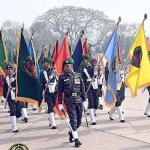
Two dates frame the army's public year: Armed Forces Day on 21 November, marking the joint command of 1971, and Victory Day on 16 December, marking the surrender in Dhaka. The army also takes part in the Independence Day parade on 26 March alongside the navy and the air force.
Sources
- Banglapedia, "Military" (Asiatic Society of Bangladesh): the East Bengal Regiment's raising on 15 February 1948, the revolt of March 1971, Osmany's appointment, the eleven sectors, the Z, K and S forces, the post war headquarters and divisional expansion, the training institutions, and the Bangladesh Infantry Regiment's inauguration in 2001.
- Bangladesh Army, official public website, army.mil.bd, and public releases of the Inter Services Public Relations (ISPR) Directorate, reported by Bangladesh Sangbad Sangstha (BSS), 2024 to 2026: the army's motto and headquarters, and General Waker-Uz-Zaman's activities as Chief of Army Staff through November 2026.
- International Institute for Strategic Studies (IISS), The Military Balance 2024: the estimate of about 132,150 army personnel within 171,250 total active armed forces personnel for Bangladesh.
- United Nations, Department of Peace Operations, uniformed personnel country rankings as of 31 October 2025 and as of 28 February 2026 (peacekeeping.un.org): Bangladesh third with 5,568 personnel in October 2025, and fourth with 4,148 personnel in February 2026.
- United Nations statement reported by United News of Bangladesh (UNB), 28 November 2025: Bangladesh as third largest contributor with more than 5,600 personnel in seven named missions, and the first deployment of 15 observers to UNIIMOG in 1988.
- Published accounts of Forces Goal 2030 and formation lists: the 17th Division (2013), 10th Division (2015) and 7th Division (2018), and the ten area commands.
- Published reporting on the Padma Multipurpose Bridge and the Padma Bridge Rail Link Project (Bangladesh Bridge Authority and national press, 2013 onward): the army's role as construction supervision consultant.
- Reuters and BSS reporting of 5 to 8 August 2024: the announcement by General Waker-Uz-Zaman, the resignation of Sheikh Hasina, and the formation of the interim government on 8 August 2024.
- Published disaster reporting, Cyclone Sidr (2007) to the floods of August 2024: rescue, relief and Ashrayan housing work.
Note: This article has been compiled solely from publicly available sources, including official public releases and the published reference works listed below, for general information only. It is not an official publication of the Bangladesh Armed Forces or the Border Guard Bangladesh.