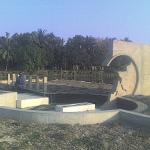
Jaflong is the place where a river changes country in full view. In Gowainghat Upazila of Sylhet District, in the far north east of Bangladesh, the Piyain River comes down out of the hills of Meghalaya in India, crosses the border and spreads, suddenly, across a wide and open bed of stones on the Bangladeshi plain. Behind the visitor, to the south, lie tea gardens, villages and the road back to Sylhet city. Ahead, to the north, the land rises in layered green ridges, and the Indian town of Dawki sits on the far bank, close enough for its houses and hanging bridge to be picked out one by one.
Jaflong has been loved for that view for decades, but it has never been only a beauty spot. The same river has carried stones down from the hills for as long as anyone can remember, and collecting, breaking and selling them built a second Jaflong: a working riverbank of boats, baskets, trucks and crushing machines. That trade has employed thousands, damaged the river that feeds it, and made Jaflong a test case for how Bangladesh protects a famous landscape.
A River That Arrives From Another Country
The Piyain is a transboundary river. On the Indian side it is known as the Dawki River, and further upstream in Meghalaya as the Umngot, celebrated for water so clear that boats look as if they float on air. Flowing south through a gorge in the Khasi and Jaintia hills, it enters Bangladesh at Jaflong as the Piyain and continues towards the Surma system. It is one of many rivers that reach Bangladesh already formed elsewhere, a theme explored in Rivers of Bangladesh.
The river changes character with the seasons, and so does Jaflong. In the dry months, roughly October to March, the Piyain runs low, slow and remarkably clear. Its rounded stones, grey, brown, rust and pale cream, show through the water, and broad bars of stone and sand stand exposed. In the monsoon the channel fills and quickens, the water turns opaque, waterfalls thread down the hillsides, and the hills deepen to an intense green. Winter brings the clarity photographers prefer; the rains bring a fuller river, but also stronger currents, disrupted boat trips and, in flood years, temporary closures by the district administration.
The View That Made Its Name
Most visitors head first for Zero Point, the stretch of bank at the border itself. From here the composition that made Jaflong famous arranges itself: clear river, pale stone bed, slow boats, and behind them the hills rising in layer behind layer into Meghalaya. On the Indian side, the suspension bridge at Dawki hangs across the gorge. Built under the British in 1932, it still carries road traffic, and from the Bangladeshi bank it reads as a thin line across the green hillside. It appears in almost every photograph taken here.
Zero Point is a viewing place, not a crossing. The formal border crossing for travellers with the right documents is the land port at nearby Tamabil, and the border at Jaflong itself is guarded. Visitors should stay on the Bangladeshi side and follow the instructions of Border Guard Bangladesh personnel. Boats carry visitors along the Piyain towards the border reach, giving the closest water level view of the gorge, the bridge and the hills. Agree the fare before boarding, and wear a life jacket during the ride.
Jaflong lies about 60 kilometres from Sylhet city, a drive of roughly two hours; official sources put the distance between about 56 and 62 kilometres. On winter weekends the bank can be crowded by midday; a weekday shows the river at its calmest.
Stones: How the Riverbed Became a Workplace
Accounts describe a quiet, forested border tract under the old Khasi and Jaintia rulers, thinly settled for centuries. The modern stone trade grew after the abolition of the zamindari system in 1954, when traders arrived in search of river stone and settlements formed around the work. The road link with Sylhet, completed in the 1980s, opened the area to tourists as well as trucks. By the late twentieth century Jaflong stone was being sent across Bangladesh for construction, and the riverbank had become one of Sylhet's eight gazetted stone quarries, leased for manual extraction for more than two decades until 2020.
Traditional collection is hand work. Collectors wade or dive from small boats, fill baskets with stone, and load the long, narrow barki boats that ferry it to the bank. There it is sorted by size, much of it by women sitting among the piles, and loaded onto trucks for the crushing mills in and around Jaflong, which break the boulders into graded chips for the construction industry. At its height this chain employed large numbers of people, and for many families around Gowainghat it was the main cash income available.
Alongside the hand work came machines. Excavators and the suction dredgers locally called boma machines began digging deep pits in and beside the river, pulling stone and sand from well below the surface layer that the floods renew. Extraction spread beyond the quarry boundaries onto government khas land and reserved forest land, where unauthorised crushing mills were set up, as reporting has documented since at least 2006. It was this mechanised version of the trade, not the basket and boat work, that brought Jaflong into the courts.
The Human and Environmental Cost
Stone work at Jaflong has always been dangerous and poorly paid. Collectors work in cold water and strong currents without protective equipment, and the crushing yards fill the air with dust and noise. Studies of the riverbank record air, sound and water pollution from quarrying and crushing, and loss of agricultural land. The Bangladesh Environmental Lawyers Association (BELA) recorded 76 deaths and 21 injuries of labourers in illegal stone quarries in Sylhet District between 2017 and 2020, figures cited in academic work on the area; they cover the district's quarries as a whole, not Jaflong alone, but Jaflong workers are part of that toll. Women form a large share of the sorting and crushing workforce and have typically been paid less than men for comparable work.
The landscape carries its own costs. Deep pits scar the bed and banks, alter the river's flow and, residents and environmental groups argue, worsen bank erosion in the monsoon. Hills have been cut for stone and earth, and crusher dust settles on houses, crops and tea bushes. In early 2005 the Deputy Conservator of Forests for Sylhet, Laskar Muqsudur Rahman, warned that the Jaflong he had known in his boyhood as the lungs of Greater Sylhet was at stake from encroachment and unauthorised crushing mills. His response, the Jaflong Green Park, took back grabbed land for replanting: forestation by the Forest Department and the Jaflong Foundation began in 2007 on about 100 hectares of recovered land.
The Khasi Punji: Betel Leaf, Oranges and a Matrilineal World
Jaflong is also home, far longer than the stone trade. The Khasi people, an Austroasiatic speaking community whose heartland lies in Meghalaya, live on both sides of this border, and their settlements, called punjis, dot the hills. Sangrampunji, across the Piyain from the main tourist bank and reached by boat, is the best known to visitors. A punji is a cluster of houses, often raised on stilts, set among trees, and headed traditionally by a chief known as the Siem.
Khasi society is matrilineal: lineage and family identity pass through the mother, property is held through the female line, and the youngest daughter is traditionally the custodian of the family home. It is one of the few such systems in the world.
The economic heart of the punji is the betel leaf garden, the barouj, where vines climb living trees in shaded forest gardens: an agroforestry method passed down for generations that keeps the canopy standing. Its leaf, Khasi paan, is a prized cash crop. Around the gardens grow areca nut, oranges, jackfruit and pineapple: the groves listed in every account of Jaflong's attractions are largely Khasi plantings. In early 2025 the Jaflong Khasi punji opened formally to community based tourism, with homestays, a small museum, weaving workshops and evening music organised by the community's own Destination Management Committee, with support from a government and International Labour Organization project. It is the most respectful way for visitors to meet Jaflong's oldest community: as guests, on the community's terms.
Jaflong Tea Garden and the Green Hills
Below the hills, Jaflong has its own tea garden, a level, carefully kept estate whose rows of dark green bush run towards the river plain. It is part of the Sylhet tea country that began with the Malnicherra estate near Sylhet city in 1854 and grew under British planters into a defining landscape of the north east. Jaflong's garden lacks the rolling drama of the estates around Srimangal, further south, but its setting is unmatched: tea bushes in the foreground, a famous river beside them, and the hills of another country behind. For many visitors it is a quiet half hour to walk the rows, watch pluckers at work in season and buy fresh leaf.
What a Visitor Sees and Does Today
A typical visit, as of November 2026, runs as follows. Visitors walk down from the market area to the river, hire a boat for the run along the Piyain towards Zero Point, and spend time on the stone bars, where the dry season water runs clear over coloured pebbles. Dawki and its bridge fill the northern view. Boats also serve Sangrampunji and the Khasi homestays, and seasonal waterfalls, of which the Mayabi falls near the punji are the best known, draw visitors in and after the monsoon. The tea garden, the Green Park and stalls selling oranges and pineapple fill out the day. Most people combine Jaflong with other Sylhet sights, as set out in Sylhet: Explore the Gem of Natural Beauty, and return to Sylhet city by evening, though the Khasi homestays now make staying in Jaflong itself a real option.
Two cautions belong in any honest account. The first is the water. The Piyain looks calm in the dry season and treacherous currents run under that calm surface, especially near Zero Point and after rain upstream. Tourists drown at Jaflong with grim regularity: a 13 year old in March 2025, a child of 11 at Zero Point in March 2026 and a teenager in June 2026 are only the most recent reported cases. The safe rule is simple: do not swim, stay in the boat, and wear the life jacket. The second caution is the border: this is a guarded frontier, and no visitor should step across the line, however open the bank appears.
An Ecologically Critical Area: Courts, Bans and an Unsettled Debate
Jaflong's legal story can be told in dates. In 2014 the High Court banned mechanical stone extraction at all eight of Sylhet's quarries. In 2015 the government declared the Jaflong and Dawki riverbank, an area of 14.93 square kilometres, an Ecologically Critical Area (ECA), the strongest protective designation in Bangladeshi environmental law. In February 2020 the Bureau of Mineral Development halted extraction at the eight Sylhet quarries, Jaflong included, and the government later suspended extraction nationwide. Stones began to accumulate again on the bed, and for a few years the riverbank looked more like the postcards.
The protection did not hold on the ground. Reporting by The Daily Star in August 2026 found rampant illegal extraction continuing at Jaflong and Bichanakandi despite the bans, and traced a surge of looting to the period after the political changeover of 5 August 2024: the administration estimated that stones worth about Tk 200 crore were taken from Jaflong alone within days, an official estimate to be read as an order of magnitude rather than an audited figure. Enforcement followed in waves. On 25 March 2025 the Department of Environment filed a case against 31 people over illegal extraction at Jaflong. On 27 April 2025 a government meeting banned the leasing of all 17 stone quarries in the country. The Anti-Corruption Commission opened a probe in August 2025, and that month the High Court, hearing a BELA public interest petition (Writ Petition No. 13485 of 2025), ordered a master plan for the conservation and eco-tourism management of 17 quarries, a list of those involved in destructive extraction, and an implementation report within three months.
The debate then changed direction. The government formed after the February 2026 election came under strong pressure to reopen the Sylhet quarries, where closure had thrown thousands out of work. On 7 May 2026 the Home Minister announced a high level committee to examine limited extraction in selected areas of Sylhet and Sunamganj, stating expressly that Jaflong, as an ECA, would be exempt. On 24 June 2026 the responsible minister said the quarries would reopen for traditional manual extraction, while warning that this would take time because of other ministries and the court. Statements reported in November 2026 continued to place Jaflong, with Shah Arefin Tila, outside any reopening. Enforcement also continued: on 31 October 2026 a taskforce led by the Gowainghat Upazila Nirbahi Officer destroyed 20 illegal extraction machines and seized four more in the Mandireri Jum area of the Jaflong ECA.
So the position, as of November 2026, is this. Jaflong is open to tourists, with no general closure in force at the time of writing. Stone extraction remains legally banned: it is an Ecologically Critical Area, no lease is in force, and the government's reopening process for other Sylhet quarries has so far excluded it. At the same time, reporting through 2026 records illegal extraction continuing despite taskforce drives, so a visitor may still see pits, machines or stone laden trucks near the river. A protected area on paper, a contested one in practice: that is the honest summary of Jaflong today.
Visiting Responsibly
Take no stones away: removing stone from an Ecologically Critical Area is part of the problem the law exists to stop, and the riverbed is at its most beautiful left whole. Use the Khasi community's own tourism services where possible, ask before photographing people or homes, and buy grove produce, which gives the punjis an income independent of stone. Follow the boat operator's instructions, refuse overloaded boats, and give crushers and extraction pits a wide berth: they are workplaces, not viewpoints.
Standing on the stone bed on a clear winter morning, with the Piyain running transparent over its pebbles, the Dawki bridge against the hills and tea country at your back, it is easy to see why travellers call this the finest view in Sylhet. Whether it stays that way depends on decisions taken in courtrooms and ministries far from the riverbank, and on whether protection can be made worth more than its stones.