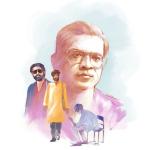
On the bank of the Kalni River, in a village that disappears under water for part of every year, an old man with a one-stringed ektara sang for most of the twentieth century — and for most of that time, almost nobody beyond his own wetlands was listening. Shah Abdul Karim (15 February 1916 – 12 September 2009) wrote and composed, by the most commonly cited count, more than 1,500 songs: songs of God and of the human body, of boatmen and faithless lovers, of hunger, dignity and the lost days when Hindu and Muslim neighbours sang together in the same village courtyard. Bangladesh came to him late. He was in his eighties before the cities learned his name, in his mid-eighties when the state gave him the Ekushey Padak, and a household name across the country only in the last decade of his life. By then his voice was nearly gone. What remains is the songs — and the title his people gave him long before Dhaka did: Baul Samrat, the Baul King.
A Childhood in the Bhati: Poverty, Cattle and First Songs
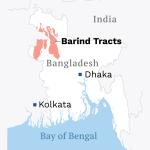
Karim was born on 15 February 1916 in Ujan Dhol, a remote village in Derai, in the Sunamganj district of Sylhet — in his birth year a corner of British India's Assam Province. He was the son of Ibrahim Ali and Naiorjan Bibi, poor peasants, and the only son among six children. (According to The Daily Star, which profiled him in 2007, Karim himself was never quite certain of his exact birth date; 15 February, in the month of Falgun, is the date that has been accepted.)
His was a childhood shaped by the haor basin of Sunamganj, the vast seasonal wetlands of the northeast, where villages become islands in the monsoon and the year's single rice crop decides who eats. The Kalni River ran in front of his village, and it runs through his music ever after — he would name two of his six books of songs after it. Formal education barely touched him: his schooling, by the usual account, lasted about a week at a village night school. Instead, the boy was sent out as a cattle herder for a meagre wage — The Daily Star put it at two taka — spending his days with the herds and his evenings where the real education was, at the village ashar, listening to Baul singers and pala gaan performers until the songs were in his blood.
Poverty was not an episode in Karim's life; it was the condition of nearly all of it. He worked as an agricultural labourer, and farming remained his main profession into old age — a fact worth holding on to, because the later legend can make him sound like a full-time wandering minstrel. He was a peasant who sang, and sang about peasants: their boats and harvests, their debts and humiliations, their loves and their God.
The Baul Path: Gurus and a Philosophy of the Heart
The Baul tradition Karim entered is Bengal's great heterodox inheritance: a devotional path drawing on Sufi Islam and Vaishnava bhakti alike, suspicious of mosque and temple orthodoxies, and convinced that the divine is to be found within the human body and the human heart. In 2005 UNESCO proclaimed the Baul songs of Bangladesh a Masterpiece of the Oral and Intangible Heritage of Humanity, and in 2008 they were inscribed on its Representative List of the Intangible Cultural Heritage of Humanity. Karim became, for much of the world beyond Bengal, the tradition's most recognisable modern voice.
His formation was orthodox by Baul standards: a guru, and years of listening. He took his training in Baul music and philosophy principally from Baul Shah Ibrahim Mastan Baksh, and also learned from Baul Rashid Uddin; several accounts add lessons from Ustad Karam Uddin. Behind his gurus stood the great dead masters whose philosophy he absorbed and made his own — Lalon Shah, Panju Shah and Duddu Shah. Like Hason Raja, the mystic bard of Sunamganj a generation before him, Karim rooted the universal claims of Baul philosophy in the particular soil of the haor country.
It was not a path his surroundings made easy. In the conservative rural society of his youth, a Muslim boy who took to music and the company of Bauls invited disapproval, and Karim faced social rejection alongside poverty; his parents, to their credit, did not stand in his way. What he learned from his gurus was a complete philosophy of life, not merely a repertoire: the conviction that the divine dwells in the human being, that caste and sect are distractions from that truth, and that love — of God, of the guru, of other people — is the only reliable road. He carried that philosophy, with his ektara in hand, for the rest of his life.
In one respect he broke with the classic Baul pattern: he married, and lived as a householder. In 1957 he settled in Ujan Dhol with his wife, Aftabunnesa Bibi, whom he affectionately called Sarala — "a simple girl". Sarala was, by every account, the making of the musician: she shielded his singing from the family's material worries and sent him out into the world rather than tying him to the household. He named his first collection of songs, Aftab Sangeet (1948), for her, and when she died, the grief entered the music and stayed there. Their son, Shah Nur Jalal, followed his father onto the Baul path.
Songs of Love, Loss and Equality
Karim insisted on calling his compositions simply Baul gaan — Baul songs. The count most often given is more than 1,500, organised in his lifetime into six books: Aftab Sangeet (1948), Gano Sangeet (1957), Kalnir Dheu (1981), Dholmela (1990), Bhatir Chithi (1998) and Kalnir Kooley (2001) — The Waves of the Kalni, and On the Banks of the Kalni, among them. Some accounts put the total nearer 1,600 songs; what is not in doubt is the scale, nor that the Bangla Academy thought ten of the songs worth translating into English.
The range is as striking as the volume. There are murshidi songs of devotion to the spiritual guide, marfati songs of mystical knowledge, and dehotattwa songs that read the cosmos in the human body. There are love songs of rare tenderness and songs of separation that ache. And there is the social conscience: the Gano Sangeet — songs of the masses — took up the sufferings of the poor under an unjust order, and across his career he sang of the Language Movement, the mass uprising of 1969 and the Liberation War of 1971, and of ordinary social questions such as family planning.
His best-loved song is also his simplest. Age Ki Sundor Din Kataitam — "What beautiful days we spent in those days" — looks back to the village of his childhood, when young Hindus and Muslims sang Baul and murshidi songs together, when jatra plays were staged in Hindu homes and the Muslim neighbours were invited in and went gladly. It is nostalgia, but nostalgia with a point: a lament for a Bengal of easy coexistence, and the closest thing Bengali music has to an anthem of communal harmony. A modern arrangement by Habib Wahid carried it to a new urban generation in the 2000s, and new versions are still being recorded.
Other songs travelled just as far. Gari Chole Na — "The cart won't move" — turns the stalled vehicle of the body into a joke at death's expense, and became a rock-era standard in the hands of the band Dalchhut. Bonde Maya Lagaise, Keno Piriti Baraila Re Bondhu ("Why did you deepen love, my friend"), Ami Koolhara Kolonkini, Kon Mestori Nao Banaise ("Which craftsman built this boat?") and Ager Bahaduri Ekhon Gelo Koi ("Where has my old swagger gone?") are sung wherever Bengalis gather. Like Jasimuddin, the Palli Kabi who sang rural Bengal in verse, Karim proved that the dialect and daily life of the village could carry the deepest subjects there are.
His imagery was the haor's own: boats and boatmen, the river in flood and the dry winter shore, the stalled cart, the machine-driver of Ami Tomar Koler Gari awaiting his master's signal. Through such homely metaphors he smuggled in the whole Baul teaching — the body as a vessel built by an unseen craftsman, life as a journey on water, the soul as a passenger who must one day step ashore. Performed with ektara and voice, in village courtyards and at festivals, the songs were built to be carried away by listeners and sung again — which is precisely what happened, for a hundred years.
Hardship, Obscurity and the Late Harvest of Fame
For decades, Karim's reputation stopped at the edge of the Sylhet region. He travelled from village to village performing, and after the Liberation War he was a regular artiste on Sylhet Betar, the local station of Bangladesh Betar — heard, respected, and still poor. He never had, as The Daily Star put it, any acumen for making money, nor much interest in it. Old age found him frail and nearly bedridden in his Ujan Dhol cottage, his singing voice largely destroyed. In 2006 the villagers and his disciples began an annual folk festival in his honour in the village itself — the Shah Abdul Karim Loko Utshab — so that the master could hear his own tradition celebrating him while he lived.
The national breakthrough, when it came, came from an unexpected direction: the recording studio, and the diaspora. According to Wikipedia's account of his legacy, Karim's work had fallen out of the mainstream until the early 2000s, when the producer-singer Habib Wahid released his debut album Krishno, steeped in Karim's music — Sylheti-British musicians such as Kaya were among the links between the old Baul and the new sound. The album was an instant hit and effectively launched folk fusion in Bangladesh. Dalchhut's Gari Chole Na did similar work from the rock side. Suddenly the frail old man in the haor village was the fountainhead of the country's most vital popular music — and the honours, at last, followed.
Honours
Karim received the Drouhee Kotha-Shahityik Abdur Rouf Choudhury Award in 2000. In 2001 the Government of Bangladesh awarded him the Ekushey Padak for his contribution to music — the country's second-highest civilian honour. (Some Bangladeshi reports loosely call it the nation's highest award; the Independence Award ranks above it.) The title by which the nation knows him, Baul Samrat — Baul Emperor, or Baul King — was no state decoration at all, but a crown placed on him by audiences and fellow musicians during his lifetime, and it is the one he would probably have valued most.
Death and a Living Legacy
Shah Abdul Karim died on 12 September 2009, in a clinic in Sylhet, of respiratory problems. He was 93. His body was brought to Dhaka and laid in state at the Central Shaheed Minar, where crowds paid their last respects amid his own songs, before he was buried at Ujan Dhol, beside Sarala.
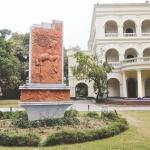
The village has kept faith with him. The Shah Abdul Karim Loko Utshab, the two-day folk festival begun there in 2006, is still held each year around his birth anniversary on the banks of the Kalni, organised by the Shah Abdul Karim Parishad under his son Shah Nur Jalal; the edition of March 2026 marked his 110th birth anniversary. In November 2018 the Shah Abdul Karim Smriti Jadughar, a memorial museum in his ancestral home displaying his instruments and everyday belongings, was inaugurated — funded by the Palli Karma Sahayak Foundation and built by the NGO TMSS. His birth centenary in 2016 was celebrated with festivals in both Sylhet and Dhaka.
But the real memorial is not a building. It is that a song written by an unschooled cattle-herder from a flooded village — Age Ki Sundor Din Kataitam — is now sung by pop stars and puja troupes, by rock bands and wandering Bauls, whenever Bengalis want to remember that Hindus and Muslims once sang in the same courtyard, and might again. The cart, as he joked in his own song, may stop. The singing has not.