Bangladesh Railway is the country's oldest large institution still doing the job it was created for. It began on 15 November 1862, when the Eastern Bengal Railway opened 53.11 kilometres of broad gauge track between Darshana, in what is now Chuadanga District, and Jagati in Kushtia. The line was built to carry jute and indigo down to the river ports and the sea. One hundred and sixty-four years later, the railway that grew from it runs, on its own published figures, more than 3,400 route kilometres, through more than 500 stations, across a country that has changed its name, its borders and its rulers around the tracks.
Its history is the history of Bangladesh in steel: built by an empire for extraction, cut in half by Partition, shattered by war, and rebuilt, slowly and then suddenly, by the independent state. In the last decade the railway has added the crossings it waited a century for, over the Jamuna and the Padma, and begun the largest expansion in its history. It has also carried into the present nearly every problem it ever had. This is the network's story, and its unfinished business.
1862: The First Line
The first train in what is now Bangladesh ran for a commercial reason: the Eastern Bengal Railway, a London-financed company working under government guarantee, wanted the produce of the Kushtia and Nadia country, its jute, indigo and sugar, moved cheaply to the Hooghly and the port of Calcutta. The Darshana to Jagati line of 1862 was broad gauge, five feet six inches, the gauge the Indian system had standardised on. On 1 January 1871 the same company extended the line to Goalanda, on the bank of the Padma, where passengers and goods transferred to steamers for Dhaka and the east. That rail-and-steamer pattern, train to the river, boat across it, train again, would define travel in the delta for more than a century.
A second technology arrived on 4 January 1885, when a short metre gauge line, 14.98 kilometres, opened between Dhaka and Narayanganj. The narrow, cheaper gauge was the one the colonial state would use to thread the east, and its arrival fixed the split personality the railway still has: broad gauge in the west, metre gauge in the east.
Building the Colonial Network
The decades around 1900 filled in the map. The Assam Bengal Railway, formed with government assistance in the early 1890s, drove the metre gauge up the east: on 1 July 1895 its lines from Chittagong to Comilla, 150.6 kilometres, and from Laksam to Chandpur, 51.2 kilometres, opened together, tying the port of Chittagong to the interior and beginning the connection toward Assam's tea country that gave the company its name. Dhaka was linked north to Mymensingh and south to the Chittagong line; the west filled in with broad gauge branches to the jute districts and the border crossings toward Calcutta and Darjeeling.
The era's monument is the Hardinge Bridge, opened in 1915: 1,798 metres of steel truss carrying a broad gauge double line over the Padma at Paksey, for eighty years the only fixed crossing of the great rivers in Bengal, and still in daily use. By the 1940s the network in the eastern wing of Bengal ran to some 2,600 kilometres, organised around a simple imperial geometry: raw materials flowed to the ports of Calcutta and Chittagong, and the lines ran where the cargo was.
1947: A Network Cut in Half
Partition cut that geometry apart in a weekend. When British India divided in August 1947, the Bengal Assam Railway was split between two countries, and the 2,603.92 kilometres of track that lay in East Pakistan passed to the new state. The lines had not been drawn for the border they now met. Routes that had run naturally to Calcutta ended at frontier stations; East Pakistan's railway faced west toward a foreign country and had to be reoriented, toward Chittagong, now its only great port, and toward its own interior.
The railway was renamed as the state around it changed: the Eastern Bengal Railway became the Pakistan Eastern Railway on 1 February 1961, and in 1962 its control passed from the central government in Karachi to the government of East Pakistan and a Railway Board. Investment through the Pakistan years was thin and the east's share thinner; the network the liberation war inherited in 1971 was ageing, undercapitalised and still running much of its colonial stock.
1971 and a Railway Reborn
The Liberation War tore the system apart. Railways are a occupier's logistics and a guerrilla's target, and through 1971 bridges were blown, track was torn up and stations were fought over across the country; among the major structures damaged were the Hardinge Bridge over the Padma and the great bridge over the Meghna at Ashuganj. When the war ended in December 1971, the new state of Bangladesh had a railway that could not run across its own territory.
Reconstruction took years, and the institution took its present name in the process: Bangladesh Railway, operating from 1972 under a Railway Board, then within the communications ministry, and since December 2011 under a Ministry of Railways of its own. What it could not recover quickly was capital. For three decades after independence the railway lived on patching: keeping the colonial alignment running, replacing stock piecemeal, and watching its passengers and freight drain away to the roads, which the state funded far more generously. By the 2000s the railway carried a fraction of the traffic its size promised, on a network still divided by gauge and, until 1998, by the Jamuna itself.
One Country, Two Gauges
The gauge split is the railway's inheritance and its daily tax. West of the Jamuna, the lines are broad gauge, 1,676 millimetres, continuous with India's main system. In the east, around Dhaka and Chittagong, they are metre gauge, 1,000 millimetres. For most of the railway's life the two halves met only at ferries, and a wagon loaded in Chittagong could not run to Rajshahi at any price.
The state's answer, pursued for three decades now, is dual gauge: laying a third rail so both kinds of train can share one track. The Jamuna crossing was built dual gauge in 1998; the Dhaka to Tongi corridor and the approaches to the capital followed; and every major new line of the last decade, to Cox's Bazar, over the Padma, over the Jamuna again, has been built broad or dual gauge with conversion in mind. The goal, a single network on which any train can run anywhere, is official policy and unfinished business at once.
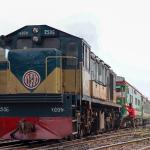
The railway is run as two operating zones divided by the Jamuna, an East Zone and a West Zone, each under a general manager, subdivided into four divisions: Dhaka, Chittagong, Paksey and Lalmonirhat. Its great workshops at Saidpur in the west and Pahartali in Chittagong, and the central locomotive workshop at Parbatipur, maintain a fleet that mixes modern diesels with machines decades past their intended lives.
Bridging the Great Rivers
What transformed the railway was not track but bridges, three generations of them. The Hardinge Bridge of 1915 first carried trains over the Padma. The Jamuna Bridge of 1998, whose story is told in our profile of the crossing, carried the first train between the eastern and western networks, ending the rail ferry era at Bahadurabad. And on 18 March 2025 the dedicated Jamuna Railway Bridge was inaugurated beside it, a dual gauge double track built for 88 trains a day at up to 120 kilometres an hour, replacing a crossing on which trains had crept at twenty.
The southern crossing came last and changed the most geography. The Padma Bridge Rail Link, a 169 kilometre broad gauge line from Dhaka to Jashore built with Chinese financing at a cost of Tk 39,247 crore, is the largest project Bangladesh Railway has ever executed. Its first section, the 82 kilometres from Dhaka to Bhanga across the Padma Bridge, was inaugurated on 10 October 2023, and passenger trains began on 1 November 2023, the first in history to cross the Padma by rail south of Paksey. The full line to Jashore opened on 24 December 2024, cutting the Dhaka to Jashore journey from about ten hours to about three, and giving twenty-one south-western districts their first fast connection to the capital.
New lines followed the bridges. The 100 kilometre dual gauge line from Dohazari to Cox's Bazar, opened in late 2023, took the railway to the country's main tourist coast for the first time. The Khulna to Mongla line, opened in stages through 2023 and 2024, gave Mongla, the second seaport, its first rail connection. The container trains that have run since 1991 between Chittagong Port and the Dhaka inland container depot remain the freight system's backbone, and railway towns like Srimangal, where the Dhaka to Sylhet line runs through the tea gardens, still organise their days around the timetable.
The Network Today
Bangladesh Railway's Information Book 2023 records a network of 3,422 route kilometres at the end of the 2022-23 financial year, reaching 50 of the country's 64 districts, with about 25,000 regular staff on the rolls and some 3,650 bridges of all sizes on its lines. It runs intercity expresses between the divisional cities, mail and commuter trains, the cross-border services to India restored link by link since 2008, and a freight operation carrying containers, fuel, fertiliser and foodgrain at state-set rates.
The numbers describe a mid-sized railway with an outsized importance. Bangladesh is dense, flat and flood-prone, built for trains; the railway's fares are the cheapest long-distance travel the poor can buy; and its freight rates underwrite the movement of essentials to districts the ports and highways serve badly. It is also, by its own accounts, a railway that does not pay for itself, and never has.
Modernisation and Its Limits
The modernisation programme of the last fifteen years is real: new bridges, new lines, doubling of the busiest corridor between Dhaka and Chittagong in stages, new locomotives from American and Indian builders, Indian grant locomotives in 2020 and 2023, station rebuilding and a master plan that looks toward 2045. The railway of 2026 reaches places, Cox's Bazar, Mongla, Jashore by the short road, that it could not reach in 2010.
Its limits are equally real, and they are the old ones. Much of the core network is still single track, so trains wait in loops for each other as their grandfathers did. A large share of the locomotive fleet is beyond its economic life, and shortages of drivers and running staff are chronic: in December 2024 a running-staff strike delayed even the launch of the Dhaka to Khulna trains on the new Padma line. Projects habitually cost more and take longer than their approvals: the Jamuna Railway Bridge rose from Tk 9,734 crore at approval to Tk 16,781 crore as built. Level crossings, thousands of them, many unauthorised, kill people every year. And the operating deficit is covered by the state as a matter of routine, which keeps fares low and investment dependent on the next loan.
None of this is an argument that the expansion was wasted. It is the measure of the distance between building lines, which Bangladesh has learned to do, and running a railway, which is the work of the next thirty years.
Conclusion
Bangladesh Railway has been, in turn, a jute company's conveyor, a partitioned remnant, a war ruin and a national project. The steel thread that runs from the Darshana to Jagati line of 1862 to the trains now crossing the Padma and the Jamuna at speed is the same institution, and its recent history suggests the obituaries written for it in the road-building decades were premature. The bridges are built. The gauges are converging. What remains is the unglamorous work: double track, working locomotives, staffed trains, and a timetable the country can set its watch by. The first Bangladeshi railway was 53 kilometres long. The question for the next generation is not how long the network is, but how well it runs.