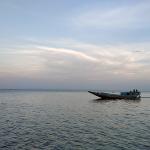
In the monsoon, it is a sea. From a boat in the middle of Hakaluki Haor in August, there is water to every horizon, waves running across it, villages standing on their mounds like islands, and the hills of India a blue line to the north. In February the same ground is a patchwork of green boro rice, grazing cattle and shrinking pools of open water, and men are casting nets in channels you could step across. Hakaluki, in the north-eastern corner of Bangladesh, is the largest haor in the country and one of the largest freshwater marshes in Asia: a seasonal wetland of some 18,000 hectares that floods and empties with the year, and on which the lives of about 190,000 people and hundreds of species of fish and birds depend.
It is also a wetland in trouble. Within living memory its waters held well over a hundred kinds of fish; surveys in the last decade have found barely half that number, and some of its famous species have all but disappeared. Hakaluki's story is the story of the whole haor basin in miniature: an ecosystem of extraordinary generosity being drawn down faster than it can refill.
Where the Land Becomes a Lake
Hakaluki lies in Sylhet Division, spread across five upazilas: Barlekha, Kulaura and Juri in Moulvibazar District, and Fenchuganj and Golapganj in Sylhet District. Banglapedia gives its surface area as 181.15 square kilometres, about 18,000 hectares, of which the largest share, some forty per cent, falls in Barlekha. The Kushiyara River bounds it to the north; the Fenchuganj to Kulaura railway runs along its western edge, close enough that passengers watch the water change with the seasons from the train window.
A haor is a bowl. Through the dry months, Hakaluki's bowl holds a network of about 240 beels, permanent or near-permanent pools linked by channels, together covering roughly 4,400 hectares of open water. From April the pre-monsoon rain and the hill streams racing down from across the Indian border begin to fill it; by July the beels have merged into a single sheet of water four times that size, several metres deep, and the bowl has become an inland sea. Then, from October, the water drains away to the Kushiyara, the fish retreat into the beels, and farmers plant boro rice on the exposed bed, racing, as haor farmers always race, to harvest before the next flood arrives.
It is one of the great seasonal landscapes of Asia, and it works because of the rhythm, not in spite of it: the flood feeds the fish, the fish feed the people, and the emptied bed feeds them again with rice.
A Wetland That Works for a Living
Around 190,000 people live in the villages around Hakaluki, and nearly all of them draw their living from the wetland in one form or another. The pattern of the year is fixed by the water. In the dry season the haor bed carries one of the region's great boro harvests, a single crop of irrigated rice grown on land that will be lake bed again by summer. As the water rises, fishing takes over: professional fishing families, and farming families turning to the net for the season, work the open water and the beels. Cattle and buffalo graze the emerging grassland as the flood falls, ducks are herded across the shallows, and in the villages around the edge, people weave, trade and mend boats in the economy the wetland supports.
The haor is also a commons, and that is the root of both its generosity and its danger. Its fish belong to whoever can catch them, its beels are leased, fought over and fished under layers of custom and paper rights, and for a poor household the haor is the one asset that asks no capital to enter: a net, a boat, and the water provides. What the wider fisheries industry of Bangladesh draws from wetlands like Hakaluki is measured in hundreds of thousands of tonnes; what Hakaluki's own families draw from it is measured in whether they eat protein at all.
The Mother Fishery
Fisheries scientists use a particular phrase for wetlands like this one: a mother fishery. The beels that never dry are the nurseries of the whole system. Through the winter, brood fish shelter in their depths; when the flood comes, the fish spill out across the inundated haor to feed and breed, and their young repopulate not only Hakaluki but the rivers and floodplains connected to it. Protect the beels, and the fishery renews itself. Empty them, and there is nothing left to renew.
At its best, the system was astonishingly rich. Local records and older surveys credited Hakaluki with more than 110 species of indigenous fish: the great carps, rui, catla and mrigal; the catfish, boal, pabda and magur; chital, baghair and rita; and dozens of small species, puti, tengra, koi, mola and their kin, minor in weight and central to the nutrition of the poor, who eat them whole, bones and all. A number of beels have been set aside as fish sanctuaries over the past two decades, closed to fishing year-round under government and community-based projects, precisely so that brood stock can survive the dry season unmolested. Where sanctuaries are respected, fishers themselves report the water around them thickening with fish.
Vanishing Fish
The trend, measured carefully, runs the other way. A study published in the journal Heliyon in 2021, tracking Hakaluki's fish between 2008 and 2018 through the records of 150 fishing families, found that of 63 species, the share classed as readily available fell from 83 per cent in 2008 to 51 per cent a decade later, and diversity declined across every one of the twelve taxonomic orders it examined. Field surveys in the same period found between 57 and 64 species where older accounts listed more than 110. Around a fifth of the species that remain are now classed as threatened. Species that elders describe as once ordinary, baghair, chital, rita, nandina, the loach called rani, have become rarities or vanished from the catch altogether.
The causes the researchers identified divide between the sky and the shore. From the sky: erratic rainfall, temperature fluctuation, and the siltation of the beels themselves, as sediment-laden hill water slowly fills the deep pools that are the fish's dry-season refuge. A shallower beel is a smaller ark. From the shore: destructive fishing gear, above all the fine monofilament current nets that take everything that swims, fry and brood fish together; the practice of fishing a beel completely dry, pumping or bailing out the last water to take the last fish; the use of urea to stun fish for harvest; and simple overfishing, too many nets in a shrinking refuge. A fisheries officer in Kulaura told reporters in 2026 that his teams had seized and burned more than 12,000 metres of banned nets, and the drives, and the fishing, both continue.
Fishers feel it first as income: the same effort brings a smaller, poorer catch than five years ago, and species that once commanded the market are replaced by whatever the nets still find.
Winter Guests: The Birds of Hakaluki
If the fish are Hakaluki's wealth, the birds are its fame. Banglapedia records 558 species of animals and birds identified in and around the haor, and each winter the wetland fills with migratory waterfowl down from Siberia and Central Asia: ducks, geese, waders and herons in their tens of thousands, rafting on the beels and feeding across the shallows. A January census in 2016 counted about 34,000 birds of 56 species. Around the beels stand fragments of the haor country's freshwater swamp forest, hijal and koroch trees that shelter roosting birds and shade young fish in the dry months.
The counts tell the same story as the fish surveys, in a quieter voice: in successive winters, counters have often recorded fewer birds than the year before. A wetland that is fished dry, netted over and disturbed through the winter is a less welcoming refuge, and the birds, who have the whole flyway to choose from, vote with their wings.
Threats on Every Side
Hakaluki's pressures arrive together. Siltation raises the beel beds year by year, shrinking the dry-season refuge on which the whole fishery depends. Encroachment and conversion nibble at the margins, as wetland is bunded, filled or turned to permanent farmland. Agrochemicals wash off the surrounding paddy and, as local environmentalists report, from the tea country that begins in the hills not far east, where the gardens around Srimangal drain toward the same low ground. Flash floods arrive earlier and harder in some years, drowning the boro crop before harvest; in others the water itself comes late. Over it all stands the arithmetic of poverty: 190,000 people with few alternative incomes, drawing on a commons that no one household has reason to spare.
The legal protection, on paper, is real. Hakaluki was declared an Ecologically Critical Area in 1999, a status that restricts activities harmful to the ecosystem. It is worth being precise about what it is not: despite claims on some official tourism pages, Hakaluki is not a Ramsar site; Bangladesh has only two, the Sundarbans and Tanguar Haor. Parliament's passage of a Haor and Wetlands Conservation Act in April 2026 added a newer statute aimed at encroachment and destructive fishing in natural wetlands. The gap, as with so much in the haors, is between the law in Dhaka and the water in Moulvibazar.
Saving Hakaluki
What would saving it take? The research converges on a practical list. Deepen the beels, by excavation where siltation has filled them, so the dry-season refuge holds more water and more fish. Make the sanctuary system permanent and complete: environmentalists in the district have called for a permanent fish sanctuary under a planned project, rather than the present patchwork of project-funded closures that lapse when funding ends. Enforce the bans that already exist, on current nets, on beel dewatering, on fishing in the breeding season, with the fisheries department's drives backed by the courts. And give the families around the haor other ways to live, since no conservation rule survives contact with hunger for long: the community-based management projects that have worked in the haor basin share a single insight, that fishers who hold a stake in a beel's future will police it themselves.
None of this is technically difficult. All of it requires the wetland to be governed as one system, water, fish, birds and people together, rather than as a stock of fish to be argued over beel by beel.
Conclusion
Hakaluki Haor is the largest of Bangladesh's haors and a fair test of whether the country can keep its wetlands alive. It still floods and empties with the ancient rhythm; it still feeds 190,000 people; it still fills each winter with birds that have flown half a continent to reach it. But the margin is thinning: fewer fish, in fewer species, in shallower beels, counted year by year in the studies and felt season by season in the nets. The haor does not need to be rescued from its people, who have lived off it for centuries without exhausting it. It needs to be rescued from the last few decades: the fine nets, the drained beels, the rising silt. A mother fishery, once emptied, does not refill on its own.