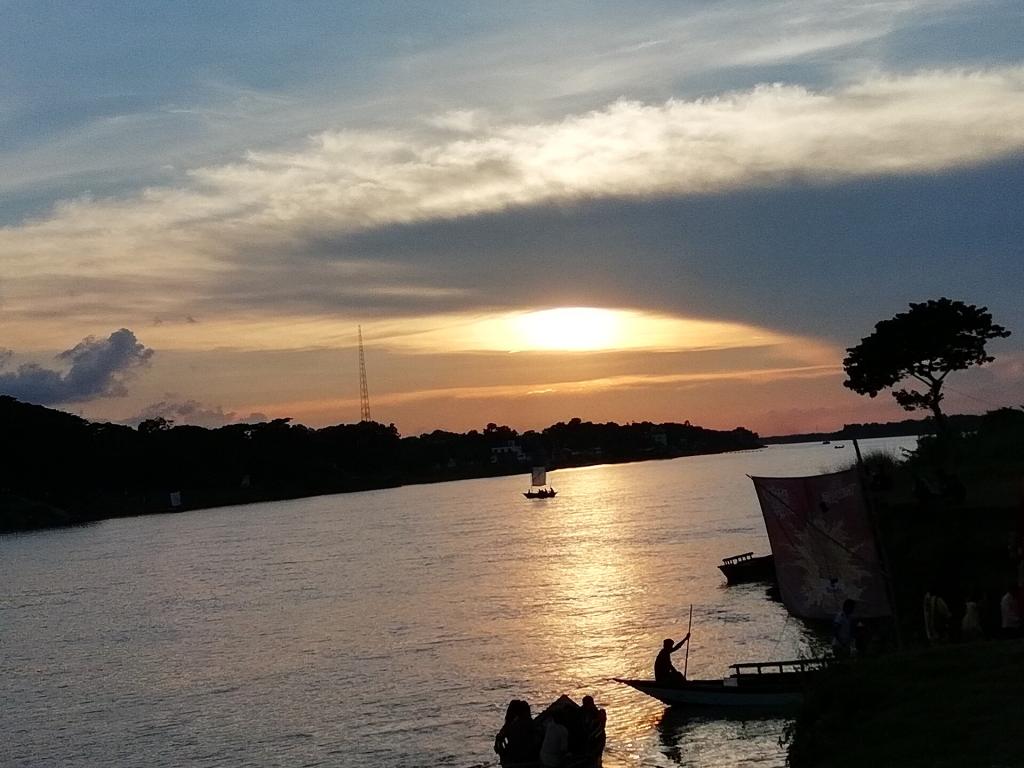
About 120 kilometres north of Dhaka, the road and the railway reach a city that moves at a gentler pace than the capital. Mymensingh stands on the bank of the Old Brahmaputra, a river that was once one of Asia's great waterways and is now a calm, wide stream lined with parks and boats. Around it, the city has layered three identities: an old district town of zamindar palaces, a university city anchored by the country's first agricultural university, and, since 2015, the capital of Bangladesh's newest division. It is also the homeland of the Mymensingh Gitika, the folk ballads that carried the voices of Bengal's village women to the world's libraries.
Mymensingh at a Glance
- Location: on the Old Brahmaputra River, about 120 kilometres north of Dhaka
- Status: capital of Mymensingh Division and Mymensingh District; a city corporation since 2018
- Founded as a district: 1 May 1787, by the British East India Company; one of the 16 old districts of Bangladesh
- Population: 577,000 in the city corporation and 5.9 million in the district (2022 census); the division holds 12.2 million people in four districts
- Known for: Bangladesh Agricultural University, Shashi Lodge, Alexander Castle, the Mymensingh Gitika ballads and Nakshikantha embroidery
- Earlier names: Momenshahi, after a ruler called Momen Shah; Nasirabad in the colonial period
A District Older Than Most
Mymensingh is one of the oldest administrative cities in Bangladesh. The East India Company constituted the district on 1 May 1787, and for much of its early life it was enormous, one of the largest districts in Bengal. The greater Mymensingh of the 19th century reached across most of today's north-central region; over the following two centuries it was divided again and again, giving birth to the separate districts of Tangail, Jamalpur, Sherpur, Netrokona and Kishoreganj, until the modern district remained. The city's own name is a softened pronunciation of Momenshahi, the land of Momen Shah, a local ruler of an earlier age; in the British period the town was also known as Nasirabad.
The wealth of old Mymensingh came from its land and rivers, and much of it pooled in the hands of great zamindar families, above all the Acharya Chowdhurys of Muktagachha, whose seat lay a short distance west of the town, with the houses of Gouripur and Atharabari close behind. Under their patronage the town grew into a hub of the jute trade, of administration and of the arts. Their money built the palaces, town hall, schools and colleges that still give the city its character, and their rivalry in public works made Mymensingh an education town long before it became a university city.
The River That Moved Away
The strangest fact about Mymensingh is written in its river's name. The stream flowing past the city is the Old Brahmaputra: until the late 18th century this was the Brahmaputra's main channel, carrying the river's full force down from Assam. Then, in the decades around 1800, following the great floods and the earthquake of 1787, the river's main current swung west into the channel now called the Jamuna, and the old course past Mymensingh dwindled into the gentler waterway it remains today.
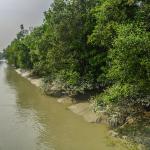
The change shaped everything. Mymensingh lost the through trade of a great river but gained a sheltered, human-scale waterfront. The Old Brahmaputra now runs along the city's north, crossed by the Shambhuganj Bridge to the far bank, and its parks and ghats form the city's front room. Bipin Park, near the old Boro Bazaar, and the riverside Zainul Abedin Park draw the evening crowds, and small boats still ferry passengers and sightseers between the banks. In the dry season the water is low and clear; in the monsoon it fills again and reminds the city of the giant it once hosted. River erosion and siltation remain live concerns, and reviving the old channel's flow has been a recurring demand of the region for decades.
The Shape of the City
Mymensingh has no formal boundary wall, but its landmarks mark it out like compass points. The river bounds it to the north. To the south and east the city runs out through the Agricultural University campus and the Medical College to the army cantonment, while the railway, laid through the town between 1885 and 1899, slices it into two halves that meet at the level crossings. One quarter carries a different history altogether: Sultanabad, a township built for followers of the Aga Khan, whose Ismaili community settled here in the colonial period. Since the 1980s the city has grown fast and informally beyond all of these edges, spreading along the Dhaka road and the riverbank, but the old skeleton, river, railway, campus and palace quarter, still shows through the new concrete.
The Zamindars' City: Shashi Lodge and Alexander Castle
Two buildings carry the memory of the zamindari age. Alexander Castle, known locally as Lohar Kutir, the Iron House, was built in 1879 by Maharaja Surya Kanta Acharya Chowdhury of Muktagachha, a steel and timber mansion raised in part to receive grand visitors, among them Grand Duke Boris of Russia and the British commander General Sir George White. Its iron frame was meant to be earthquake-proof, and its guest list grew to include Rabindranath Tagore, Mahatma Gandhi and Subhas Chandra Bose. The same maharaja built the Old Town Hall in 1878, which hosted the city's dramas, meetings and cultural functions for generations.
Shashi Lodge, the Mymensingh Palace, rose a little later on the site of an earlier palace, the Rang Mahal. Built by Maharaja Shashikanta Acharya Chowdhury, it is a two-storeyed European-style mansion of colonnaded verandas, ornate plaster and sculpture, set in gardens in the heart of the city. Surya Kanta did not live to see it finished, but the lodge became the family's city palace and one of the finest zamindar residences in Bengal. Today it is used by a teachers' training college, its rooms given over to classrooms, which has kept the building alive if not restored. Together, palace, castle and town hall mark the high noon of a landed order that the abolition of zamindari in 1950 swept away.
The Education City
If the zamindars gave Mymensingh its buildings, education gave it its modern soul. The city's defining institution is Bangladesh Agricultural University, founded in 1961 as the country's first agricultural university. Its green campus of about 1,200 acres, with lakes, research farms, a botanical garden and the Fish Museum and Biodiversity Centre, stretches along the river south of the centre and functions almost as a second city: thousands of students, the nation's agricultural research establishment, and a park-like landscape open to the town. Graduates of the university staff much of Bangladesh's agriculture, fisheries and livestock administration.
Around it stands a full ladder of older institutions. Mymensingh Medical College grew from a medical school founded in 1924 and took its present form in 1962. Ananda Mohan College carries the name of the educationist Ananda Mohan Bose, and the Muminunnesa Women's College, the Zilla School and the Girls' Cadet College draw students from across the division. The cadet college, opened in 1982, was the first cadet college for girls in Bangladesh, and its presence underlines how central schooling is to the city's identity. The railway, built through the city between 1885 and 1899, still cuts it in two, and the student population it serves gives Mymensingh its bookshops, its adda and its unhurried intellectual air.
Ballads, Quilts and the Shilpacharya
Mymensingh's greatest gift to Bengali culture came not from its palaces but from its villages. In the early 20th century the schoolteacher and folklorist Chandra Kumar De travelled the region collecting the long narrative ballads sung by rural people, many of them composed by and about women. Edited by Dinesh Chandra Sen and published by the University of Calcutta from 1923 as the Mymensingh Gitika, the ballads, among them Mahua, Malua and the works attributed to Chandravati, often called the first woman poet of Bengali literature, were translated into languages across the world and changed how scholars understood Bengali folk literature. The region's other famous craft is the Nakshikantha, the embroidered quilt whose running-stitch pictures turn old cloth into family history.
The visual arts have their own shrine here. The Zainul Abedin Sangrahashala, established in 1975, preserves the work of Zainul Abedin, the founding figure of modern art in Bangladesh, who spent his boyhood by the Brahmaputra in Mymensingh and returned to its banks and boatmen throughout his painting life. The museum stands near the river that taught him to draw. The city's sense of itself was also forged in the language struggle: its first Shahid Minar, raised in memory of the martyrs of 1952, was built in 1958 near the town centre, early for a district town, and the monument remains a point of local pride.
The Modern Divisional Capital
On paper, Mymensingh's modern rise has been rapid. In 2015 the government created Mymensingh Division, the country's eighth and newest, joining the districts of Mymensingh, Jamalpur, Netrokona and Sherpur, with the city as its capital. In 2018 the municipality was elevated to a city corporation, the 12th in Bangladesh, with an area of about 91 square kilometres. The 2022 census counted 577,000 people in the corporation area and 5.9 million in the district, the fourth most populous in the country.
The division the city governs is one of contrasts. Its south is a rice-surplus plain of ponds and paddy; its north rises to the Garo Hills foothills along the Indian border, home to Garo and Hajong communities whose languages and festivals give the region a character found nowhere else in the delta, and to the haor wetlands of Netrokona, where the land dips toward the great Sunamganj basin. Few divisional capitals administer so varied a territory, and much of Mymensingh's administrative work is the management of that variety.
The economy still runs on the land. The district is one of Bangladesh's great freshwater fish farming centres, its ponds supplying markets across the country, and the Bangladesh Fisheries Research Institute keeps its headquarters in the city, beside the agricultural university that trains its scientists. Rice, jute and vegetables move through its bazaars, and the division's haor-fringed northern districts send their produce and their students down to the capital on the Old Brahmaputra. The challenges are those of every fast-growing Bangladeshi city, strained services, traffic and pressure on the river, but Mymensingh faces them with an asset few cities can match: two and a half centuries of practice at being a regional capital, and a population that has always valued a school as much as a shop.
Sources
Bangladesh Bureau of Statistics, Population and Housing Census 2022 (city corporation, district and division figures); Banglapedia and district administration histories of Mymensingh (district formation 1787, zamindari landmarks); Bangladesh Agricultural University institutional history; University of Calcutta's Mymensingh Gitika editions and Dinesh Chandra Sen's introductions; bdnews24 on the 2018 city corporation elevation.