Twenty-three kilometres east of Rajshahi city, beside the highway to Dhaka, a small town holds a sight found nowhere else in Bangladesh. Around a chain of quiet lakes stand the temples of Puthia: a five-spired Shiva temple of white plaster, a Krishna temple sheathed from plinth to cornice in terracotta storytelling, a four-storeyed festival pavilion, and the palace of the zamindar family that built them all. The Puthia Temple Complex is the largest cluster of historic Hindu temples in the country, the surviving heart of one of the richest landed estates of British Bengal, and a strong candidate for World Heritage recognition.
Puthia Temple Complex at a Glance
- Location: Puthia Upazila, Rajshahi district, 23 kilometres east of Rajshahi city on the Dhaka-Rajshahi highway
- Protected structures: 14 monuments under the Department of Archaeology: one palace and 13 temples, among some 17 temples in the town
- Builders: the Hindu zamindars of the Puthia Raj family, mainly in the 18th and 19th centuries
- Principal monuments: Bhubaneshwar Shiva Temple (1823-1830), Pancharatna Govinda Temple (1823-1895), Dol Mandir (1778), Puthia Rajbari (1895)
- Recognition: protected monuments of Bangladesh and a site on UNESCO's Tentative List for World Heritage
- Setting: temples and palace arranged around lakes, among them Shiv Sagar and Shyam Sagar, within a moated royal quarter
The Rise of the Puthia Raj Family
The story begins in the late 16th century, when the Mughal general Raja Man Singh campaigned in Bengal for the emperor Akbar and confiscated the estate of a rebellious local jagirdar, Lashkar Khan. The confiscated zamindari of Lashkarpur was offered to Bhatsacharya, a learned holy man, who declined it. His son Pitambar accepted, made Puthia his capital, ringed it with canals for defence, dug a great pond before his palace, and founded the Puthia Raj family. Pitambar died without children, and the estate passed to his younger brother Nilambar, who received the title of Raja from the emperor Jahangir and stands as the first king of the line.
Under his descendants the estate grew into one of the giants of Bengal. In its British-era prime the Puthia Raj estate was the second-largest zamindari in Bengal and among the wealthiest, its rents funding schools, charities and an extraordinary programme of temple building. In 1744 the estate was divided between branches of the family, the eldest son taking a five-and-a-half-anna share and his brothers three-and-a-half-anna shares, which is why the surviving palace is known as the Panch Ani, or five-anna, palace. The family, converted to Vaishnavism by the saint Radhamohan Thakur, poured its devotion into brick and terracotta, and Puthia became a temple town.
The Bhubaneshwar Shiva Temple
The complex's greatest monuments rose in a single remarkable generation. After the death of Raja Jagat Narayan Roy, his widow Rani Bhuban Moyi Devi began a building campaign in 1823 that produced the Shiva temple and the Rath Temple together, while work on the Govinda Temple also began in the same period. A widowed queen regent, ruling one of Bengal's richest estates, stamped her devotion on the town in brick and plaster, and Puthia has been defined by her temples ever since.
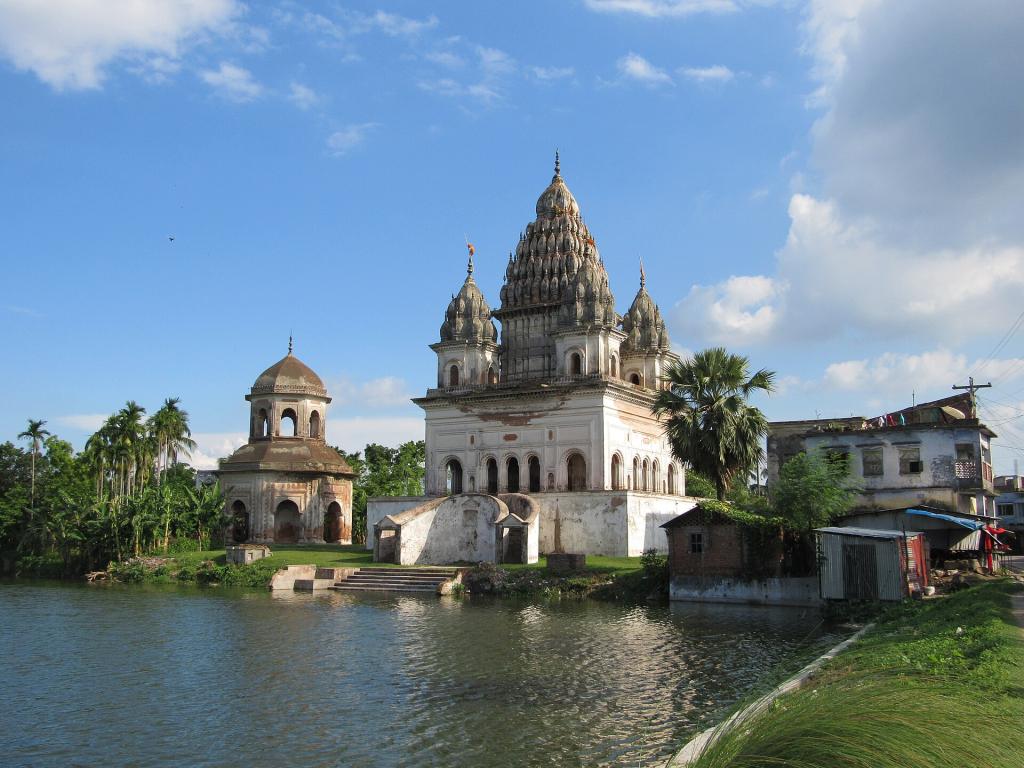
The first monument a visitor meets, and the tallest in Puthia, is the Bhubaneshwar Shiva Temple, raised on a high plinth above the lake called Shiv Sagar. It is the largest Shiva temple in Bangladesh. The temple was built between 1823 and 1830 by Rani Bhuban Moyi Devi, widow of Raja Jagat Narayan Roy, and it is a masterpiece of the pancharatna, or five-spire, style. A great central spire rises over the sanctuary, itself composed of 108 smaller spires, and four corner spires, each built up of 17 sub-spires, complete the five. The plastered walls below are comparatively plain, so the eye is drawn upward to the clustered towers, which are mirrored in the lake on a still morning.
Beside the Shiva temple stands the smaller Rath Temple, also called the Jagannath Temple, built by the same widowed queen in 1823. Its domed form contrasts with its neighbour's spires, and together the two temples frame the entrance to the royal quarter: Shaiva and Vaishnava shrines side by side, reflecting the family's widening devotion.
The Pancharatna Govinda Temple
Inside the palace grounds, in the inner courtyard, stands the temple many consider the jewel of Puthia. The Pancharatna Govinda Temple was built across the 19th century, between 1823 and 1895, and dedicated to Krishna. It combines the five-spire plan with the curved Jor-bangla roofline of Bengal, but its glory is its surface. Every wall is covered with terracotta plaques: baked-clay panels carved with scenes from the Ramayana and the Mahabharata, episodes from the life of Krishna, and, woven between the gods, the ordinary Bengal of the time, its soldiers and musicians, boats and animals, dancers and farmers.
Terracotta was Bengal's answer to a land without stone. On an alluvial plain of clay and brick, artists pressed entire scriptures into the walls of temples, and at Puthia the craft reached one of its highest points. Students of Bengal's temple art usually name one rival for the Govinda Temple's storytelling walls: the Kantajew Temple in Dinajpur, built a century earlier. Between them, the two temples hold much of the finest terracotta work surviving in Bangladesh.
Reading the Architecture
Puthia is a compact textbook of Bengal's temple styles. The pancharatna plan, used for both the Shiva and the Govinda temples, sets four corner towers around a taller central tower, all of them curving inward as they rise. The Jor-bangla form, folded into the Govinda Temple's design, joins two hut-shaped roofs in memory of the paired village huts of the delta, translated into brick. Other temples in the town use the simple do-chala, a single curved roof like an upturned boat hull. All of these forms descend from the bamboo and thatch building of the Bengal countryside, rebuilt in permanent materials by wealthy patrons.
The material itself explains the decoration. The Bengal delta has almost no building stone, so its temples are brick, and brick invites a skin of fired clay. Terracotta plaques could be moulded or carved while soft, fired hard, and set into the wall as a permanent picture book, cheap enough to cover an entire temple and durable enough to survive two centuries of monsoon. At Puthia, where one family spent generations competing in piety, the result is a density of sacred architecture that no other Bangladeshi town matches.
The Dol Mandir and the Palace
Across an open ground from the palace rises the strangest silhouette in Puthia. The Dol Mandir, built in 1778 by the zamindar Bhubanendra Narayan Roy, is a four-storeyed pyramid raised for Dol Purnima, the spring festival of colours sacred to Krishna. Each storey steps back from the one below and carries fewer arches: seven on each side at the base, then five, then three, then a single arch at the top, crowned by a small dome. It is less a temple than a stage, built so the festival image could be displayed and swung before the whole town.
Facing it stands the Puthia Rajbari, the family's palace. The present building dates to 1895, when Maharani Hemanta Kumari Devi raised a grand two-storeyed mansion in the Indo-Saracenic Revival style, mixing Bengali, Islamic and British colonial elements behind an imposing facade about 61 metres long. The palace, the Dol Mandir, the temples and the lakes together form a complete zamindari capital in miniature: court, shrine, festival ground and water, arranged within the old moat that Pitambar dug for defence four centuries ago.
The Smaller Temples and the Lakes
Beyond the great monuments, a ring of smaller shrines completes the town. The Choto Govinda Temple serves the same Krishna devotion as its larger namesake. The Gopal Temple, the Boro Annik Temple and the hut-shaped Jagaddhatri Temple, which stands to the west of the palace, each keep the forms of Bengal's domestic sacred architecture, small, curved-roofed and intimate. In total some 17 temples survive at Puthia, of which 13, with the palace, are formally protected.
Water organises everything. The royal quarter grew around its lakes, Shiv Sagar before the Shiva temple and Shyam Sagar at the complex's heart, with the old defensive moat still tracing the estate's edge. The temples were placed to be seen across water, their spires doubled in reflection, and the daily life of the town, bathing, washing, fishing and prayer, still moves along the ghats between them. Part of Puthia's pleasure is that it is not a fenced museum but a living town, where protected monuments stand beside homes, markets and schools, and where a 200-year-old temple wall may form one side of a family's courtyard.
Decline, Protection and the World Heritage Ambition
Puthia's royal age ended abruptly. After the Partition of 1947 the Raj family migrated to India, and the East Pakistan Estate Acquisition Act of 1950 abolished the zamindari system altogether. The palace and temples passed to the state, and the complex is now protected and maintained by the Department of Archaeology. Protection, however, has not meant safety. Heritage writers have warned for years about unplanned construction pressing against the monuments, weathering of the terracotta, and the slow decay of plaster and brick in the damp Bengal climate. The Govinda Temple in particular has been described as threatened by a college established close beside it and by the general lack of conservation work, and commentators have asked, only half in jest, whether buildings that have lasted a little over a century in good order can be made to last another one without serious care. The monuments have survived zamindari, Partition and abolition; their present enemy is slower and quieter: neglect, damp and the building boom of a growing town.
The strongest hope for Puthia's future is its place on UNESCO's Tentative List, the first step toward World Heritage inscription. Listing would bring international attention, conservation funding and stricter control of the building work that now crowds the site. For a town that holds the largest number of historic temples in Bangladesh, most of them raised within a single extraordinary century by a single family, the case is a powerful one. What the Puthia Raj family built as an act of devotion has become, two centuries on, a national inheritance, and one that Bangladesh is still learning how to keep.
Visiting Puthia
Puthia is one of the easiest heritage trips in Bangladesh. The town sits directly on the Dhaka-Rajshahi highway, 23 kilometres east of Rajshahi, and buses and local transport pass the complex throughout the day. The monuments stand close together around the lakes and can be seen on foot in two to three hours; the Shiva temple and the lake are best in the early morning, when the spires reflect in Shiv Sagar and the terracotta of the Govinda Temple catches low, warm light. Most travellers visit as a half-day trip from Rajshahi and combine the temples with the city's own silk, mango and Padma riverfront heritage.
Sources
Department of Archaeology protected monument records for Puthia; Encyclopaedia and heritage literature on the Puthia Raj family and the Bhubaneshwar, Govinda and Dol temples; UNESCO Tentative List entry for the Puthia Temple Complex; Financial Express and travel literature on the complex's conservation.