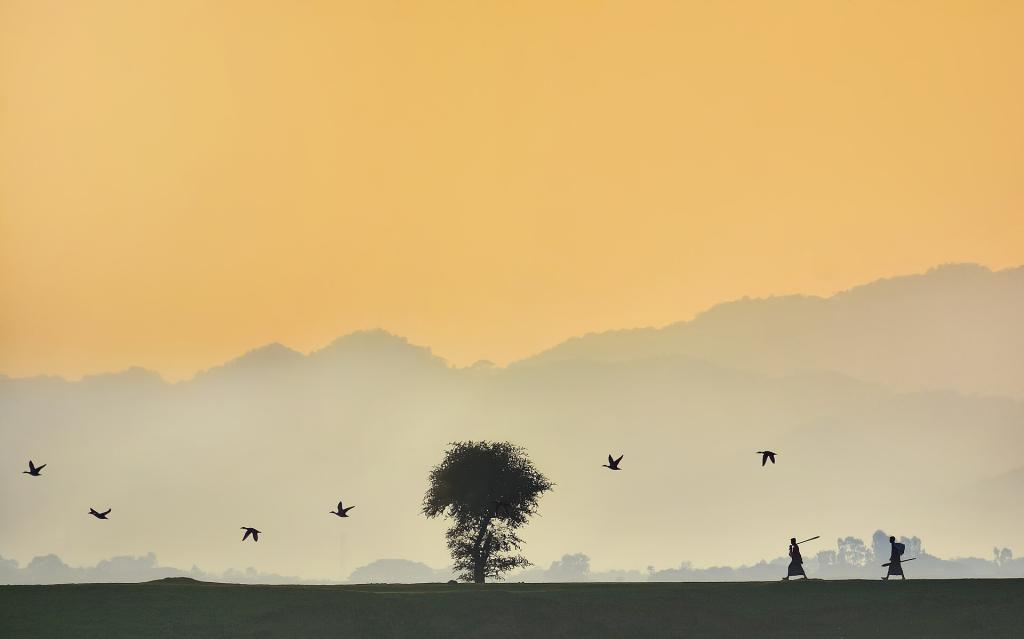
At the foot of the Meghalaya Hills in Sunamganj district, where the plains of Sylhet meet the Indian border, lies a wetland that changes its face with the seasons. In the monsoon, Tanguar Haor is a single vast sheet of water, dotted with villages that stand like islands and crossed only by boat. In winter, the water retreats into deep permanent pools, farmland reappears, and tens of thousands of migratory birds descend on what is left. Tanguar Haor is Bangladesh's second Ramsar site, its most celebrated freshwater fishery, and one of the most ecologically important wetlands in South Asia. It is also, by almost every recent measure, a wetland in trouble, and since late 2025 it has been protected by the strictest rules in its history.
Tanguar Haor at a Glance
- Location: Tahirpur and Madhyanagar upazilas, Sunamganj district, Sylhet Division, about 40 kilometres from Sunamganj town
- Ramsar site: No. 1031, designated on 10 July 2000; the second Ramsar site of Bangladesh after the Sundarbans
- Listed area: 9,500 hectares in the Ramsar listing; the protected core is commonly cited as 9,727 hectares
- Wider complex: about 12,655 hectares across 18 mouzas and four unions, with 54 major beels among more than a hundred water bodies
- Earlier protection: declared an Ecologically Critical Area in 1999
- Known for: 141 recorded fish species, more than 200 bird species, a submerged swamp forest of hijal and koroch, and the nickname "mother fishery" of Bangladesh
A Wetland Shaped by Hills and Floodwater
Tanguar Haor sits in the floodplain of the Surma River at the base of the Meghalaya Hills, in the great depression of the Sylhet basin. Rain falling on the hills in India drains south into the haor through rivers and channels, among them the Baulai and the Patlai, and every monsoon the whole basin fills. From roughly June to October the beels merge into one continuous water body, locally called a sea, and the only way to move between the 88 villages in and around the haor is by boat. Raised banks known as kanda stay above the water, carrying trees, grazing land and the paths that link the villages.
From November the water falls back. What remains is a chain of permanent beels, deep pools that hold water all year and act as the wetland's dry-season refuge for fish. The exposed haor bed is some of the most fertile land in the district, and farmers plant a single vast crop of Boro rice across it. Scattered through the water stands the haor's famous swamp forest: hijal, koroch and borun trees that spend half the year with their trunks submerged and still thrive, sheltering fish, birds and the people who harvest both. Aquatic plants such as shaluk and shapla complete a landscape that supports life at every level of the food chain.
This double life, half lake and half farmland, is what makes Tanguar Haor so productive and so fragile. Everything in it depends on the flood arriving on time, reaching the right depth, and retreating slowly enough for fish to breed and rice to ripen.
The Mother Fishery of Bangladesh
No freshwater wetland in Bangladesh carries a heavier reputation than Tanguar Haor as a fish nursery. The district fisheries office records 141 species of fish in the haor, alongside 150 plant species, 11 amphibians, six turtles and 21 reptiles. The Ramsar site information service lists at least 135 fish species and describes the haor as one of the country's richest breeding grounds for freshwater fish. When the monsoon flood connects the beels, fish move out across the whole basin to spawn; when the water falls, they concentrate in the permanent beels, where the next season's stock survives.
The fishery feeds far more than the haor's own villages. Sunamganj district produced 109,517 metric tonnes of fish in 2021-22, of which 32,096 tonnes came from its haor areas, and a 2016 survey of Tanguar Haor itself estimated a fish stock of 6,701 metric tonnes. Common catches include rohu, catla, kalbaush, boal, shol and tangra. The haor is also one of the last refuges of threatened species such as chital, mahashol, nanid, sarputi, baghair and ritha.
The warning signs, however, are stark. A study by Bangabandhu Maritime University found that of the 141 native fish species once recorded in the haor, only 58 are still found. Fishers describe beels that once teemed with chital now nearly empty of them. Overfishing, banned fine-mesh nets, fishing during the breeding season and the steady loss of swamp forest are the causes most often named, and they frame the central question of Tanguar Haor's future: whether its protected status can be made real on the water.
A Winter Home for Migratory Birds
From November to February, Tanguar Haor belongs to the birds. The Ramsar listing counts 208 bird species in the haor, including 92 waterbird species and 98 migratory species, with 10 species on the IUCN Red List and 22 listed under CITES. Between 30,000 and 40,000 migratory waterfowl were once expected in a normal winter, and a fisheries survey in 2016 counted 91,236 migratory birds. The haor is one of the few places in Bangladesh where the rare Pallas's fish eagle not only visits but breeds, one of 26 threatened wildlife species recorded here.
The recent counts tell a sobering story. Figures compiled by the Bangladesh Bird Club and reported in the national press record about 60,000 migratory birds in 2018, just over 27,000 in 2022, and about 23,000 in the 2025 census, described by researchers as the lowest in twenty years. Bird experts point to silt washing down from the hills and filling the beels, the felling of the koroch and hijal trees the birds roost in, hunting, and the disturbance of ever more tourist boats.
The birds are not only a spectacle. They are the most visible indicator of the wetland's health, and their decline is the measure by which the new protection regime will ultimately be judged. The same open water can be seen from the haor's watchtower, a favourite viewpoint near the middle of the wetland, and from the boats that carry visitors to it from Tekerghat and Tahirpur. Travellers combining the haor with the hills usually pair it with Jaflong, the stone-strewn river crossing below the same Meghalaya range.
The People of the Haor
Around 60,000 people in 88 villages depend directly on Tanguar Haor, and their year is written by its water. In the dry season they farm Boro rice on the haor bed; in the monsoon they fish. Many families do both, and many own neither land nor a boat, working as labourers in other people's fields and on other people's nets. When the water is high, villages become islands, schools and clinics are reached by boat, and stored rice and dried fish carry households through the flood.
The system's cruellest hazard is the early flash flood. Rain on the Meghalaya Hills can send a wall of water into the basin in April or May, days before the Boro harvest, and a single such flood can take the entire year's crop from thousands of families at once. Protective embankments and early harvesting help, but the risk is built into the geography, and it is one reason haor households remain among the poorest in Bangladesh despite living beside one of its richest ecosystems.
Protection on Paper: ECA, Ramsar and the Long Road to Management
The state recognised Tanguar Haor's importance early. It was declared an Ecologically Critical Area in 1999, and on 10 July 2000 it was inscribed as a Ramsar site, the second in Bangladesh after the Sundarbans, which had been listed in 1992. In 2001 its management passed to the Ministry of Environment and Forests. Community-based management projects followed, working with local resource user groups to guard fish sanctuaries and plant swamp forest, and parts of the haor recovered visibly during those years.
Yet for most of its protected life, Tanguar Haor's status was stronger on paper than on the water. Jurisdiction was split, enforcement was thin, and the same decades that brought Ramsar status also brought mass tourism. The gap between designation and protection is the story of the haor's last twenty years, and it is the gap the government moved to close in 2025.
Tourism, Houseboats and the New Rules
In the early 2020s Tanguar Haor became one of Bangladesh's most fashionable domestic destinations. Fleets of large houseboats, some carrying dozens of tourists at a time, cruised the monsoon water, anchoring wherever the view was best. The money reached boat owners and some local families, but so did the costs: litter and sewage in the water, loud music over the bird colonies, and propellers and anchors in the fish breeding grounds.
The response came in two steps. On 6 November 2025 the government issued the Tanguar Haor and Hakaluki Haor Protection Order under the Bangladesh Water Act 2013, with 19 directives for both wetlands. Bird hunting and commercial duck farming in bird-rich zones were banned, felling of aquatic forest was prohibited, tourists and houseboats were barred from ecologically sensitive zones, boat passenger limits and designated routes were imposed, houseboats were capped at 100 feet in length, loud music and parties on board were banned, and violations were made punishable under the Water Act.
Then, in August 2026, the Sunamganj district administration went further with a 13-point emergency directive. All houseboats and tourist vessels were banned from entering the Ecologically Critical Area until further notice, and every operator was required to register with the Deputy Commissioner's office. Registered boats must carry septic tanks, at least two waste bins, water purification filters, life jackets and fire extinguishers; single-use plastic is banned; and motorised vessels may not pass beyond the watchtower, though routes to the watchtower, Matian Haor and along the Baulai River to Tekerghat remain open. Tourism has not ended at Tanguar Haor, but it now operates on the wetland's terms rather than the market's. Visitors who prefer their water scenery with hills attached also travel onward to Rangamati and Kaptai Lake in the Chittagong Hill Tracts.
Threats and the Road Ahead
The pressures on Tanguar Haor are not only local. A joint study published in April 2025 by Noakhali Science and Technology University, BUET and BCSIR detected harmful levels of nickel, lead, zinc, chromium, copper and manganese in the haor's water, pollution carried in from upstream and from the growing traffic and settlement around it. Silt from the hills is slowly filling the beels. Swamp forest continues to be cut in secret. Climate change is making the rainfall that feeds the system, and the flash floods that can destroy its harvest, harder to predict.
Against this, the haor has two assets few wetlands can match: a legal armoury that is now genuinely strong, and an ecosystem that has shown it can rebound when pressure lifts. Restoration work on the swamp forest and fish sanctuaries has raised cautious hope among conservationists watching the haor, and the bird and fish counts of the next few winters will show whether the 2025 and 2026 rules are working. Tanguar Haor has been called the mother of fisheries and the mother of haors. Bangladesh's task now is to let it remain both.
Sources
Ramsar Sites Information Service, site no. 1031 (Tanguar Haor); Sunamganj district fisheries office figures as reported in national media; UNB and BSS reports on the Tanguar Haor and Hakaluki Haor Protection Order, November 2025; Prothom Alo and The Business Standard reports on the district administration's 13-point directive, August 2026, and on migratory bird censuses; NSTU, BUET and BCSIR joint water quality study, April 2025.