A Province That Felt Treated as a Colony
The Six-Point Movement began with a complaint that had been building since 1947: East Pakistan held the majority of Pakistan's population and earned much of its foreign exchange, yet received a minority share of its spending, its industry and its senior posts. The two wings were separated by more than a thousand miles of Indian territory, and by the mid-1960s many East Pakistani economists argued that they functioned as two separate economies, one developing at the expense of the other.
The economic case was set out repeatedly in the 1950s and 1960s. Jute, grown overwhelmingly in the east, was Pakistan's largest export earner, yet the foreign exchange it brought in was pooled at the centre and spent disproportionately in the west. Development expenditure, industrial licences and foreign aid followed the same pattern. Studies cited at the time, and since repeated by historians, put per capita income in West Pakistan at about 32 percent higher than in East Pakistan in 1959-60, with the gap widening sharply over the following decade. East Pakistanis were also scarce in the higher ranks of the civil service and the armed forces, and the federal capital and the central bank were both in the west.
Politics reinforced the grievance. The demand for provincial autonomy was not new: it ran from the Lahore Resolution of 1940 through the United Front's 21-point programme, which had swept the East Bengal provincial election of 1954 before the elected ministry was dismissed. The Language Movement of 1947 to 1952 had already shown how quickly a cultural demand in the east could become a wider argument about the province's place in Pakistan. Under President Ayub Khan, who seized power in 1958, elections were indirect and political activity restricted, and East Pakistan's larger population brought it no corresponding weight at the centre.
The immediate trigger was war. During the seventeen-day India-Pakistan war of September 1965, East Pakistan was left almost undefended, on the assumption that its security would be settled by fighting in the west. When the war ended with the Tashkent Declaration of January 1966, many in the east concluded that the province had been treated as expendable. Banglapedia notes that to the old grievances of economic disparity was now added the complaint of the central government's negligence towards the defence of East Pakistan. It was in that atmosphere that the Awami League prepared a compact charter translating two decades of complaint into six numbered demands.
Lahore, February 1966
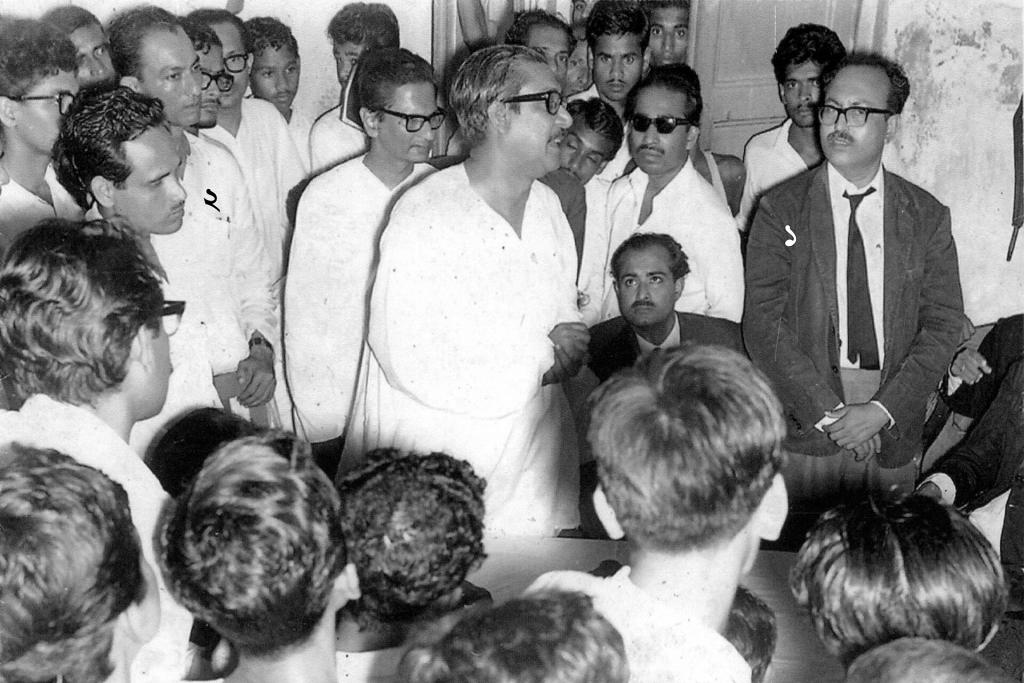
The opposition parties of West Pakistan convened a national convention at Lahore, opening on 6 February 1966, to assess the political situation after Tashkent. Sheikh Mujibur Rahman, then general secretary of the East Pakistan Awami League, reached Lahore on 4 February with the party's senior leaders. On 5 February he placed the six points before the conference's subject committee, presenting them as the demands of the people of East Pakistan and pressing for their inclusion in the conference agenda.
The subject committee rejected the proposal. West Pakistani newspapers reported the programme the following day and portrayed its author as a separatist, and the Awami League delegation withdrew from the conference. The rejection, however, gave the six points a publicity that adoption might not have: announced at a press conference in Lahore and reported across both wings, the programme was now a public document, and the argument over it moved to the towns of East Pakistan.
On 21 February 1966 the working committee of the Awami League took up the programme together with a proposal for a movement to realise it, and adopted both unanimously. A booklet setting out the six points was published, and a second booklet, titled Amader Banchar Dabi: 6-dafa Karmasuchi (Our Demands for Existence: the Six-Point Programme), was distributed at the party's council meeting in Dhaka on 18 March 1966.
The Six Points, One by One
The programme was short enough to be printed on a leaflet, and each point answered a specific grievance. Summarised from the text reproduced by Banglapedia, the six points were as follows.
Point one: a genuine federation. The constitution should provide for a federation of Pakistan in its true sense, on the basis of the Lahore Resolution, with a parliamentary form of government and the supremacy of a legislature directly elected on the basis of universal adult franchise. In practice this meant government answerable to an elected parliament, and representation that reflected East Pakistan's majority of the population.
Point two: a centre limited to two subjects. The federal government should deal with only two subjects, defence and foreign affairs. All other residuary subjects should be vested in the federating states. Every other field of government, from education and health to industry and agriculture, would belong to the provinces.
Point three: currency and banking safeguards. Two separate but freely convertible currencies should be introduced for the two wings. If that proved unfeasible, there should be one currency, but with effective constitutional provisions to stop the flight of capital from East to West Pakistan. A separate banking reserve should be established, and a separate fiscal and monetary policy adopted for East Pakistan.
Point four: taxation in the hands of the units. The power of taxation and revenue collection should be vested in the federating units, and the federal centre should have no such power. The federation would instead be entitled to a share of the state taxes to meet its expenditure. The centre, in other words, would be funded by the provinces rather than the other way round.
Point five: separate foreign exchange accounts. There should be two separate accounts for the foreign exchange earnings of the two wings, and the federal government's requirements should be met by the two wings equally or in a ratio to be fixed. Products made within Pakistan should move free of duty between the two wings, and the constitution should empower the units to establish trade links with foreign countries.
Point six: a paramilitary force for East Pakistan. East Pakistan should have a separate militia or paramilitary force. After the experience of 1965, this point spoke directly to the fear that the province could not rely on the centre for its defence.
Taken together, the points left the federation responsible for defence and foreign policy and transferred money, taxation, trade and internal government to the provinces. Supporters described the programme as a charter for survival within Pakistan. Critics in West Pakistan treated it as a device to disband the country. That disagreement, over whether the six points described a reformed federation or a step towards separation, was never resolved by negotiation, and it structured Pakistani politics for the next five years.
Adoption and the Campaign of 1966
The Awami League council meeting at the Eden Hotel in Dhaka on 18 and 19 March 1966 ratified the programme and elected Sheikh Mujibur Rahman president of the party, with Tajuddin Ahmad as general secretary. The six points were now the party's official platform, and the new leadership set out to sell them across the province.
Between March and early May 1966, the party's leaders toured East Pakistan almost continuously, addressing rallies in Dhaka, Chittagong, Khulna, Sylhet, Mymensingh, Jessore, Pabna, Faridpur and Narayanganj, among other towns. Contemporary and later accounts agree that the campaign met an unusually ready audience: the programme gave students, workers, lawyers and small traders a single text around which separate complaints about prices, jobs and provincial neglect could be organised. The provincial government of Governor Abdul Monem Khan responded with warnings and prosecutions, and accounts of the campaign record repeated short arrests, with the party's president detained and bailed in town after town as the tour proceeded.
The tour ended on 8 May 1966. After addressing a rally of jute mill workers at Narayanganj, Sheikh Mujibur Rahman was arrested in Dhaka under the Defence of Pakistan Rules. This time there was no quick release. Through May and into June, most of the Awami League's senior leadership was also detained, and the movement passed to acting office holders. The arrests converted a campaign for a programme into a campaign for the release of its imprisoned advocates, and the party called a province-wide hartal, or general strike, for 7 June 1966.
7 June 1966: The Hartal and Its Dead
The hartal of 7 June 1966 was observed across East Pakistan despite a government ban imposed under Section 144. Shops, offices, courts and transport shut down, and processions came out in defiance of the ban. Police and the East Pakistan Rifles opened fire in several places, most seriously in Dhaka, at Tongi and in the industrial belt of Narayanganj, where jute mill workers were among the strongest supporters of the six points.
The figure most commonly cited in Bangladeshi accounts, and repeated in official commemorations of Six-Point Day, is eleven people killed, among them Manu Miah (also written Monu Mia), Shafik and Shamsul Haque. Hundreds more were reported injured, and arrests on and after the day ran into the hundreds. Some contemporary summaries give lower figures for individual cities, and no single verified list of the dead for the whole province was published at the time, so the total of eleven is best understood as the widely cited figure rather than a forensically settled one.
Whatever the precise toll, the political effect is not in dispute. The firing was condemned in the East Pakistan Assembly, the dead were commemorated as the movement's first martyrs, and 7 June entered the political calendar as Six-Point Day, observed in Bangladesh to this day. A programme that had begun as a conference paper four months earlier now had a mass following and a detained leadership. Repression, intended to end the campaign, instead kept the six points at the centre of provincial politics for the rest of the decade.
Repression and the Agartala Conspiracy Case
On 6 January 1968 the Home Department of Pakistan announced by press note that a conspiracy to separate East Pakistan by armed revolt, with Indian assistance, had been detected the previous December, and that arrests had been made. A second declaration on 18 January 1968 implicated Sheikh Mujibur Rahman, who had been in jail since May 1966. He and other detainees were taken into military custody in Dhaka Cantonment.
The case, formally titled State vs Sheikh Mujibur Rahman and Others, became known as the Agartala Conspiracy Case, after the town in the Indian state of Tripura where the alleged meetings with Indian officials were said to have taken place. Thirty-five accused were charge-sheeted: politicians, serving and former members of the armed forces, and civil servants. The charge sheet ran to 100 paragraphs, and the prosecution listed 227 witnesses, including 11 approvers, four of whom were later declared hostile after stating in the witness box, according to Banglapedia, that they had been compelled to give false evidence.
A special tribunal, created after an amendment to the criminal procedure law, opened hearings inside Dhaka Cantonment on 19 June 1968. The proceedings were meant to establish that the autonomy movement's leader was a separatist acting with a foreign power. In East Pakistan they had the opposite effect: the trial was widely regarded there as a frame-up directed at the six points themselves, and the demand for the case's withdrawal became the rallying point of a broader movement. In January 1969 the Sarbadaliya Chhatra Sangram Parishad, an alliance of student organisations, launched its Eleven-Point Programme, which incorporated the six points and added the withdrawal of the Agartala case and the release of all political prisoners.
Withdrawal: February 1969
By early 1969 the movement had outgrown the courtroom. Strikes, processions and clashes spread through the province in the Mass Upsurge of 1969. On 15 February 1969 Sergeant Zahurul Haq, one of the Agartala accused, was shot dead in custody in Dhaka Cantonment. News of his death provoked furious crowds, and buildings in Dhaka, including the State Guest House where the tribunal's chairman and the chief prosecution lawyer were staying, were set on fire.
President Ayub Khan announced a round table conference with opposition leaders, but the case remained the central obstacle. On 22 February 1969 the government withdrew the Agartala Conspiracy Case unconditionally, and all the accused were released. The following day, 23 February, a vast reception in Dhaka welcomed the freed men home. The withdrawal was an admission that the prosecution had failed: the man the state had charged with conspiring against Pakistan emerged from prison as the acknowledged leader of East Pakistan, and the six points emerged with him, no longer a party programme but the province's minimum demand.
Within weeks Ayub Khan had resigned, handing power to the army commander Yahya Khan, who promised elections on the basis of universal adult franchise and one person, one vote. That promise set up the test the six points had been demanding since point one was written: a free national election in which East Pakistan's population majority would count.
Assessment: The Road to 1970 and 1971
The general election of December 1970, the first in Pakistan's history held on universal adult franchise, was fought by the Awami League explicitly on the six points. The party won 160 of the 162 National Assembly seats allocated to East Pakistan, giving it an absolute majority in the assembly as a whole and, under point one, the right to form the federal government and frame a constitution. Banglapedia describes the result as an absolute mandate in favour of the six points. The mandate was not honoured. The assembly session scheduled for 3 March 1971 was postponed, negotiations in Dhaka during March failed, and on the night of 25 March 1971 the army launched its crackdown in East Pakistan.
What followed was the Liberation War of 1971, at the end of which East Pakistan became the independent state of Bangladesh. The six points were a programme for autonomy within a Pakistani federation, not a declaration of independence, and historians continue to debate the intentions behind them. Some read the programme, with its currency provisions, its provincial control of taxation and foreign exchange and its paramilitary point, as a confederal arrangement that left little of substance to the centre. Others stress that its authors presented it, and campaigned on it for five years, as a basis for remaining in Pakistan on renegotiated terms, and that the refusal to accept the 1970 verdict made the federation impossible. Both readings agree on the practical achievement: the movement unified East Pakistan's grievances into one short, memorable text, and gave the province a programme on which an election could be won and a mandate claimed.
The movement is commemorated in Bangladesh every 7 June, and its documents and martyrs are preserved in the national memory, including in the displays of the Liberation War Museum in Dhaka. The road from Lahore in February 1966 ran through a hartal, a conspiracy trial and a mass upsurge to the ballot box of 1970. When that road was blocked in March 1971, the province took another one.