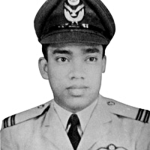
Flight Lieutenant Matiur Rahman (29 October 1941 to 20 August 1971) was a Bengali pilot in the Pakistan Air Force who died trying to take a jet trainer out of Karachi and join the Liberation War of Bangladesh. On the morning of 20 August 1971 he boarded a Lockheed T-33 trainer, call sign Bluebird 166, that a young pilot officer named Rashid Minhas was about to fly from PAF Base Masroor. The aircraft turned towards India, the two men struggled for control, and the jet crashed near Thatta, short of the Indian border. Both men were killed. Bangladesh awarded Matiur Rahman the Bir Shreshtha, its highest gallantry award, one of only seven given for the war. Pakistan awarded Rashid Minhas the Nishan-e-Haider, its highest award, for the same flight. Few events in 1971 are remembered in such opposite ways by the two countries that came out of it.
His story has two parts: the documented course of his life, from a Dhaka childhood through a Pakistan Air Force career to a secret plan formed during the war, and the contested account of his final flight, where the Bangladeshi and Pakistani narratives agree on the outline and differ sharply on the meaning. What is not contested is the ending. Matiur Rahman lay buried in Karachi for almost 35 years, in a graveyard for fourth class employees at the base from which he had taken off. In June 2006 his remains were flown home and reburied with full military honours at the Martyred Intellectuals Graveyard in Mirpur, Dhaka. The full background is set out in the Liberation War of Bangladesh, 1971.
Early Life in Dhaka
Matiur Rahman was born in Dhaka in 1941, at the family house known as Mobarok Lodge at 109 Aga Sadek Road in the old city. Most Bangladeshi profiles give the date as 29 October 1941, although Banglapedia, the national encyclopedia of Bangladesh, gives 29 November 1941, and the difference is flagged in the sources rather than settled by them. His ancestral home was at Ramnagar village in Raipura, in what is now Narsingdi District. His father was Maulvi Abdus Samad and his mother was Syeda Khatun Mobarakunnesa, according to Bangladeshi biographical accounts, and he was the sixth child in a large family.
He completed his primary education at Dhaka Collegiate School and then crossed to West Pakistan for the schooling that pointed towards an air force career: the Pakistan Air Force Public School at Sargodha. After completing his twelfth class there, he entered the Pakistan Air Force Academy at Risalpur on 15 August 1961. It was a familiar pattern for ambitious Bengali boys of his generation: the armed forces offered education, status and a technical profession. Nothing in his cadet record suggests that anyone foresaw the choice that 1971 would force on Bengali officers serving in the west.
Pakistan Air Force Career
Matiur Rahman was commissioned as a pilot officer on 22 June 1963, from the 36th GD(P) course, and was posted to No. 2 Squadron at Mauripur air base in Karachi, the base later renamed Masroor. He completed jet conversion training on T-33 trainers there, passing with 75.66 percent by the figures in his biographical profiles, then passed the fighter conversion course on F-86 Sabre jets with 81 percent and was posted to No. 19 Squadron at Peshawar. He served through the Indo-Pakistani war of 1965 and was promoted to flight lieutenant in 1967. By 1971 he was an experienced operational pilot and, at Masroor, an instructor pilot.
That seniority matters. Matiur Rahman was a trusted instructor in the unit that taught newly commissioned pilots to fly jets, he knew the T-33 in both seats, and he knew the Karachi coast and the Indian border as well as any pilot on the base. When the crisis of 1971 became a war, those facts gave him the opportunity and the means to attempt what almost no other Bengali officer in West Pakistan was positioned to try.
1971: Leave, Bhairab and the Return to Karachi
At the end of January 1971, Matiur Rahman travelled to Dhaka with his family for a two month vacation, and he was at Ramnagar when the Pakistan Army launched Operation Searchlight on the night of 25 March 1971. Banglapedia and the fuller Bangladeshi accounts agree on what he did next. He opened a training camp at Bhairab and began training local volunteers for the Mukti Bahini, forming a small defence force from willing men and a few collected weapons. On 14 April 1971 the Pakistan Air Force bombed the camp. By the Bangladeshi account he had anticipated the attack and moved the camp beforehand, and his trainees survived. He also took part, Banglapedia records, in a battle against the Pakistan Army at Bhairab.
Then came the decision that defines his story. Under pressure from his family, the accounts say, he returned to his posting. He reached Dhaka on 23 April and flew back to Karachi with his family on 9 May 1971, resuming duty at Masroor while the war continued in the east. Bangladeshi accounts present the return as the first step of a plan rather than a change of heart: from Karachi he could bring an aircraft with him when he defected. One episode from these months is told by another officer's family. Farhan Quddus, writing in the Dhaka Tribune in 2014, recorded that Matiur Rahman helped smuggle the family of Group Captain Taher Quddus out of Pakistan on a Royal Saudi Arabian C-130 bound for Riyadh. By the summer of 1971 he had formed his secret plan: to take a PAF aircraft, fly it to India, and join the liberation forces with the plane.
20 August 1971: The Flight of Bluebird 166
On the morning of Friday 20 August 1971, Pilot Officer Rashid Minhas, aged 20, newly commissioned from the 51st GD(P) course and posted to No. 2 Squadron for jet conversion training, taxied a Lockheed T-33A trainer towards the runway at PAF Base Masroor for his second solo flight in the type. Its call sign was Bluebird 166. What happened next is described in two official versions that share the same skeleton. In the Pakistani account, set out in Minhas's Nishan-e-Haider citation and in Pakistan Air Force histories, Matiur Rahman signalled the taxiing aircraft to stop, climbed into the rear instructor's seat, seized control after take off and headed towards India. In Banglapedia's shorter telling, Minhas was scheduled to fly that morning with Matiur Rahman as his trainer, and during the flight Matiur Rahman attempted to take control. Whether he boarded by pretext or as the assigned instructor is a detail on which the two accounts have never aligned.
Once airborne, the accounts converge. The jet turned east, towards India. Minhas radioed Masroor that he was being hijacked, and when the controller asked him to repeat the message, he confirmed it. The two men fought for the aircraft through its mechanically linked dual controls, instructor and trainee each trying to overpower the other. The aircraft never crossed into Indian airspace. It crashed near Thatta, in what is now Sujawal District in Sindh, about 32 miles, or 51 kilometres, short of the Indian border. Both men were killed. Matiur Rahman's body was found near the crash site. Banglapedia notes that in its account the other pilot's body could not at first be traced, a detail the Pakistani accounts, which record Minhas's burial with full honours in Karachi, do not repeat.
A third account of the final seconds surfaced decades later. In 2004 the writer Yawar A. Mazhar reported a conversation with retired Group Captain Cecil Chaudhry, who said he had led the investigation of the wreckage. According to Mazhar, the jet had hit the ground nose first, the canopy was missing, and Matiur Rahman's body lay some distance behind the wreckage with abrasions consistent with striking the sand at high speed and a low angle. On this reconstruction, Minhas jettisoned the canopy at low altitude and Matiur Rahman, not properly strapped in, was thrown from the cockpit, after which the aircraft was too low to recover. This is one investigator's reconstruction, relayed second hand, not the official version in either country. It is included because it is widely cited and attempts to explain the evidence, the separated body and the missing canopy, that the official narratives leave unaddressed.
Two Nations, Two Highest Honours
Pakistan moved first. Minhas's citation for the Nishan-e-Haider, awarded posthumously by President Yahya Khan, states the official version in its strongest form: that with some 40 miles of territory remaining, Minhas, finding it impossible to regain control against his instructor's superior skill and experience, forced the aircraft to crash 32 miles from the border and deliberately made the supreme sacrifice. He remains the youngest and shortest serving recipient of the Nishan-e-Haider, and the only Pakistan Air Force officer ever to receive it. PAF Base Kamra was renamed PAF Base Minhas in his honour. In the Pakistani narrative, Matiur Rahman is the instructor who betrayed his service and his trainee.
Bangladesh, once independent, answered with the mirror image. Matiur Rahman was awarded the Bir Shreshtha, the highest of the gallantry awards of Bangladesh, in recognition, as Banglapedia puts it, of his patriotism and sacrifice for the nation. In the Bangladeshi narrative he is the officer who had already trained freedom fighters at Bhairab, who returned to Karachi only to complete a defection that would bring a jet with him, and who died minutes short of the border he was trying to cross. Bangladeshi accounts add two grievances about his treatment after death: that he was buried in a fourth class employees' graveyard at Masroor, and that his photograph was displayed at the base entrance identifying him as a traitor. The burial place is documented in Pakistani as well as Bangladeshi reporting. The photograph claim is repeated in many Bangladeshi accounts, but a 2025 fact check by Rumor Scanner, which examined surviving photographs of his Karachi grave, found no evidence that the word traitor was inscribed on the grave itself. The grave inscription version should be treated as unverified, and the entrance photograph version as a long repeated account for which no photograph has been produced.
Stated neutrally, the factual core both sides support is narrow. An instructor pilot took control of a trainer flown by his 20 year old trainee, intending to fly it to India and join the Liberation War. The trainee reported it by radio and resisted. The aircraft crashed in Pakistani territory and both men died. Each country then gave its own man its highest award for gallantry, the only case in the 1971 war in which the highest awards of two opposing states rest on the same few minutes in the same cockpit.
Burial in Karachi and the Long Wait
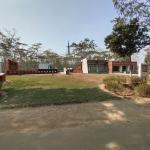
Matiur Rahman was buried at Masroor, in the graveyard reserved for fourth class employees, and there he stayed for almost 35 years. His widow, Milly Rahman, spelled Mili in some accounts, raised the couple's two daughters, Mahin and Tuhin, while successive Bangladeshi governments and the family pressed for the return of his remains. The grave was at times renovated, and Pakistani reporting in 2021 noted that his daughter had been permitted to visit it and offer prayers there. None of that settled the point stated plainly in Bangladesh for decades: the country's highest decorated airman should not lie in an employees' graveyard at the base he had tried to leave.
The Return in June 2006
After more than three decades of negotiation, Pakistan agreed to return the remains. Pakistan's foreign ministry spokesperson Tasneem Aslam described the decision as a goodwill gesture, and Dawn reported it as part of a policy to improve relations, following a Bangladesh government request on behalf of his family. The remains arrived at Dhaka's Zia International Airport on the night of 24 June 2006, on a special Bangladesh Biman flight from Masroor. Prime Minister Khaleda Zia received the flag draped coffin on the tarmac and placed a wreath on it, as an honour guard presented arms and state television broadcast the arrival live. His widow and family were present. His elder brother Khorshed Alam had accompanied the six member government team that travelled to Pakistan to bring him home, the Daily Star reported.
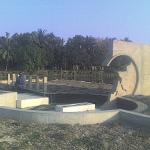
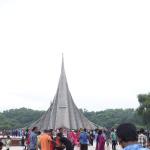
The following day, 25 June 2006, after a namaz-e-janaza and public homage at the National Parade Ground, Matiur Rahman was buried with full military and state honours at the Martyred Intellectuals Graveyard in Mirpur, Dhaka. Banglapedia closes with the same two dates, and the Bangladeshi and Pakistani press reporting agrees with them. The BBC treated the reburial as the closing of a long running symbolic dispute between the two countries.
Honours and Legacy
The Bir Shreshtha is the highest military award of Bangladesh, and only seven men received it for the Liberation War, all posthumously. Matiur Rahman is the only air force officer among the seven, and his place in the Bangladesh Air Force, itself born inside the Liberation War in 1971, is foundational: he tried to bring it an aircraft before it formally existed. The air force base at Jessore, home of the Bangladesh Air Force Academy, bears his name as BAF Base Bir Shreshtha Matiur Rahman, a name it still carried in November 2026, when the Chief of Air Staff presided over course ceremonies there. The March 2025 round of military renaming, which removed the names of the former prime minister and her family from eight establishments, did not touch his name. The air force also awards a trophy in his name for the best performance in flying training, and a Birshreshtho Matiur Rahman trophy, the Golden Pen award, is given for the best research paper of the Air Wing at the Defence Services Command and Staff College.
His name reached a wider public in March 2025, when the international cricket stadium at Chittagong was renamed the Bir Shreshtho Flight Lieutenant Matiur Rahman Cricket Stadium. His life has been retold on screen in the docudrama Ognibolaka, with Riaz as Matiur Rahman and Tarin as his wife, and in the 2007 film Ostittey Amar Desh, which his wife co wrote and acted in. Every 20 August, Bangladesh marks his death anniversary with Bir Shreshtha ceremonies.
What endures most is the doubleness of the record. In Karachi is the grave of Rashid Minhas, buried with full honours in 1971. In Dhaka is the grave of Matiur Rahman, buried with full honours in 2006. The two graves commemorate the same flight from opposite sides. Schoolchildren in Pakistan learn the name of the 20 year old who would not surrender his aircraft. Schoolchildren in Bangladesh learn the name of the instructor who tried to steal one for his country's freedom. Neither story can be told without the other man in the cockpit. That is why the flight of Bluebird 166, which lasted only minutes and crossed no border, remains one of the most written about episodes of the Liberation War.