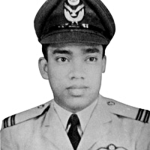
Captain Mohiuddin Jahangir (7 March 1949 to 14 December 1971) was a Pakistan Army engineer officer who escaped from West Pakistan in the middle of the Liberation War, crossed into India, and joined the Mukti Bahini as a sub-sector commander in Sector 7. Two days before the victory of 16 December 1971, he led the assault that broke the Pakistani defences of Chapai Nawabganj, silencing an enemy machine gun with a grenade at point blank range and dying in the same moment from a bullet fired from a nearby building. He was 22 years old. Bangladesh honoured him posthumously with the Bir Shreshtha, the highest gallantry award of the country, and he is the only commissioned army officer among the seven men who hold that title. His grave, beside that of Major Nazmul Hoque, the first commander of his sector, lies in the premises of the Chhoto Sona Mosque in Shibganj, in the border country where he had fought for five months.
His story compresses the whole arc of the Liberation War of Bangladesh in 1971 into one short life: a village boyhood in Barisal, a scholarship student's rise through school and college, a commission in an army that was not, in the end, his country's army, a dangerous escape across Pakistan, and a final battle fought within sight of victory.
Early Life in Rahimganj, Barisal
Mohiuddin Jahangir was born on 7 March 1949 at Rahimganj village in Babuganj upazila of Barisal district, then in East Bengal. Banglapedia, the national encyclopedia of Bangladesh, gives this date and place, and most official and press accounts agree, although a minority of newspaper reports print 8 March instead (see the notes on variant dates in the package file). His father was Abdul Motaleb Hawlader, also written Hawladar.
He began school at Patarchar Primary School in neighbouring Muladi. He passed his matriculation in 1964 from Muladi Mahmud Jan Pilot High School, and his Higher Secondary Certificate in the science group in 1966 from Barisal BM College, the best known college of the district town. He then went up to the University of Dhaka and enrolled for a B.Sc. (Honours) in Statistics. While a student at Dhaka he was selected as a trainee officer cadet, and in 1967 he left the university for the Pakistan Military Academy at Kakul, aged 18.
A Commission in the Corps of Engineers
Jahangir joined the Pakistan Military Academy on 5 October 1967 as a cadet of the 15th short service course, called the 15th war course in some accounts. He was commissioned in 1968, and the arm he entered matters to his story: he was not an infantry officer, and not, as some popular summaries claim, an officer of a frontier infantry regiment. Banglapedia and Wikipedia agree that he was commissioned into the Corps of Engineers and posted to the 173 Engineer Battalion. He was promoted to Lieutenant on 3 December 1968. On 30 August 1970 he was promoted to Captain, still only 21.
In early 1971 Banglapedia places his battalion at Saiydur Sharif in Swat, while Wikipedia and several press accounts describe him as working at a construction site in the Karakoram region, near Chilas. Engineer units moved between station and works sites, so the versions may not conflict, but his exact posting that spring is a detail the sources do not settle. What no source disputes is what he did next.
Escape from Pakistan, 1971
After the Pakistan Army crackdown of 25 March 1971, Bengali officers in West Pakistan were uniformed members of the force occupying their homeland, with no legal way out. Jahangir's answer was escape. Banglapedia, the fullest of the short sources, says that he and three fellow Bengali officers, Captain Salahuddin, Captain Shahriar and Captain Anam, slipped away from their station with the declared object of joining the Liberation War, crossed difficult hill country and the Munawar Tawi river, and got over the border near Sialkot into India after a perilous journey.
The dates of the escape are told differently in different sources, and readers should know that. Banglapedia dates the escape itself to 3 July 1971. Wikipedia's version has him taking leave on 10 June 1971, travelling via Risalpur to the Sialkot border, and reaching the Mukti Bahini at Mehdipur in Malda district, with 3 July as the date he formally became a captain of Sector 7. An account circulated in army circles puts the crossing on 8 July, with the same three companions. The companions, route and destination agree in every telling; the calendar does not. The honest summary is that he escaped in late June or early July 1971 and was in Mukti Bahini service at Mehdipur by the first week of July.
Sector 7 and the Mehdipur Sub-Sector
The Mukti Bahini posted him to Sector 7, covering Rajshahi, Pabna, Bogra and part of Dinajpur district, with its headquarters at Tarangpur. He was made commander of the Mehdipur sub-sector in Malda district, taking over from Subedar Iliyas, and sector lists also associate him with the Malan sub-sector later in the war. His charge was the Chapai Nawabganj border, across the Mahananda River from India.
One point of the record needs care, because short biographies often get it wrong. Jahangir did not serve out the war under Major Nazmul Hoque. Nazmul Hoque was the first commander of Sector 7, from April 1971, but he was killed on 27 September 1971, and command passed to Lieutenant Colonel Kazi Nuruzzaman, who led the sector for the rest of the war. Banglapedia states plainly that when Jahangir was posted to Mehdipur, Nuruzzaman was the sector commander. The two men, Jahangir and Nazmul Hoque, are linked not by a long shared command but by death and by burial: they lie side by side at the Chhoto Sona Mosque, the sector's first commander and its most famous sub-sector commander, in graves visitors now photograph as a pair.
Through the autumn of 1971 Jahangir built the reputation that would put him in charge of the final operation. Banglapedia credits him with extraordinary skill and valour in successful actions against Pakistani positions, naming the Kansat, Aragararhat and Shahpur operations: attacks on enemy camps and strongpoints in the Shibganj and Kansat country west of Chapai Nawabganj, the same ground his men would cross in December. Some longer accounts add that he was wounded in one of these battles and treated in an Indian hospital; that detail rests on fewer sources and is repeated here as reported rather than established. When the order came in December to take Chapai Nawabganj itself, the contingent chosen was placed under Captain Mohiuddin Jahangir.
The Task: Take Chapai Nawabganj
Chapai Nawabganj had stayed in Pakistani hands for the whole war. It was a border town of real strategic weight, the gateway on the Mahananda, and by December the Pakistan Army had dug in to hold it. Banglapedia describes the defences in terms an engineer would appreciate: bunkers with communication trenches five feet deep, laid along the bank of the Mahananda and covering about three kilometres to protect the town.
Jahangir's force was small. With Lieutenant Qayyum and Lieutenant Awwal and nearly fifty freedom fighters, on 10 December 1971 he took up position at Bargharia, also written Baroghoria, west of the town.
The Final Battle: Rehaichar, 13 to 14 December 1971
The attack opened in darkness. In Banglapedia's account, at dawn on 13 December Jahangir crossed the Mahananda at Rehaichar with a platoon of freedom fighters in country boats and surprised most of the enemy trench line. The Pakistani troops fell back into Nawabganj town and kept up machine gun fire from the roof of a building, blocking the advance. Other accounts, including the Bangladesh Sangbad Sangstha (BSS) anniversary reports and Wikipedia's reconstruction, shift the main river crossing to the hours before dawn on 14 December, with the force dividing into groups on 13 December to close on the town from more than one direction and camping at Rehaichar before the final assault. The broad shape is the same in every version: positioning on 13 December, the river crossed at Rehaichar, the trench line broken, and the decisive fight for the town's edge on 14 December.
The end, all accounts agree, was personal. With the advance stalled by machine gun fire, Jahangir decided to destroy the gun himself. Banglapedia's telling is the one most often quoted: an SMG in his left hand and a grenade in his right, he left cover alone, crossed the road by crawling, rushed the building and threw the grenade onto the machine gun point, which the explosion completely dismantled. In the same seconds, a bullet from a nearby two storeyed building struck him in the forehead, and he died on the spot. Press accounts describe the target as a light machine gun bunker rather than a rooftop position, and one eyewitness based account in The Daily Star says the bullet struck him at the left eye. The variations do not change the verified core: a lone officer crawled within grenade range of the gun holding up his force, silenced it, and was killed by fire from a second position as he did so.
His men finished what he had started. Banglapedia records that the freedom fighters renewed the attack at nightfall and fought on until deep into the night, when the Pakistani force abandoned Nawabganj town under cover of darkness. Chapai Nawabganj was free on 14 December 1971, two days before the surrender in Dhaka ended the war. Jahangir's body was found at dawn, on 15 December by the BSS and press accounts, and carried from Rehaichar, near where the bridge that now bears his name crosses the Mahananda, to his burial place.
Burial at the Chhoto Sona Mosque
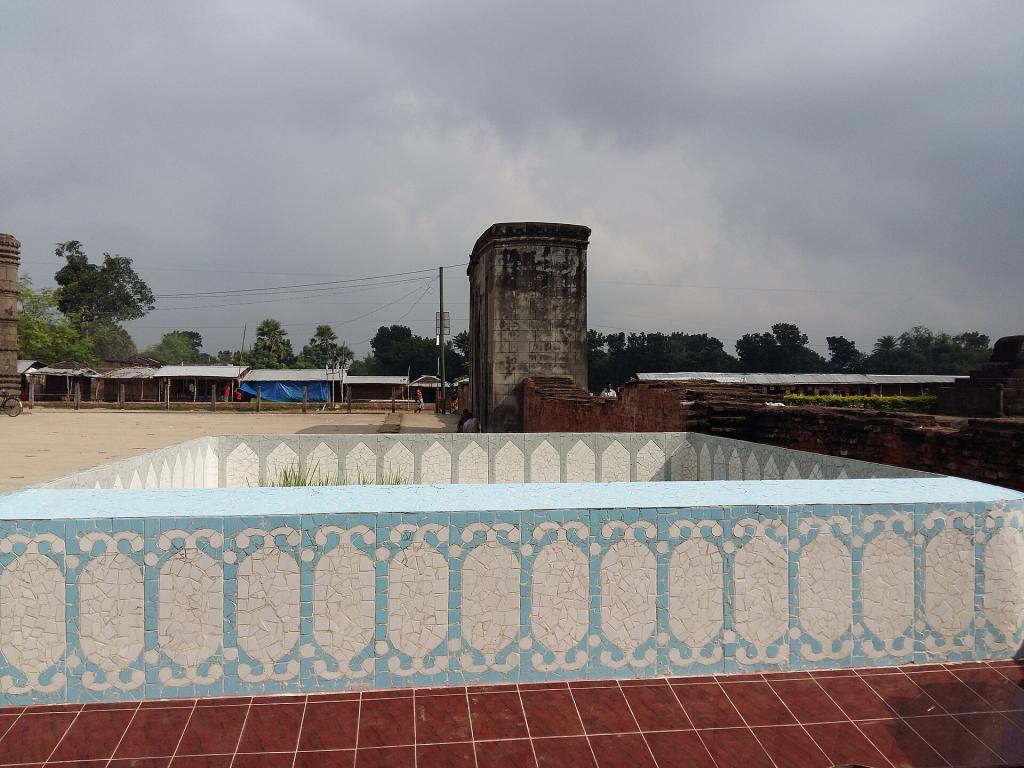
Jahangir was laid to rest in the premises of the Chhoto Sona Mosque, the small golden mosque of Gaur, at Mehdipur in Shibganj upazila, the area where, as Wikipedia puts it, most of his activities during the war had taken place. Banglapedia's entry on the mosque describes the graves precisely: on the southeast corner within the mosque premises, two modern graves stand enclosed by a low brick wall, belonging to Captain Mohiuddin Jahangir, died 14 December 1971, and Major Nazmul Hoque, died 27 September 1971, both killed fighting the Pakistan Army near Nawabganj town. A memorial stands near the tomb, and a second marks the place of his death at Rehaichar. Every 14 December, officials, freedom fighters and local people place wreaths at both, in observances BSS described as mixing solemnity, joy and sorrow: a victory anniversary and a martyrdom anniversary in the same ceremony.
The Bir Shreshtha Honour
In recognition of his valour and sacrifice, Mohiuddin Jahangir was honoured posthumously with the Bir Shreshtha, the highest gallantry award of Bangladesh. He is one of only seven men to hold it, and all seven were killed in action in 1971: alongside Jahangir stand Sepoy Mohammad Mostafa Kamal, Sepoy Mohammad Hamidur Rahman, Engine Room Artificer Mohammad Ruhul Amin, Flight Lieutenant Matiur Rahman, Lance Naik Munshi Abdur Rouf and Lance Naik Noor Mohammad Sheikh. The awards were declared in the Bangladesh Gazette of 15 December 1973. His service number, PSS-10439, is still carried in army lists, where his name appears in full as Bir Shreshtha Shaheed Captain Mohiuddin Jahangir. The full order of the country's gallantry decorations, and where the Bir Shreshtha sits at its head, is set out in the companion article on the gallantry awards of Bangladesh.
The Bir Shreshtha marks a single standard: utmost bravery in the face of the enemy at the cost of the holder's own life. Jahangir's case fits it exactly. He identified the one weapon stopping his force, took the task of destroying it on himself rather than ordering a subordinate forward, and completed it at the moment of his death. The town fell that night.
Legacy: Gates, Roads, a Bridge and a Town That Remembers
Banglapedia lists the memorials that carry his name, and the list is long for a man who died at 22. In Dhaka, the main gate of Dhaka Cantonment is the Bir Shreshtha Jahangir Gate, also styled Shaheed Jahangir Gate, so that the army's principal cantonment is entered under his name. In Chapai Nawabganj there are the Bir Shreshtha Shaheed Captain Mohiuddin Jahangir College at Swarupnagar and the Bir Shreshtha Jahangir Club, and the bridge over the Mahananda at the southern edge of the town, close to Rehaichar where he fell, is the Bir Shreshtha Shaheed Captain Mohiuddin Jahangir Bridge. In his home village, the Bir Shreshtha Jahangir High School stands at Rahimganj. Rajshahi has the Bir Shreshtha Jahangir Sarani, a road named for him,. Banglapedia also records a BIWTC ferry named for him. In 2003 the National Sports Council decided to name the Rajshahi divisional stadium after him, as one of seven stadia named for the seven Bir Shreshtha; stadium naming in Rajshahi has been revisited since, so this article records that decision as a decision rather than describing the stadium's present name.
One naming confusion is worth clearing up, because his surname invites it. Jahangirnagar, the old name of Dhaka preserved in Jahangirnagar University, has nothing to do with Mohiuddin Jahangir: it commemorates the Mughal emperor Jahangir, in whose reign the city took that name in the seventeenth century. The captain's memorials are the gate, the bridge, the college, the school, the road and the graveside at Gaur, and they are his alone.
His biography is a standard passage in Bangladeshi school textbooks: the boy from Rahimganj who won scholarships, read statistics at Dhaka, and died with a grenade in his hand two days before victory. The Liberation War Museum in Dhaka preserves the wider record of the war in which he fought. Chapai Nawabganj was freed on 14 December 1971 because a 22 year old engineer captain decided that the machine gun would be silenced by him personally, or not at all. The town has never forgotten his name.